
XRP ETF Approval and October Regulatory Catalysts: A New Era for Institutional Adoption


 Aime Summary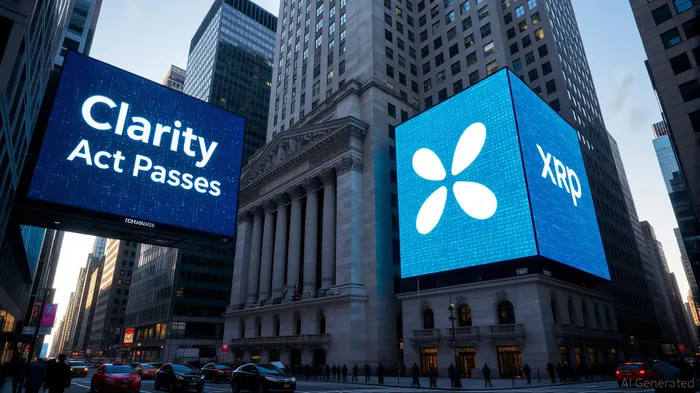
The cryptocurrency market is on the cusp of a seismic shift. By October 2025, three pivotal regulatory developments—the approval of XRPXRPI-- ETFs, the passage of the CLARITY Act, and Ripple's potential national banking license—could collectively unlock institutional demand, reshape market sentiment, and redefine XRP's trajectory. For investors, this convergence represents a rare alignment of regulatory clarity, institutional adoption, and market infrastructure, creating a compelling case to position for a new era in digital assetDAAQ-- investing.
The CLARITY Act: A Regulatory Framework for Institutional Confidence
The Digital Asset Market Clarity Act of 2025 (CLARITY Act) is a cornerstone of this transformation. Passed by the House in July 2025 and now awaiting Senate approval, the Act establishes a clear division of regulatory jurisdiction: the Commodity Futures Trading Commission (CFTC) will oversee digital commodities like XRP and BitcoinBTC--, while the SEC will regulate tokenized securities. This bifurcation eliminates the ambiguity that has long hindered institutional participation.
The Act also mandates that crypto platforms adhere to the same anti-money laundering (AML) and know-your-customer (KYC) standards as traditional banks. This not only strengthens investor protection but also signals to institutional players that the crypto ecosystem is maturing. For XRP, the CLARITY Act's classification as a commodity—confirmed by the August 2025 dismissal of the SEC v. Ripple lawsuit—removes the last legal barrier to its inclusion in regulated investment vehicles.
XRP ETF Approvals: A Gateway to Mainstream Capital
The SEC's October 2025 decisions on XRP ETF applications are the next critical catalyst. Applications from Grayscale, Bitwise, and 21Shares are under review, with Grayscale's proposal facing a hard deadline of October 18. If approved, these ETFs will provide a regulated, liquid pathway for institutional and retail investors to gain exposure to XRP, mirroring the success of Bitcoin and EthereumETH-- ETFs.
The implications are profound. ETFs could inject up to $8.4 billion in institutional capital into XRP by 2026, according to Benchmark analyst Mark Palmer. This influx would not only boost liquidity but also validate XRP's utility as a cross-border payment asset. Ripple's On-Demand Liquidity (ODL) service, already adopted by 1,700 institutions, reduces liquidity costs by 70% for banks, further cementing XRP's role in global finance.
Ripple's Banking License: Bridging DeFi and Traditional Finance
Ripple's application for a U.S. national banking license, submitted to the Office of the Comptroller of the Currency (OCC) on July 2, 2025, is another linchpin. A 120-day review period points to a decision in late October, aligning with the ETF rulings. Approval would allow Ripple to operate as a federally regulated trust bank, offering custody services, stablecoin issuance (e.g., RLUSD), and access to the Federal Reserve's payment systems.
This move would position Ripple as a bridge between decentralized finance (DeFi) and traditional banking. A Federal Reserve master account would enable Ripple to hold reserves directly with the central bank, enhancing its credibility and operational capabilities. Legal expert Bill Morgan has called October 2025 a “make-or-break” month, noting that the combined approval of the banking license and ETFs could trigger a re-rating of XRP's value.
The October 2025 Inflection Point: Scenarios and Strategic Implications
The interplay of these events creates a high-stakes regulatory inflection pointIPCX--. If both the ETFs and banking license are approved, XRP could see a price surge to $1.50–$2.00, driven by institutional inflows and enhanced utility. A mixed outcome (e.g., ETF approval but delayed banking license) might cap gains at $0.80–$1.00, while a bearish scenario (denial of both) could push XRP below $0.55.
For investors, the key is to position ahead of October's decisions. The CLARITY Act's passage in the Senate, expected by mid-September, will set the regulatory tone. Those who act now can capitalize on the pre-approval volatility, while hedging against potential delays.
Conclusion: Positioning for a Regulated Future
The October 2025 regulatory catalysts are not just about XRP—they represent a broader shift toward institutional adoption of digital assets. The CLARITY Act's framework, XRP ETF approvals, and Ripple's banking license collectively signal that crypto is no longer a fringe asset but a core component of modern finance.
For investors, the message is clear: this is the time to act. Whether through ETFs, staking, or direct exposure to XRP, the convergence of regulatory clarity and institutional demand creates a unique opportunity. As the lines between DeFi and traditional finance blur, those who align with these tailwinds will be well-positioned to capitalize on the next phase of crypto's evolution.
"""

Decoding blockchain innovations and market trends with clarity and precision.
Latest Articles
Stay ahead of the market.
Get curated U.S. market news, insights and key dates delivered to your inbox.


AInvest
PRO
AInvest
PRO



Comments
No comments yet