
XRP Enters 2026 With Reduced Regulatory Uncertainty and Institutional Adoption Gains
 Aime Summary
- XRP's price has experienced sharp declines in early 2026 due to leveraged liquidations, risk-off sentiment, and weak institutional flows, with the token approaching the $1.28 level.
- Institutional adoption has been supported by Ripple's infrastructure developments, such as Dfns' secure wallets and Permissioned Domains on the XRPXRP-- Ledger, which facilitate regulated compliance.
- While regulatory clarity has improved with the SEC ending its case against RippleRLUSD--, XRP still requires increased real-world usage.
XRP entered 2026 with a mix of positive and negative momentum. Reduced regulatory uncertainty following the SEC's case resolution opened the door for U.S. spot XRP ETFs, drawing initial institutional interest. However, recent outflows and declining transaction volumes have cast doubt on the token's ability to sustain this momentum.
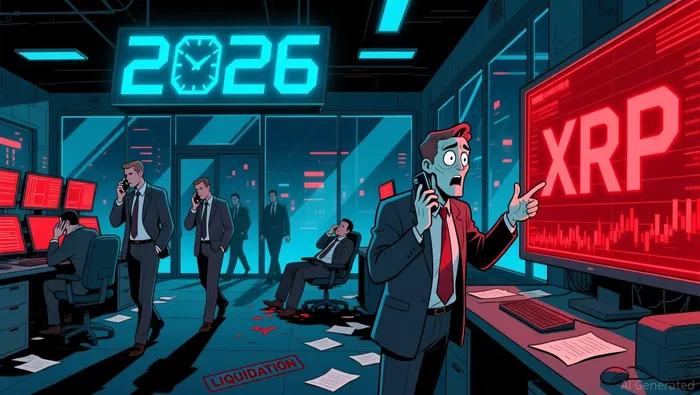
The token's performance has been further compounded by broader market dynamics. In early 2026, XRP faced a sharp sell-off, driven by leveraged liquidations. Exchange inflows and loss-driven transactions have contributed to increased downside pressure, with technical indicators pointing to further bearish momentum in the short term.
Despite these near-term challenges, XRP has made strides in infrastructure and institutional compatibility. The XRP Ledger's Permissioned Domains feature allows regulated institutions to operate on a public blockchain with restricted access and on-chain compliance. This supports cross-border transactions and stablecoin usage, which are key to broader adoption.
What Drives XRP's Price Volatility in Early 2026?
XRP has been highly sensitive to leveraged trading activity and macroeconomic pressures in early 2026. Traders reducing leveraged positions and shifting to safer assets have intensified the sell-off. Institutional flows have also turned cautious, limiting the availability of aggressive buying to offset the selling pressure.
The price drop has also been attributed to increased risk-off sentiment in the broader crypto market. This is not unique to XRP, as many assets have experienced similar volatility. However, the token's exposure to leveraged positions and the absence of clear adoption catalysts make it particularly vulnerable to continued bearish pressure.
Market participants are closely watching whether new institutional inflows can counteract the current selling pressure and restore investor confidence. Until such inflows materialize, XRP may remain under downward pressure, with key support levels expected to be tested in the near term.
How Does XRP's Infrastructure Support Institutional Adoption?
Ripple's XRP Ledger has introduced features designed to attract regulated financial institutions. Permissioned Domains allow users to create restricted on-chain areas where only verified participants can engage in transactions. This aligns with KYC and AML requirements, making the XRP Ledger more attractive to traditional finance players.
In addition, infrastructure upgrades like Dfns' secure wallet system and the integration of Ripple Prime with Hyperliquid have enhanced XRP's utility for institutional users. These upgrades facilitate fast, low-cost transactions and bridge traditional finance with decentralized markets.
The XRP Ledger's escrow mechanism also supports institutional adoption by managing supply uncertainty. With 55 billion XRP in escrow and a monthly release of 1 billion tokens, this model provides a predictable supply flow, which is essential for institutional planning and compliance.
What Factors Determine XRP's Long-Term Potential?
Long-term growth for XRP is contingent on increased real-world usage and adoption. While regulatory clarity has helped, the token still requires sustained transaction activity and cross-border payment use cases to justify a higher valuation.
Recent outflows and declining transaction fees indicate that XRP's infrastructure and regulatory improvements alone are not sufficient to drive adoption. The token must demonstrate tangible use in financial services, stablecoin ecosystems, and tokenized assets to attract and retain institutional and retail interest.
Future regulatory developments, such as potential classification under the CLARITY Act, could also play a significant role. If XRP is classified as a non-security, it could unlock broader institutional demand and cross-border utility, further supporting its long-term potential.
Until these adoption drivers materialize, XRP remains vulnerable to market sentiment, leveraged trading activity, and institutional caution. A sustained upward movement will require a combination of macroeconomic stability, regulatory clarity, and real-world transaction volume to reinforce investor confidence.

Blending traditional trading wisdom with cutting-edge cryptocurrency insights.
Latest Articles
Stay ahead of the market.
Get curated U.S. market news, insights and key dates delivered to your inbox.


AInvest
PRO
AInvest
PRO



Comments
No comments yet