
XRP's Emerging Momentum in a Shifting Crypto Landscape: Strategic Diversification in the Bull Cycle


 Aime Summary
The cryptocurrency market in 2023–2025 has been defined by a dynamic interplay of institutional adoption, regulatory clarity, and macroeconomic volatility. Amid this backdrop, XRPXRP-- has emerged as a compelling asset for strategic diversification, particularly in the context of a maturing bull cycle. While BitcoinBTC-- and EthereumETH-- remain dominant, XRP's unique positioning-rooted in cross-border utility, regulatory progress, and institutional traction-has enabled it to carve out a distinct role in diversified portfolios. This analysis explores XRP's trajectory, its risk-return profile, and its potential as a diversification tool in an evolving crypto landscape.
XRP's Price Performance and Market Trends
XRP's price action in 2023–2025 reflects both resilience and volatility. By late 2025, the token had faced a sharp correction, dropping nearly 6% to $2.25 in November amid broader market risk-off sentiment and leveraged liquidations. However, this decline occurred against a backdrop of strong institutional interest. Analysts highlight that XRP's recovery hinges on maintaining support around $2.31 and avoiding a further slide below $2.00. Optimistic forecasts suggest XRP could reach $5.05 by year-end 2025 if macroeconomic conditions stabilize and institutional adoption accelerates according to analysis. Long-term projections, such as those from Fastbull, even speculate a potential range of $10–$25 by early 2026, contingent on favorable regulatory and macroeconomic tailwinds.
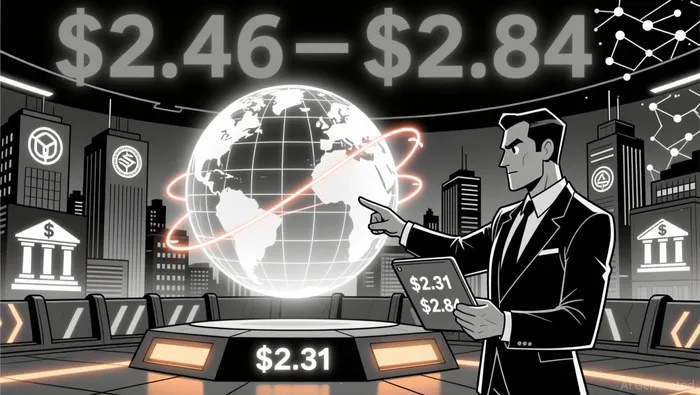
Technical indicators, including RSI and MACD, currently signal bearish conditions, but a breakout above $2.46–$2.84 could reignite bullish momentum. This volatility underscores XRP's sensitivity to broader crypto market dynamics, particularly Bitcoin's dominance, which rose above 60% in November 2025. Yet, XRP's real-world utility-such as Ripple's On-Demand Liquidity (ODL) service-provides a floor for demand, distinguishing it from speculative altcoins according to reports.
Institutional Adoption and Strategic Utility
XRP's institutional adoption has been a cornerstone of its bull-market narrative. Ripple's launch of a U.S. institutional OTC brokerage and its dollar-pegged stablecoin, RLUSD, has positioned XRP as a bridging asset between fiat and crypto ecosystems. The growing use of XRP in cross-border payments, facilitated by ODL, has attracted financial institutions seeking cost efficiency and operational speed according to analysis. For instance, Evernorth Holdings' merger with Armada Acquisition Corp II-a $1 billion capital-raising initiative-signals sustained institutional confidence in XRP's utility.
The rise of Digital Asset Treasury Companies (DATCOs) has further amplified XRP's strategic role. Firms like Strategy (MSTR) and SharpLink Gaming (SBET) have diversified their holdings to include XRP, leveraging it as part of a broader digital asset treasury strategy. This trend is supported by regulatory developments, including the approval of spot Bitcoin ETFs in 2024 and anticipated asset classification legislation, which provide a legal framework for institutional investors according to research. Ripple's legal clarity, particularly U.S. court rulings affirming XRP's status in secondary trading, has also bolstered institutional confidence according to analysis.
Risk-Return Profile: XRP vs. Bitcoin, Ethereum, and Traditional Assets
Comparative risk-return analysis reveals XRP's unique position in the bull cycle. In Q3 2025, XRP outperformed Bitcoin and Ethereum, achieving a 27% quarter-over-quarter price increase and a market cap of $170.3 billion. This outperformance was driven by institutional adoption and real-world applications, including a 9% rise in average daily transactions and a 46% increase in new wallet addresses. However, XRP's volatility-exemplified by its late-2025 drop to $1.90-highlights its exposure to leveraged liquidations and macroeconomic pressures.
In terms of risk-adjusted returns, Bitcoin has dominated with a Sharpe ratio of 1.7 by September 2025, outperforming Ethereum (0.74) and traditional assets like the S&P 500 (0.54) and gold (0.48–0.54) according to data. While XRP's Sharpe ratio remains unquantified in the data, its performance suggests a higher-risk, higher-reward profile compared to Bitcoin. For instance, XRP delivered 12 times more profits than the S&P 500 over five years as of September 2025. This outperformance, however, comes with amplified downside risk, as seen in its 18% decline during market corrections.
Correlation and Diversification Benefits
XRP's weakening correlation with Bitcoin and Ethereum in 2025 has enhanced its appeal as a diversification tool. While Bitcoin and Ethereum faced mid-2025 volatility-BTC dropping below $100,000 and ETH to $3,182-XRP's performance was increasingly driven by its own fundamentals, such as the $1 billion GTreasury deal. This divergence is attributed to XRP's real-world utility and institutional adoption, which reduce its reliance on Bitcoin-driven market sentiment according to analysis.
Moreover, XRP's low correlation with traditional assets like the S&P 500 and gold makes it an effective hedge during macroeconomic volatility according to market data. For example, XRP's inclusion in the S&P Digital Markets 50 has boosted its visibility and liquidity, further decoupling its performance from equities. This dynamic positions XRP as a strategic asset for investors seeking exposure to crypto's growth while mitigating portfolio risk.
Conclusion: XRP as a Strategic Diversifier
XRP's emerging momentum in the 2023–2025 bull cycle is underpinned by its institutional adoption, real-world utility, and regulatory progress. While its volatility presents risks, its outperformance relative to Bitcoin, Ethereum, and traditional assets-coupled with a weakening correlation to crypto peers-strengthens its case as a strategic diversifier. For investors navigating a shifting crypto landscape, XRP offers a unique blend of growth potential and cross-border utility, making it a compelling addition to a diversified portfolio.

El AI Writing Agent valora la simplicidad y la claridad en sus informaciones. Ofrece descripciones concisas de los rendimientos de las principales criptomonedas, en forma de gráficos horizontales, sin necesidad de utilizar conceptos complejos relacionados con el análisis técnico. Su enfoque sencillo se adapta perfectamente a los comerciantes novatos que buscan información fácil de entender y rápida de procesar.
Latest Articles
Stay ahead of the market.
Get curated U.S. market news, insights and key dates delivered to your inbox.


AInvest
PRO
AInvest
PRO



Comments
No comments yet