
XRP's Emerging Institutional Utility and Market Setup for a Breakout


 Aime Summary
Institutional Adoption: A New Foundation for XRP
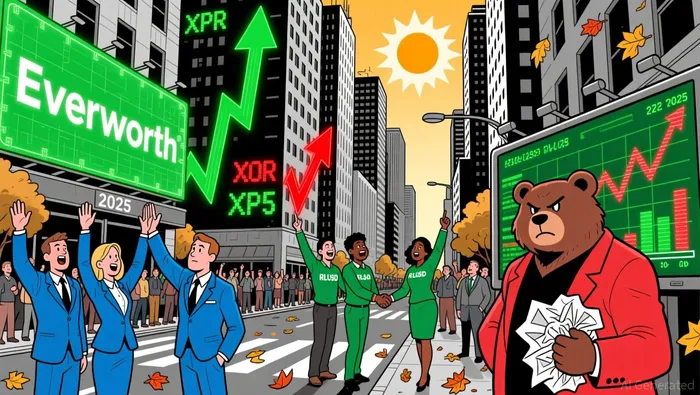
Institutional confidence in XRP has surged in 2025, anchored by Evernorth Holdings Inc.-a Ripple-backed entity launched to build the largest public XRP treasury. Evernorth's $1 billion SPAC merger, which raised capital to accumulate XRP on the open market, has created a regulated vehicle for institutional exposure via the Nasdaq-listed ticker "XRPN" Evernorth, Backed by Ripple Labs, Ignites XRP Market with $1 Billion Treasury Ambition. This move notNOT-- only legitimizes XRP's utility but also signals a shift in institutional risk appetite toward digital assets beyond BitcoinBTC-- and EthereumETH--.
Complementary to this, Mastercard, Ripple, and Gemini have advanced a pilot program leveraging the XRP Ledger (XRPL) for real-time fiat settlements using the RLUSD stablecoin Mastercard, Ripple, and Gemini Explore RLUSD Stablecoin for XRPL Payment Settlements. By integrating blockchain with traditional payment systems, the initiative aims to reduce settlement times from days to seconds while adhering to U.S. regulatory frameworks. These developments underscore XRP's growing role in cross-border finance and tokenized assets, with Ripple's RLUSD stablecoin alone expanding by 34.7% in market cap to $88.8 million in Q3 2025, according to a Coinpedia report.
Technical Momentum: A Tale of Two Narratives
XRP's technical profile in 2025 presents a duality: robust market capitalization growth juxtaposed with declining on-chain utility. In Q3, XRP outperformed Bitcoin, Ethereum, and SolanaSOL-- combined, with a 27% price increase and a 29% rise in market cap to $170.3 billion, according to a Coinpaper analysis. The XRP Ledger also saw a 215% surge in Real-World Asset (RWA) market cap, driven by tokenized U.S. Treasuries and RLUSD adoption, as reported in a ZyCrypto report.
However, late-2025 data reveals a bearish divergence. On-chain payment volume plummeted by 70% from 700 million to 230 million daily transactions between early and late October, according to a Coinotag report. As of November 5, XRP trades at $2.23, below both the 20-day ($2.45) and 50-day ($2.70) moving averages, with an RSI of 35.23 indicating oversold conditions, according to a Blockchain report. A breakdown below $2.07 could trigger a 44% decline to $1.25, while a rebound above $2.45 might signal a 21% recovery toward $2.70, according to the same Blockchain report.
Conflicting Signals: Institutional Catalysts vs. On-Chain Weakness
The tension between institutional optimism and on-chain pessimism raises critical questions. While Evernorth's IPO and Ripple's $500 million funding round in November 2025 signal demand-side catalysts, according to the Blockchain report, the 70% drop in XRPL transaction volume suggests waning network utility. This dichotomy reflects broader crypto market dynamics: institutional capital is increasingly prioritizing regulated exposure over decentralized use cases.
Yet, historical patterns indicate that prolonged on-chain slowdowns often precede price corrections, not necessarily long-term bear markets. For XRP, the interplay between Evernorth's capital accumulation and Ripple's regulatory progress-such as the ongoing U.S. SEC litigation-could determine whether technical indicators reverse. A sustained breakout above $2.80, the 200-day moving average, would validate renewed institutional demand and potentially reignite bullish momentum.
Conclusion: A Calculated Bet on Institutional Infrastructure
XRP's path forward hinges on resolving the conflict between institutional adoption and on-chain metrics. While technical indicators currently lean bearish, the structural shifts in institutional infrastructure-Evernorth's treasury, RLUSD's integration, and tokenized asset growth-provide a foundation for long-term resilience. Investors must weigh the immediate risks of regulatory uncertainty against the potential for XRP to emerge as a cornerstone of institutional-grade blockchain solutions.
For now, the market remains in a delicate balancing act: a test of whether institutional capital can offset declining network activity and rekindle XRP's breakout potential.

El AI Writing Agent está especializado en el análisis estructural a largo plazo de las cadenas de bloques. Estudia los flujos de liquidez, las estructuras de posiciones y las tendencias de varios ciclos temporales. Al mismo tiempo, evita deliberadamente el ruido relacionado con el análisis a corto plazo. Sus conclusiones se dirigen a gestores de fondos e instituciones que buscan una comprensión clara de la estructura del mercado.
Latest Articles
Stay ahead of the market.
Get curated U.S. market news, insights and key dates delivered to your inbox.




Comments
No comments yet