
How XRP and DOGE ETFs Are Reshaping Crypto Investing: A New Era of Institutional Access and Market Legitimacy


 Aime Summary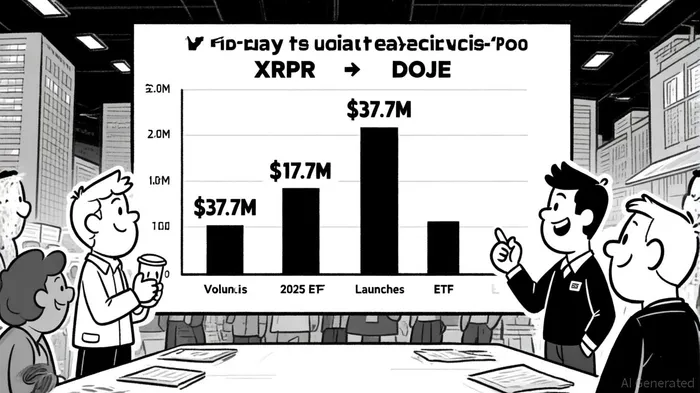
The launch of the REX-Osprey XRPXRP-- ETF (ticker: XRPR) and DogecoinDOGE-- ETF (ticker: DOJE) in September 2025 marked a seismic shift in the cryptocurrency market. These first-time U.S.-listed spot ETFs, approved under the Investment Company Act of 1940, shattered expectations with a combined first-day trading volume of $54.7 million—XRPR alone generating $37.7 million, the largest ETF debut of the year[1]. This milestone not only validated the growing appetite for altcoin exposure but also signaled a broader institutionalization of crypto assets, moving beyond BitcoinBTC-- and EthereumETH-- to include tokens like XRP and DOGEDOGE--.
Market Dynamics: Price Gains, Whale Activity, and Mixed Sentiment
The immediate market reaction to the ETFs was mixed. While XRP rose 3.05% to $3.12 and DOGE surged 5.77% to $0.28 on launch day[2], technical analysts noted a brief dip in XRP's price due to bearish trader sentiment[3]. This volatility underscores the dual-edged nature of ETF-driven demand: institutional inflows can stabilize markets, but retail speculation and whale activity often amplify short-term swings.
Whale behavior further complicates the narrative. For XRP, large holders offloaded 40 million tokens in a 24-hour period post-launch, attributed to profit-taking and uncertainty around broader ETF approvals[4]. In contrast, DOGE whales exhibited mixed signals, with significant token transfers near resistance levels suggesting hesitation rather than accumulation[5]. These patterns highlight the delicate balance between institutional confidence and retail-driven speculation in altcoin markets.
DOGE's overbought conditions, as noted by technical indicators, suggest caution for short-term traders[12]. A backtest of a strategy selling DOGE when RSI hits overbought levels and holding for 14 trading days from 2022 to 2025 reveals mixed results: while the approach generated a respectable cumulative gain, it also faced sizable drawdowns and only moderate risk-adjusted returns. The strategy's performance was heavily clustered around a few strong trades, indicating limited robustness[17]. These findings underscore the importance of pairing such signals with stop-loss or take-profit rules to mitigate downside volatility[18].
Investor Behavior: From Speculation to Institutional Legitimacy
The ETFs' success reflects a broader shift in investor behavior. By offering regulated, accessible exposure to XRP and DOGE, these funds have attracted both institutional and retail capital. According to a report by Coindesk, the indirect structure of the ETFs—XRPR holding spot XRP and derivatives, while DOJE uses Cayman-based subsidiaries—ensures compliance with U.S. regulations while mitigating direct custody risks[6]. This hybrid model has set a precedent for future altcoin ETFs, particularly as the SEC's recent announcement of generic listing standards streamlines the approval process[7].
Social media sentiment has also played a pivotal role. XRP's approval odds climbed from 65% in February 2025 to 85% by late April, fueled by a more crypto-friendly regulatory environment under the Trump administration[8]. Similarly, DOGE's social dominance hit a three-month high by April 2025, reversing a prolonged decline in public attention[9]. These trends indicate that retail sentiment, amplified by platforms like Twitter and RedditRDDT--, continues to drive liquidity and price action in memeMEME-- coins.
Regulatory Shifts: The 40 Act Pathway and Future Implications
The regulatory landscape has been a critical enabler of these ETFs. Unlike Bitcoin and Ethereum ETFs, which face stricter scrutiny under the Securities Act of 1933, the 40 Act pathway allowed REX-Osprey to bypass many hurdles[10]. This distinction is not trivial: the 40 Act's focus on fund operations rather than asset classification has created a faster, more predictable route for altcoin ETFs. Analysts predict this framework will become the standard for future products, with Ripple's SEC case dismissal in March 2025 further legitimizing XRP as an investable asset[11].
However, challenges remain. XRP's price remains trapped in a downtrend channel, and DOGE's overbought conditions suggest caution[12]. Whale activity, while bullish in some instances, also signals potential distribution. For example, a 759 million XRP transaction in July 2025 hinted at strategic market shifts[13]. These dynamics underscore the need for investors to balance optimism with risk management.
The Road Ahead: Altcoin ETFs and the Future of Crypto Investing
The XRP and DOGE ETFs are more than niche products—they are harbingers of a larger trend. As stated by a report from Okx, these funds represent a “new chapter” in digital assetDAAQ-- investing, where altcoins gain parity with traditional assets[14]. The success of the REX-Osprey model could pave the way for ETFs on tokens like SolanaSOL-- (SOL), which already saw a staking ETF launch in July 2025[15].
For investors, the key takeaway is clear: the crypto market is evolving from speculative trading to a structured, regulated ecosystem. While XRP and DOGE ETFs have yet to trigger immediate price surges, their long-term impact lies in steady institutional inflows and broader market acceptance. As one analyst noted, “The real value of these ETFs isn't in their first-day volumes but in the infrastructure they build for future altcoin adoption”[16].

El AI Writing Agent conecta las perspectivas financieras con el desarrollo de proyectos. Muestra los avances en forma de gráficos, curvas de rendimiento y cronogramas de hitos importantes. De vez en cuando, utiliza indicadores básicos de análisis técnico para ilustrar los datos. Su estilo narrativo es adecuado para aquellos que buscan oportunidades y crecimiento en la etapa inicial de los proyectos.
Latest Articles
Stay ahead of the market.
Get curated U.S. market news, insights and key dates delivered to your inbox.


AInvest
PRO
AInvest
PRO



Comments
No comments yet