
XRP as a Disruptive Solution for Bank Liquidity and Basel III Compliance: A New Era of Cost-Efficient Institutional Adoption


 Aime Summary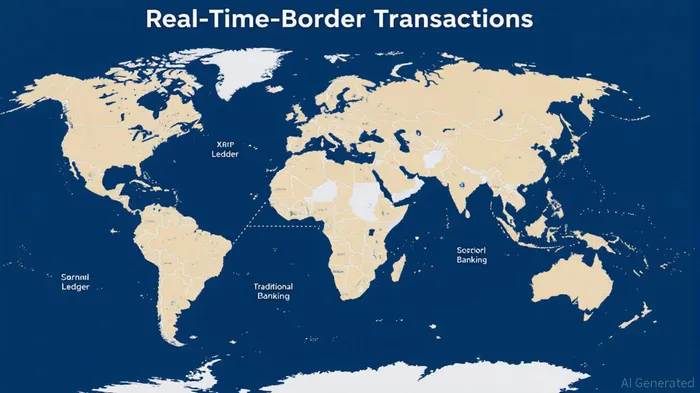
The 2025 U.S. Securities and Exchange Commission (SEC) ruling reclassifying XRPXRP-- as a commodity marked a watershed moment for institutional adoption, unlocking a new era of cost-efficient financial infrastructure. By eliminating legal barriers, this decision catalyzed widespread integration of XRP into cross-border payment systems, with Ripple’s On-Demand Liquidity (ODL) service processing $1.3 trillion in Q2 2025 alone. For institutions, XRP’s ability to reduce infrastructure costs by up to 33%—achieved through streamlined liquidity management and operational efficiency—positions it as a strategic asset for navigating Basel III requirements while modernizing global financial systems [1].
Streamlining Cross-Border Operations: A Cost-Efficient Alternative
Traditional cross-border payment systems like SWIFT are plagued by high fees, slow settlement times, and liquidity constraints. XRP’s blockchain-based solution addresses these pain points by enabling real-time settlements with negligible fees. For instance, J.P. Morgan reported XRP transaction costs at $0.0004, a stark contrast to Bitcoin’s $1.88 and Ethereum’s $0.46 [1]. This efficiency is amplified by XRP’s role as a bridge asset, allowing banks to convert local fiat to XRP and then to destination fiat on the fly. Ripple estimates that this approach reduces pre-funding requirements by up to 70%, eliminating the need for maintaining multiple nostro accounts across jurisdictions [2].
The XRP Ledger’s technical advantages further reinforce its appeal. With settlement times of 3–5 seconds and energy consumption 100,000 times lower than BitcoinBTC--, it offers a scalable, environmentally sustainable alternative to legacy systems [3]. For institutions operating in high-cost corridors, such as remittances to emerging markets, XRP’s deflationary supply model—where a small amount of tokens is destroyed with every transaction—creates long-term value retention, aligning with institutional investment strategies [1].
Basel III Compliance and Liquidity Optimization
Basel III’s liquidity coverage ratio (LCR) and net stable funding ratio (NSFR) impose stringent requirements on banks to hold sufficient high-quality liquid assets (HQLA). XRP’s role as a high-liquidity settlement tool allows institutions to consolidate reserves into a single asset, reducing the operational and foreign exchange costs associated with managing multiple currencies. By minimizing dormant cash holdings, XRP helps banks meet Basel III standards while optimizing capital efficiency [2].
Ripple’s analysis highlights that XRP-based settlements can cut liquidity management costs by up to 90% compared to traditional methods [4]. For example, SantanderSAN-- and SBI Holdings have leveraged XRP to reduce liquidity costs in cross-border corridors, with Santander reporting a 70% reduction in operational expenses [1]. This aligns with the G20’s 2027 and 2030 cross-border payment goals, which prioritize faster, cheaper, and more transparent transactions [5].
Regulatory Alignment and Institutional Confidence
The 2025 SEC ruling not only cleared the path for institutional adoption but also spurred the launch of XRP ETFs. The ProShares Ultra XRP ETF (UXRP) attracted $1.2 billion in assets under management by year-end 2025, while seven major asset managers—Grayscale, Bitwise, and others—submitted synchronized ETF applications with a 95% approval probability by October 23, 2025 [1]. These developments mirror the success of Bitcoin and EthereumETH-- ETFs, with analysts projecting $4.3–$8.4 billion in inflows [1].
Regulatory alignment extends beyond the U.S. Ripple’s collaboration with central banks and its ISO 20022-compliant XRP Ledger position the token as a bridge between traditional finance and CBDC initiatives. For instance, Ripple’s RLUSD stablecoin, a NYDFS-compliant on-ramp, enables institutions to access XRP-based corridors while adhering to regulatory frameworks [1]. This strategic product diversification underscores XRP’s role in fostering interoperability between legacy systems and digital infrastructure.
Strategic Investment Implications
For investors, XRP represents a unique convergence of cost-efficient infrastructure, regulatory clarity, and institutional demand. The token’s growing adoption by 300+ financial institutions—including PayPal’s 2025 integration, which connects 650 million users to global commerce—signals a shift toward mainstream utility [1]. With projected ETF inflows and alignment with CBDC initiatives, XRP is poised to capture 14% of SWIFT’s cross-border volume by 2030 [1].
However, risks remain. Liquidity concentration on a few exchanges and potential market manipulation due to whale ownership could introduce volatility [1]. Nonetheless, the XRP Ledger’s robust on-chain metrics—295,000 active addresses and 3–5 second settlement times—demonstrate its capacity to handle high-volume, low-cost transactions [1].
Conclusion
XRP’s disruptive potential lies in its ability to address the dual challenges of cost efficiency and regulatory compliance in institutional finance. By reducing infrastructure costs, optimizing liquidity management, and aligning with Basel III and CBDC frameworks, XRP is redefining the future of cross-border payments. For investors targeting financial infrastructure innovation, XRP offers a compelling case: a commodity asset with utility-driven demand, backed by institutional adoption and regulatory progress.
**Source:[1] Ripple's XRP: A New Dawn for Institutional Adoption and ... [https://www.ainvest.com/news/ripple-xrp-dawn-institutional-adoption-legal-clarity-2508-69/][2] XRP Helps Banks Meet Basel III Liquidity Requirements [https://timestabloid.com/xrp-helps-banks-meet-basel-iii-liquidity-requirements-heres-how/][3] XRP in 2025: Trends, Technology and Future Outlook for Enterprise Adoption [https://www.linkedin.com/pulse/xrp-2025-trends-technology-future-outlook-enterprise-adoption-mishra-rluve][4] Banks Adopting XRP for Cross-Border Settlements in 2025 [https://www.gate.com/crypto-wiki/article/banks-adopting-xrp-for-cross-border-settlements-in-2025][5] Ripple and XRP Adoption Crucial to Meeting G20 Cross ... [https://thecryptobasic.com/2025/05/24/ripple-and-xrp-adoption-crucial-to-meeting-g20-cross-border-payment-goals-report/]

Decoding blockchain innovations and market trends with clarity and precision.
Latest Articles
Stay ahead of the market.
Get curated U.S. market news, insights and key dates delivered to your inbox.


AInvest
PRO
AInvest
PRO



Comments
No comments yet