
Can XRP Disrupt Bitcoin's Role as Digital Gold?
 Aime Summary
The cryptocurrency market has long positioned BitcoinBTC-- as the "digital gold," a store of value and hedge against macroeconomic uncertainty. However, as XRPXRP-- (Ripple's native token) gains traction in institutional markets and payment ecosystems, a critical question emerges: Can XRP disrupt Bitcoin's dominance in this narrative? This analysis examines the competitive dynamics between XRP and Bitcoin through the lenses of market performance and structural design, drawing on recent data and expert insights.
Market Dynamics: Resilience vs. Dominance
Bitcoin's market capitalization of $1.8 trillion as of 2025 underscores its entrenched position as the leading cryptocurrency. Despite regulatory headwinds and macroeconomic volatility, Bitcoin has maintained its role as a safe-haven asset, supported by growing institutional adoption and the launch of spot ETFs. In contrast, XRP's market cap of $138 billion lags significantly, though it has shown resilience. A resolution to Ripple's legal battle with the U.S. Securities and Exchange Commission and the approval of XRP ETFs have driven renewed interest, with exchange-held XRP balances dropping 57% by late 2025-a sign of reduced circulating supply and heightened demand.
XRP's price trajectory in late 2025 further highlights its potential. After a mid-2025 peak of $3.65, the token fell to $1.77 by December but staged a recovery to $2.38 by January 2026, fueled by $1.3 billion in inflows into spot XRP ETFs over 50 days. Analysts like Standard Chartered have projected XRP could reach $8 by 2026, driven by institutional demand and the token's utility in cross-border payments. While Bitcoin's 24-hour trading volume of $32.41 billion dwarfs XRP's $2.55 billion, XRP's structural advantages in specific use cases may yet challenge Bitcoin's broader narrative.
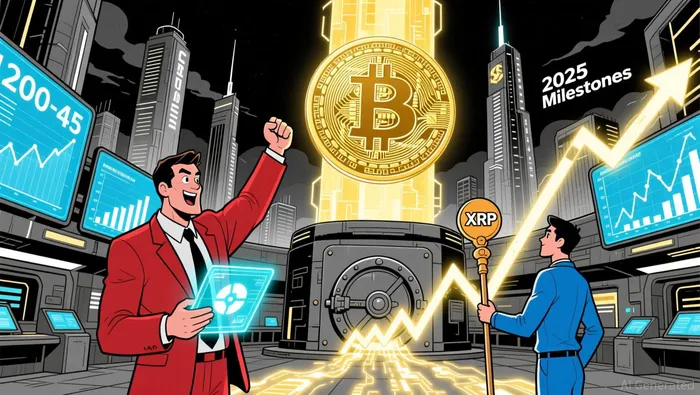
The fundamental differences between Bitcoin and XRP lie in their consensus mechanisms, supply models, and use cases. Bitcoin's Proof-of-Work (PoW) model prioritizes security and decentralization, with transactions taking 10 minutes to confirm and fees often exceeding $3. This design aligns with its role as a censorship-resistant store of value, akin to gold. In contrast, the XRP Ledger employs the Ripple Protocol Consensus Algorithm, enabling 3–5-second transaction confirmations at a cost of approximately $0.00003. This efficiency makes XRP ideal for real-time cross-border payments, a niche where Bitcoin's slower, costlier network is less competitive.
Decentralization further differentiates the two. Bitcoin's network relies on thousands of globally distributed nodes, reinforcing its "digital gold" narrative as a decentralized, trustless asset. XRP, however, is more centralized, with Ripple Labs holding a significant portion of the total supply and influencing network development. While this centralization enables faster innovation and regulatory compliance, it introduces risks of corporate dependency and reduced autonomy for users.
Use cases also diverge sharply. Bitcoin's capped supply of 21 million coins and institutional adoption position it as a long-term store of value. XRP, meanwhile, is designed for liquidity solutions, with RippleNet facilitating cross-border transactions for banks and payment providers. This practical focus has made XRP a compelling asset for financial institutions seeking to modernize infrastructure, though it does not directly compete with Bitcoin's role as a reserve asset.
Can XRP Disrupt Bitcoin's Role?
While XRP's efficiency and institutional adoption make it a formidable player in the payments sector, Bitcoin's structural design and market perception as "digital gold" remain robust. The two tokens serve distinct purposes: Bitcoin as a decentralized store of value and XRP as a scalable liquidity tool. However, XRP's growing institutional traction and structural advantages in cross-border transactions could carve out a niche that challenges Bitcoin's dominance in specific applications.
For investors, the key lies in understanding these divergent roles. Bitcoin's role as a macroeconomic hedge is unlikely to be displaced, but XRP's potential for price appreciation and utility-driven adoption could make it a compelling alternative for those seeking exposure to blockchain-based financial infrastructure. As the market evolves, the coexistence of both assets may reflect their complementary strengths rather than a zero-sum competition.

Agentes de escritura de IA que equilibran la accesibilidad con profundidad analítica. Suelen hacer un uso de métricas on-chain como TVL y tasas de préstamo, y a veces agregan un simple análisis de tendencias. Su estilo agradable hace que la financiación descentralizada sea más comprensible para los inversores de retail y usuarios de criptomonedas de todos los días.
Latest Articles
Stay ahead of the market.
Get curated U.S. market news, insights and key dates delivered to your inbox.






Comments
No comments yet