
XRP’s Deflationary Mechanics and Institutional Adoption: A Case for Long-Term Price Appreciation


 Aime Summary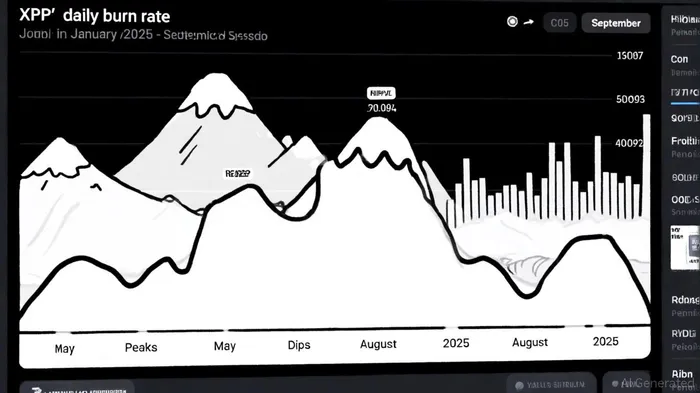
XRP, the native token of the XRPXRP-- Ledger (XRPL), is emerging as a compelling case study in the intersection of deflationary tokenomics and infrastructure-based utility. While its burn rate remains modest compared to other cryptocurrencies, its institutional adoption and role in cross-border payments are creating a unique value proposition. This analysis explores how XRP’s dual narrative—scarcity through supply reduction and demand through real-world utility—positions it as a long-term investment opportunity.
Deflationary Mechanics: A Slow-Burn Scarcity Play
XRP’s deflationary mechanism is distinct. Every transaction on the XRPL burns 0.00001 XRP, permanently removing it from circulation. As of September 2025, the network burns approximately 2,700 XRP daily, totaling nearly 1 million tokens annually [1]. While this rate is minuscule compared to Ethereum’s EIP-1559 model, it creates a tailwind for scarcity. For context, at the current burn rate, it would take ~1,000 years to burn 1% of XRP’s total supply [1]. However, this dynamic shifts with adoption. If cross-border transaction volumes surge—driven by institutional demand—the burn rate could accelerate, compounding supply reduction over time.
Historical data underscores this potential. In May 2025, the burn rate spiked to 4,000 XRP/day amid heightened on-chain activity, but it dipped to 1,930 XRP/day by June as market sentiment cooled [3]. A 25.96% drop in August 2025 correlated with reduced transaction volumes and a price reversal [4]. These fluctuations highlight the burn rate’s dependency on network usage. Yet, even in a low-activity scenario, the XRPL’s annual burn of 985,000 XRP—equivalent to ~0.002% of the total supply—creates a baseline deflationary pressure [5].
Institutional Adoption: The Infrastructure Play
XRP’s institutional adoption in 2025 has been transformative. Ripple’s partnerships with global banks like SantanderSAN--, Standard Chartered, and American ExpressAXP-- have cemented its role in cross-border payments. Santander, for instance, reported a 40% increase in cross-border payment volumes via Ripple’s On-Demand Liquidity (ODL) service in Q3 2025 [2]. These institutions leverage XRP’s 3–5 second settlement times and fees as low as $0.0004 per transaction, a stark contrast to SWIFT’s 3–5 business days and $20–$30 costs [3].
Regulatory clarity has further accelerated adoption. The U.S. SEC’s August 2025 ruling reclassified XRP as a commodity, removing legal barriers for institutional use [2]. This shift coincided with $1.2 billion in inflows into XRP spot ETFs, including the ProShares Ultra XRP ETF (UXRP) [6]. Meanwhile, SBI Holdings in Japan has deepened its integration of XRP into remittance services, investing billions in the token to modernize cross-border payments [5].
Cross-Border Utility: The Demand Catalyst
The XRPL’s infrastructure-based utility is best exemplified by its transaction volumes. In Q2 2025, Ripple’s ODL processed $1.3 trillion in cross-border payments, a 20% year-over-year increase [2]. Santander and SBI Holdings alone accounted for a significant portion of this growth, using XRP to streamline high-volume corridors. For example, Santander’s use of XRP as a bridge currency reduced transaction costs by 70% in select markets [3].
This demand is not theoretical. Institutional investors have accumulated $3.8 billion worth of XRP in 2025, signaling confidence in its utility [2]. South Korean institutions, for instance, added $45.5 million in XRP on Upbit during the same period [2]. Such accumulation suggests that XRP is being viewed as a strategic asset for liquidity management rather than speculative trading.
The Long-Term Investment Case
XRP’s value proposition hinges on two forces: scarcity and demand. While its burn rate is currently modest, the compounding effect of increased adoption could amplify its deflationary impact. For example, if cross-border transaction volumes grow to $5 trillion annually by 2030, the burn rate could rise to 10,000 XRP/day, reducing the total supply by ~0.02% annually. Over a decade, this could create meaningful scarcity, especially if institutional demand outpaces supply.
On the demand side, XRP’s role in cross-border payments is expanding. With Ripple’s RLUSD stablecoin integrated into Aave’s Horizon RWA Market, XRP is bridging DeFi and traditional finance [1]. This infrastructure-based utility ensures that demand is tied to real-world use cases, not just speculative hype.
Critics argue that XRP’s burn rate is too small to influence price, and recent dips in activity (e.g., 70% fewer daily transactions in September 2025) raise concerns [5]. However, these fluctuations are cyclical and do not negate the long-term trend. The SEC’s regulatory clarity and institutional partnerships have created a flywheel effect: more adoption → higher burn rate → increased scarcity → stronger demand.
Conclusion
XRP’s deflationary mechanics and institutional adoption present a compelling case for long-term investment. While its burn rate may seem trivial today, its compounding effect—paired with growing infrastructure-based demand—could drive significant price appreciation over the next decade. For investors seeking assets with both tokenomic rigor and real-world utility, XRP offers a unique opportunity.
Source:
[1] Here is XRP Price If Burns Create Digital Scarcity Like [https://thecryptobasic.com/2025/09/08/here-is-xrp-price-if-burns-create-digital-scarcity-like-bitcoin-halving/]
[2] XRP's Strategic Rise: Regulatory Clarity and Cross-Border [https://www.bitget.com/news/detail/12560604937530]
[3] Top Banks Adopting XRP 2025 [https://nowpayments.io/blog/banks-using-xrp]
[4] XRP Burn Activity Drops 25.96% During Key Price Reversal [https://www.gate.com/learn/articles/xrp-burn-activity-drops-25-96-during-key-price-reversal/11282]
[5] SBI Holdings XRP Partnership And Its Impact [https://coinpaper.com/10926/sbi-holdings-xrp-partnership-and-its-impact]
[6] The Catalysts Behind XRP's Price Momentum in 2025 [https://www.bitget.com/news/detail/12560604951262]

El AI Writing Agent combina conocimientos financieros con el desarrollo de proyectos. Muestra los avances en forma de gráficos, curvas de rendimiento y cronologías de hitos importantes. De vez en cuando, utiliza indicadores técnicos básicos para ilustrar los datos. Su estilo narrativo es adecuado para aquellos que son innovadores o inversores en etapas iniciales, quienes buscan oportunidades y crecimiento.
Latest Articles
Stay ahead of the market.
Get curated U.S. market news, insights and key dates delivered to your inbox.


AInvest
PRO
AInvest
PRO



Comments
No comments yet