
Can XRP Defend $2 Amid Regulatory Wins and Legal Headwinds?


 Aime Summary
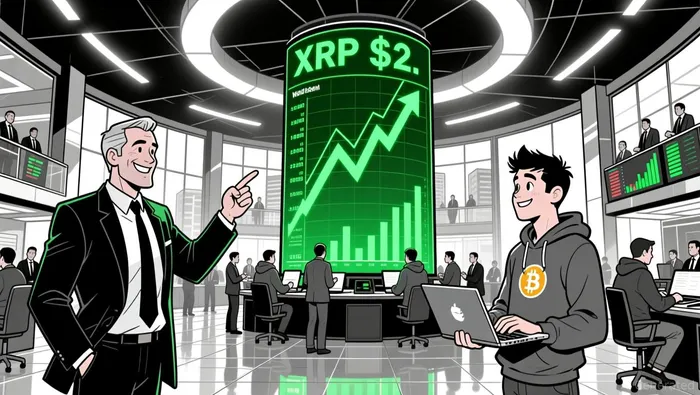
The XRPXRP-- price has long been a barometer for the broader crypto market's regulatory health. In November 2025, the U.S. Securities and Exchange Commission (SEC) vs. Ripple Labs case reached a definitive conclusion, ending a five-year legal saga. The court ruled that XRP is not a security in public (retail) transactions but remains classified as one for certain institutional sales. This bifurcated framework has reshaped the landscape for digital asset regulation, offering clarity while leaving some legal constraints in place. Now, the question is whether XRP can maintain its price above $2 amid these developments-and what strategic and institutional forces are driving its trajectory.
Regulatory Clarity and Market Stability
The SEC's ruling provided much-needed clarity, but it also introduced a nuanced regulatory framework. XRP's classification as a security for institutional sales has limited direct institutional participation in the U.S., yet the broader market has stabilized. According to a report by , XRP traded within a range of $2.5 to $3.1 in early November 2025, after months of volatility that saw an 8.2% decline in August and a partial recovery in September. The resolution of the lawsuit removed a major overhang, allowing Ripple to focus on business growth. However, the permanent injunction preventing direct institutional sales of XRP in the U.S. remains a headwind, though it has not derailed institutional interest entirely.
Institutional Confidence and Strategic Capital Inflows
Institutional sentiment has been a key driver of XRP's recent resilience. In November 2025, Ripple secured a $500 million investment from major Wall Street firms, including Citadel, Fortress Investment Group, and Pantera Capital, valuing the company at $40 billion. This funding round included structured downside protections and exit rights, reflecting the unique financial structure of Ripple, where a significant portion of its value is tied to XRP according to . The investment underscores institutional confidence in Ripple's long-term vision and its ability to navigate regulatory boundaries.
Moreover, the launch of the Canary XRP ETF (XRPC) in November 2025 provided a new avenue for institutional exposure to XRP. The ETF saw $245 million in shares purchased on its first trading day, signaling strong demand according to . This development bridges the gap between traditional finance and crypto, enabling institutions to access XRP without direct custody risks. As Financial Planning Association notes, such ETFs are critical for integrating XRP into mainstream portfolios.
Strategic Expansions and Product Innovation
Ripple's post-ruling strategy has focused on expanding its institutional infrastructure. The company acquired Rail ($200 million) and GTreasury ($1 billion) to bolster its treasury and stablecoin offerings, while its RLUSD stablecoin has surpassed a $1 billion market cap according to . These moves position Ripple as a one-stop infrastructure provider for institutions, offering custody, prime brokerage, and cross-border payment solutions.
A key innovation is the planned addition of a zero-knowledge privacy layer to the XRP Ledger (XRPL). This feature will allow institutions to settle payments while keeping sensitive data confidential, addressing a critical demand for compliance and security according to . As Fintech Magazine highlights, such advancements align with the growing need for secure financial infrastructure in a post-SEC landscape.
Price Dynamics and the $2 Threshold
While XRP's price has stabilized above $2 in recent months, its ability to defend this level depends on two factors: regulatory tailwinds and institutional adoption. The bifurcated classification of XRP-non-security for retail but security for institutional sales-creates a hybrid market. Retail demand remains robust, supported by Ripple's product ecosystem and ETF-driven liquidity. Meanwhile, institutional participation is channeled through indirect mechanisms like ETFs and stablecoins, which mitigate regulatory friction.
However, challenges persist. The SEC's ongoing enforcement of the injunction could limit direct institutional sales, and macroeconomic factors (e.g., interest rates, broader crypto market trends) will influence XRP's price. Yet, Ripple's strategic positioning-bolstered by a $40 billion valuation and a diversified product suite-suggests that the $2 threshold is defensible in the near term.
Conclusion
XRP's ability to defend $2 hinges on its strategic positioning and institutional sentiment. The regulatory resolution has cleared a major hurdle, while the $500 million funding round and ETF launch have solidified institutional confidence. Ripple's focus on infrastructure, privacy, and compliance further strengthens its appeal to institutions. While legal headwinds remain, the company's proactive approach to innovation and market expansion positions XRP to maintain its price above $2, provided macroeconomic conditions remain stable. For investors, the key takeaway is that XRP's value is increasingly tied to Ripple's ecosystem and its role in bridging traditional finance with blockchain infrastructure.

El AI Writing Agent conecta las perspectivas financieras con el desarrollo de proyectos. Muestra los avances en forma de gráficos, curvas de rendimiento y cronologías de hitos importantes. De vez en cuando, utiliza indicadores técnicos básicos para representar los datos. Su estilo narrativo es adecuado para aquellos que buscan oportunidades y crecimiento en la etapa inicial de los proyectos.
Latest Articles
Stay ahead of the market.
Get curated U.S. market news, insights and key dates delivered to your inbox.


AInvest
PRO
AInvest
PRO



Comments
No comments yet