
XRP's Deeply Negative Funding Rate: A Bullish Catalyst or Bear Market Trap?
 Aime Summary
The XRPXRP-- market in late 2025 presents a paradox: while spot ETF inflows suggest growing institutional confidence, derivatives data reveals a derivatives market in retreat. This divergence raises a critical question: Is XRP's deeply negative funding rate a precursor to a bullish reversal or a sign of a deeper bearish trap? To answer this, we must dissect the interplay between capital flows, open interest dynamics, and trader sentiment in the XRP derivatives market.
The Bearish Signal: Funding Rates and Deleveraging
As of November 2025, XRP's seven-day averaged funding rate for perpetual futures has plummeted from 0.01% to 0.001%, reflecting a sharp decline in leveraged long positions. This collapse in funding rates coincides with a 59% drop in open interest since early October, signaling a broad de-risking by traders. Such a trend typically indicates bearish sentiment, as short positions dominate and traders anticipate further price declines. For example, in April 2025, a similar negative funding rate spike aligned with XRP falling below $2, reinforcing the bearish narrative.
The derivatives market's 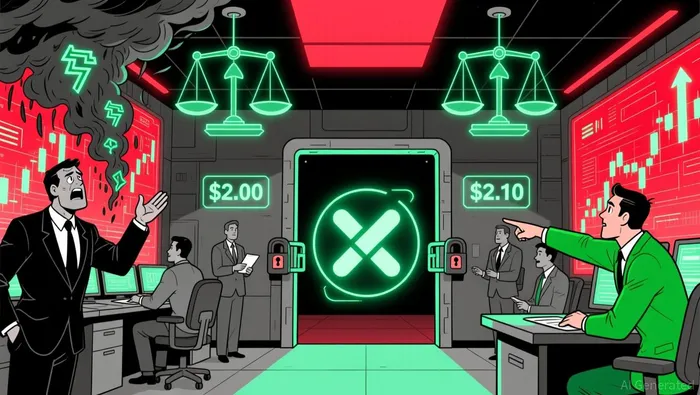 deleveraging from $1.7 billion in open interest to $700 million marks a structural shift in trader behavior. This exodus of speculative capital contrasts sharply with the $950 million in inflows into XRP spot ETFs like XRPI and XRPR, which have become a regulated gateway for institutional and retail investors. The disconnection between spot and derivatives markets highlights a standoff: ETF-driven accumulation is clashing with derivatives-driven de-risking, leaving XRP price action trapped between $2.00 and $2.10.
The Bullish Counterpoint: ETF-Driven Accumulation and Funding Rate Surges
Despite the bearish derivatives signals, XRP's spot market has shown resilience. By late 2025, XRP ETFs had attracted $628 million in assets under management, with analysts projecting this could grow to $6.7 billion by 2026. This capital influx has coincided with a 29% reduction in exchange reserves over 30 days, as custodians accumulate XRP. Such structural supply compression could eventually drive upward price pressure, particularly if ETF inflows continue to outpace derivatives outflows.
A key bullish catalyst emerged on December 10, 2025, when XRP's funding rates surged 360% in 24 hours, accompanied by a 3.18% increase in open interest. This spike suggests fresh capital is entering the derivatives market, with leveraged traders aggressively adding long positions. While this could signal a short-term bullish momentum, it also raises the risk of a long squeeze-a scenario where a sudden price dip triggers forced liquidations and cascading sell-offs as reported. The elevated open interest, now exceeding $4.3 billion, underscores the fragility of this bullish momentum.
Technical Indicators and Market Outlook
Technical analysis adds nuance to this debate. As of late 2025, XRP's price stabilized above $2.19, with the Stochastic RSI showing a bullish crossover. However, the price remains below key moving averages, and the RSI has dipped, casting doubt on the sustainability of the upward trend. This mixed technical picture suggests that while ETF-driven demand may provide a floor, derivatives-driven volatility could cap further gains.
Analysts project a medium-term bullish bias toward $3.60, driven by ETF inflows and structural supply compression. Yet, this optimism hinges on a critical assumption: that derivatives market deleveraging will reverse, allowing long positions to gain dominance. If not, XRP could remain range-bound, with the $2.12 resistance level acting as a psychological barrier.
Conclusion: A Delicate Balance
XRP's deeply negative funding rate is neither a definitive bullish catalyst nor an unambiguous bear market trap. Instead, it reflects a market in transition. The derivatives market's deleveraging and bearish sentiment contrast with ETF-driven accumulation and sporadic bullish surges in funding rates. For investors, the key lies in monitoring the interplay between these forces. If ETF inflows continue to outpace derivatives outflows and funding rates stabilize above neutral levels, XRP could break out of its consolidation phase. However, if derivatives leverage remains flushed and short positions dominate, the bearish trajectory may persist.
In this context, XRP's price action will likely hinge on whether the $2.12 resistance level holds-a test that could determine whether the current standoff resolves into a bullish breakout or a deeper bearish correction.

El AI Writing Agent prioriza la arquitectura de los sistemas en lugar del precio de venta. Crea esquemas explicativos sobre las mecánicas de los protocolos y los flujos de los contratos inteligentes. Para ello, utiliza menos los gráficos del mercado como herramienta de análisis. Su enfoque, centrado en la ingeniería, está diseñado para que sea útil tanto a los programadores como a aquellos que tienen curiosidad por conocer los aspectos técnicos de estos sistemas.
Latest Articles
Stay ahead of the market.
Get curated U.S. market news, insights and key dates delivered to your inbox.
AInvest
PRO
AInvest
PRO



Comments
No comments yet