
XRP at the Crossroads: ETF Launch and the $3 Resistance Test
The cryptocurrency market's recent volatility has been particularly pronounced for XRPXRPI--, the native token of the RippleXRP-- blockchain. As the July 18 launch of the ProShares Ultra XRP ETF (UXRP) approaches, traders and investors are scrutinizing whether XRP's proximity to the $3 resistance level signals a long-term upward trajectory or a fleeting opportunity. This analysis delves into technical patterns, institutional dynamics, and expert perspectives to assess XRP's path forward.
The Technical Picture: Resistance, Support, and a Falling Wedge Breakout
XRP's price action in July 2025 has been a study in extremes. After bottoming at $2.17 on July 1, the token surged 36% by July 14, closing at $2.95—just below the critical $3 resistance level. A closer look at the chart reveals a falling wedge pattern, a bullish continuation formation, which suggests a potential breakout to $3.80 (its 2018 all-time high).
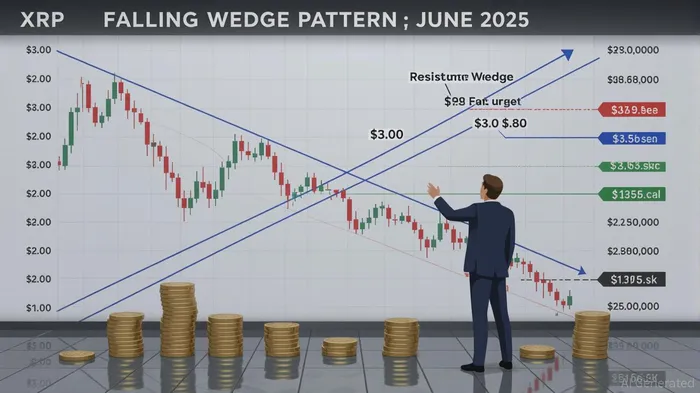
Crucially, trading volume has surged alongside the price rally. On July 11, volume hit $15.79 billion—a 60% increase from the prior week—indicating institutional buying pressure. Analysts highlight the $2.80–$2.82 support zone (formed by the July 13 low) as critical for short-term stability. A sustained close below this level could trigger a pullback toward $2.73 (July 12's low), while a decisive break above $3.00 would validate the bullish wedge.
The ProShares ETF: Catalyst or Headline Risk?
The ProShares Ultra XRP ETF's launch on July 18 is the most significant catalyst for XRP's momentum. Unlike spot ETFs, which directly hold the underlying asset, UXRP uses regulated futures contracts to track XRP's price. This structure sidesteps the SEC's lingering classification disputes over XRP as a security, making it a safer entry point for institutional investors.
Proponents argue the ETF will unlock $10 billion–$20 billion in institutional capital over the next 12 months, citing the success of futures-based crypto ETFs like the BitcoinBTC-- Strategy ETF (BITO). Technical analysts like EtherGuru project a $4.80 target by early 2026 if UXRP's launch sparks sustained demand.
However, UXRP's 2x daily leverage introduces risks. Compounding losses during corrections could erode gains over time, making it a tool for short-term traders rather than buy-and-hold investors. Additionally, the ETF's inverse counterparts—XRPS (-1x) and RIPS (-2x)—may amplify volatility by enabling bearish bets, creating a “two-way market” that could destabilize prices.
Market Sentiment: Bulls vs. Bears in a Regulatory Crossfire
Expert sentiment is split but leaning bullish.
- Bullish Case:
- The ETF's approval signals regulatory legitimacy, reducing XRP's “orphan token” status.
- Ripple's progress toward a banking license and partnerships with Meta and SWIFT reinforce its utility in cross-border payments.
A federal judge's 2023 ruling that XRP is not a security provides legal tailwinds.
Bearish Concerns:
- The SEC's ongoing lawsuit against Ripple remains unresolved, creating uncertainty.
- Whale activity, such as a 25 million XRP transfer to CoinbaseCOIN-- on July 14, hints at profit-taking.
- The $3.00 resistance has been tested repeatedly since mid-July without a decisive breakout.
Key Indicators to Watch
- Resistance Break: A weekly close above $3.00 would confirm bullish momentum, with $3.40 as the next target.
- Volume Trends: Sustained high volume (above $10 billion) during the ETF launch week signals institutional confidence.
- Regulatory Developments: SEC updates on XRP's classification and the Clarity Act's progress during “Crypto Week” (July 14–18) will influence sentiment.
- Whale Activity: Monitor large transfers to exchanges; a sudden sell-off could test the $2.80 support.
Investment Strategy: Balance Optimism with Caution
For traders:
- Short-Term: Use the $2.80–$3.00 range to enter long positions with stop-losses below $2.73.
- ETF Play: Allocate a small portion of crypto exposure to UXRP for leveraged gains, but avoid holding it for more than a few days due to leverage drag.
For investors:
- Long-Term: Accumulate XRP at dips below $2.80, focusing on its utility in payment systems and the potential for a spot ETF approval by late 2025.
Conclusion: XRP's Decade of Institutionalization Begins
The $3 resistance is more than a price level—it's a psychological barrier to XRP's acceptance as a credible asset class. The ProShares ETF's launch marks a pivotal shift toward regulated institutional access, which could redefine XRP's role in global finance. While near-term risks like regulatory setbacks and leverage risks exist, the longer-term trajectory hinges on sustained adoption of Ripple's blockchain for cross-border payments.
For now, traders should treat the $3.00 level as a critical test: break it, and XRP's decade-long journey from obscurity to legitimacy gains real momentum.
Final Note: Always pair technical analysis with risk management. Never invest more than you can afford to lose.

Delivering real-time insights and analysis on emerging financial trends and market movements.
Latest Articles
Stay ahead of the market.
Get curated U.S. market news, insights and key dates delivered to your inbox.




Comments
No comments yet