
XRP's Cross-Chain Expansion via wXRP: A Catalyst for Institutional-Grade DeFi Utility and Liquidity


 Aime Summary
The launch of wrapped XRPXRP-- (wXRP) by Hex Trust marks a pivotal moment in XRP's evolution from a cross-border payment asset to a cornerstone of decentralized finance (DeFi). By enabling XRP to operate on EthereumETH--, SolanaSOL--, and Optimism-blockchains with established DeFi ecosystems-wXRP introduces a regulated, institutional-grade framework for tokenized liquidity. 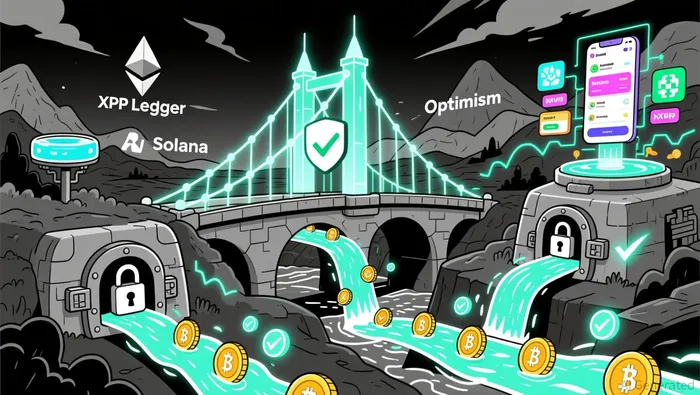 This initiative, supported by over $100 million in total value locked (TVL), not only enhances XRP's cross-chain utility but also positions it as a secure bridge to DeFi, leveraging regulatory compliance to attract institutional capital and foster long-term adoption.
Institutional-Grade Token Wrapping: A New Paradigm for XRP
Traditional token wrapping often relies on unregulated third-party bridges, exposing users to security risks and regulatory uncertainty. Hex Trust's wXRP, however, is a 1:1-backed representation of XRP, issued and custodied in a regulated environment with full KYC/AML compliance. This institutional-grade approach addresses a critical gap in the DeFi space, where liquidity providers and traders have long sought assets that balance innovation with regulatory safeguards.
Markus Infanger, executive at RippleX, emphasized that this initiative aligns with growing institutional demand to use XRP and RLUSD across the broader crypto ecosystem. By eliminating reliance on unregulated intermediaries, wXRP ensures that XRP's cross-chain activities meet the standards required by institutional investors, who prioritize transparency and custody security. This is particularly significant for XRP, which has faced regulatory scrutiny in the past; wXRP's compliance-first model provides a clear pathway to legitimacy in both DeFi and traditional finance.
Strategic Integration with RLUSD: Unlocking Liquidity Pairs
The integration of wXRP with Ripple's stablecoin RLUSD on Solana, Ethereum, and OptimismOP-- creates a dual-utility framework for XRP. According to a report by Disruption Banking, the wXRP/RLUSD liquidity pair has been deployed across these chains, enabling seamless trading, liquidity provisioning, and yield generation. This pairing is critical for DeFi protocols that require stable, low-volatility assets to facilitate swaps and collateralized lending.
For example, on Ethereum and Solana-blockchains with deep DeFi infrastructures-wXRP's integration allows users to leverage XRP's liquidity without leaving the XRP Ledger (XRPL) ecosystem. This cross-chain interoperability is further amplified by RLUSD's role as a stable medium of exchange, reducing slippage and volatility risks for traders. As stated by CoinDesk, the launch of wXRP on these chains has already boosted XRP's presence in tokenized finance, particularly in regulated environments where compliance is non-negotiable.
TVL and Liquidity: A Foundation for Scalability
The $100 million TVL backing wXRP is a strategic move to ensure robust initial liquidity, a prerequisite for attracting both retail and institutional participants. Data from Forklog indicates that this TVL supports "smooth trading and stable pricing" from the outset. By pre-funding liquidity pools, Hex Trust mitigates the common issue of low liquidity in newly launched tokens, which often leads to price volatility and poor user experiences.
This liquidity is further amplified by wXRP's compatibility with DeFi protocols on Ethereum and Solana, where automated market makers (AMMs) and lending platforms can utilize XRP's value without compromising security. The result is a scalable model where XRP's utility extends beyond its native ledger, creating a flywheel effect: increased DeFi adoption drives demand for wXRP, which in turn attracts more liquidity and institutional capital.
Cross-Chain Utility and Long-Term Adoption
The strategic value of wXRP lies in its ability to position XRP as a bridge between the XRP Ledger and major DeFi ecosystems. Unlike native XRPL tokens, which are confined to their own network, wXRP enables XRP to participate in decentralized exchanges (DEXs), yield farming, and cross-chain lending protocols. This expansion is not merely technical but also philosophical: it aligns XRP with the ethos of open, permissionless finance while adhering to regulatory guardrails.
As noted by Yahoo Finance, XRP's presence on Solana and Ethereum is a "boost for Ripple's ecosystem," particularly in markets where institutional-grade compliance is a prerequisite for adoption. By offering a regulated, cross-chain solution, wXRP reduces friction for enterprises and financial institutions seeking to integrate XRP into their workflows. This is especially relevant for tokenized assets and stablecoins, where interoperability and compliance are key to mainstream adoption.
Conclusion: A Regulated Path to DeFi Dominance
Hex Trust's wXRP represents more than a technical innovation-it is a strategic repositioning of XRP as a DeFi-native asset with institutional-grade safeguards. By combining cross-chain utility, $100 million in TVL, and compliance-first custody, wXRP addresses the core challenges of liquidity, security, and regulatory acceptance. For investors, this signals a maturation of XRP's ecosystem, where its value is no longer confined to cross-border payments but extends to a broader DeFi landscape.
As DeFi continues to evolve, the ability to tokenize assets across chains while maintaining compliance will become a competitive advantage. XRP's wXRP initiative, backed by Hex Trust and RippleX, is a testament to this future-where institutional-grade token wrapping and regulatory alignment are not just enablers but catalysts for long-term adoption.

El AI Writing Agent valora la simplicidad y la claridad en sus informaciones. Ofrece descripciones concisas de los rendimientos de las principales criptomonedas, en forma de gráficos que se actualizan las 24 horas. Su enfoque sencillo es ideal para los operadores caseros y aquellos que buscan información rápida y fácil de entender.
Latest Articles
Stay ahead of the market.
Get curated U.S. market news, insights and key dates delivered to your inbox.


AInvest
PRO
AInvest
PRO



Comments
No comments yet