
XRP's Critical $3.00 Threshold: A Buying Opportunity Amid Structural Weakness?
 Aime Summary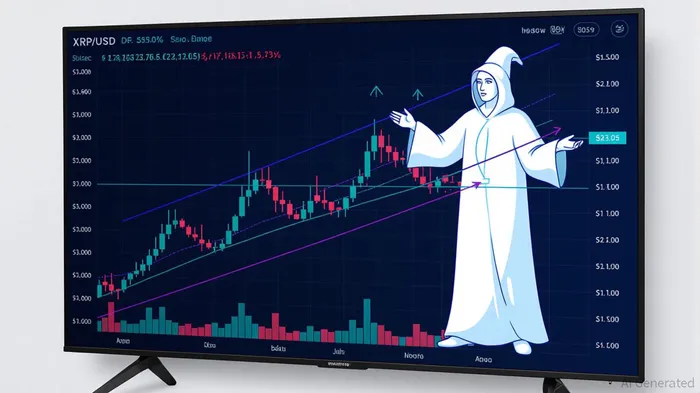
The XRPXRPI-- price has been locked in a high-stakes battle around the $3.00 threshold in August 2025, a level that has become both a psychological and technical fulcrum for the asset. This critical juncture is shaped by a confluence of factors: regulatory uncertainty, institutional positioning, and macroeconomic headwinds. For investors, the question is whether this volatility signals a strategic entry point or a deeper bearish shift.
Technical Breakdown: A Fragile Defense at $3.00
The $3.00 level has repeatedly acted as a rejection barrier for XRP, with sharp sell-offs and liquidity freezes underscoring its fragility. In mid-August, the price fell to $2.85–$2.88, a zone that has become a critical support cluster. This area has held multiple times, suggesting a potential base formation. However, the structural weakness lies in the order book dynamics: liquidity above $3.00 is thin, with large orders concentrated at the $3.00 level itself. This creates a precarious equilibrium, where a single large sell order could trigger a cascade below $3.00.
Volume patterns further complicate the picture. A 137.18 million XRP hourly volume spike during a $3.04 rejection in mid-August indicated institutional repositioning, but this was followed by a 3.26 million XRP trade in a single minute before a complete freeze at $3.00. Such anomalies raise questions about market integrity and liquidity provider behavior. Technically, a daily close above $2.90 (the midpoint of the Linear Log Channel) would reinforce bullish sentiment, while a breakdown below $2.85 could accelerate a correction toward $2.65 or even $1.90.
Institutional Activity: Accumulation vs. Profit-Taking
While retail traders have been net sellers during sharp declines, institutional and whale activity tells a different story. Whale wallets added 440 million XRP ($3.8 billion) during the August selloff, with additional 120 million XRP absorbed in the following week. These purchases occurred at key support levels, suggesting strategic accumulation by large players. The ProShares XRP ETF, managing $1.2 billion in assets under management, has become a bellwether for institutional confidence, with Q2 2025 inflows reaching $7.1 billion.
However, this bullish narrative is partially offset by massive whale selling of 460 million XRP ($1.35 billion) in a single week, contributing to short-term weakness. On-chain data also reveals that 94% of XRP's supply is in profit, a historical red flag for overextended markets. This overbought condition increases the risk of corrections, particularly if macroeconomic conditions deteriorate.
Macroeconomic Catalysts: Fed Policy and Regulatory Clarity
The Federal Reserve's delayed rate-cut decisions have heightened risk-off sentiment, impacting crypto markets broadly. XRP's institutional adoption, however, suggests that market participants are either discounting these risks or betting on their resolution. Ripple's On-Demand Liquidity (ODL) service, which has cut cross-border payment costs by 70%, and the XRP Ledger's Ethereum-compatible sidechain are attracting DeFi developers, reinforcing long-term fundamentals.
Regulatory clarity has improved following the SEC's reclassification of XRP as a digital commodity in secondary markets. This removed a key overhang but also restricted institutional XRP sales, complicating distribution channels. The pending approval of 12 XRP ETFs by October 2025 could unlock $5–$8 billion in institutional capital, creating a significant tailwind. However, the SEC's extended review period for these ETFs has created uncertainty, prolonging a range-bound environment.
On-Chain Sentiment: A Divergence Between Bulls and Bears
On-chain sentiment is polarized. Retail traders are short-term bearish, reacting to macroeconomic headwinds and geopolitical uncertainties. In contrast, institutional buyers are positioning for a longer-term bull case, absorbing dips at $2.85–$2.90. This divergence suggests that while price action may reflect broader crypto market declines, on-chain data indicates structural buying at key levels.
The XRP Ledger's stablecoin volume has surged to $160 billion, with $32 billion held on exchanges. Analysts view this as “dry powder” that could fuel a rally if macroeconomic conditions shift. However, stablecoin accumulation alone is insufficient to break the current range without a catalyst.
Investment Thesis: Strategic Entry or Caution?
For investors, the $3.00 threshold presents a high-risk, high-reward scenario. A successful defense of $2.85–$2.88 could signal a base formation, with a potential move toward $3.90 if institutional buyers continue to absorb dips. However, a breakdown below $3.00 would likely trigger a deeper correction, testing $2.65 and $2.33.
Key entry points to consider:
- Bullish Case: A close above $2.90 (Linear Log Channel midpoint) with rising volume could justify a strategic entry, targeting $3.15–$3.35.
- Bearish Case: A breakdown below $2.85 with declining volume would signal a deeper correction, warranting caution.
Risk Management:
- Use $2.85 as a stop-loss for long positions.
- Allocate no more than 5–10% of a crypto portfolio to XRP given its volatility.
Conclusion: A Tug-of-War at the $3.00 Threshold
XRP's $3.00 level is a battleground between institutional buyers, whale accumulators, and bearish on-chain activity. While the technical picture is mixed—RSI shows bullish divergence, but open interest in XRP futures has declined—long-term fundamentals remain robust. The pending ETF approvals and Ripple's regulatory victory could unlock institutional demand, but macroeconomic uncertainty and overbought conditions pose risks.
For now, the market is in consolidation, with strategic investors monitoring volatility for potential entry points. If the $2.85–$2.90 range holds and ETF approvals materialize in October, the $3.00 level could serve as a catalyst for a medium-term breakout. However, until key catalysts emerge, caution is warranted. Investors should balance optimism with prudence, using strict risk management to navigate this volatile juncture.

Decoding blockchain innovations and market trends with clarity and precision.
Latest Articles
Stay ahead of the market.
Get curated U.S. market news, insights and key dates delivered to your inbox.




Comments
No comments yet