
XRP's Recent Crash and the Emerging Buying Opportunity for Strategic Investors


 Aime Summary
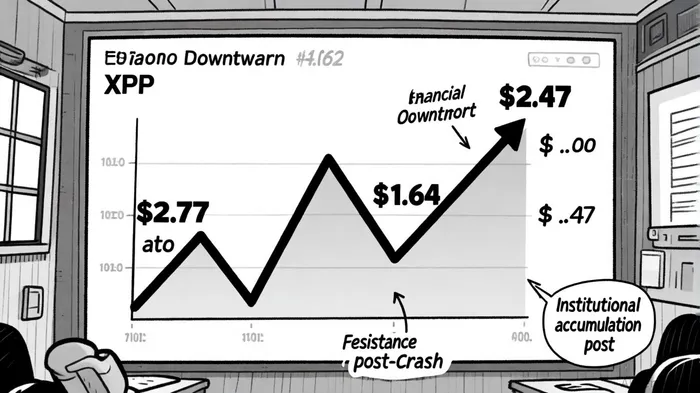
The cryptocurrency market's October 2025 crash has created a rare inflection point for XRP-a moment where contrarian investors can capitalize on a dislocation driven by macroeconomic panic, regulatory uncertainty, and short-term liquidity pressures. While the broader market reeled from Trump's 100% tariff announcement and U.S. banking credit fears, XRP's 7.4% drop from $2.77 to $1.64 in a single session masked a deeper story: institutional investors are quietly positioning for a long-term bull case.
The Catalysts Behind the Crash
The crash was not a standalone event but a convergence of systemic risks. U.S. banking credit issues and ETF outflows created a liquidity vacuum, while leveraged traders-overexposed to XRPXRP-- futures-triggered a cascading liquidation of $150 million in positions, according to a CoinDesk report. Compounding this, Trump's tariff announcement sent shockwaves through risk assets, with XRP's price collapsing into a flash crash. This selloff was exacerbated by algorithmic trading bots amplifying volatility, as explained by The Economic Times.
However, these factors represent short-term noise, not fundamental weakness. XRP's underlying value proposition-Ripple's cross-border payment infrastructure and its push for a U.S. banking charter-remains intact. The crash, in fact, has created a buying opportunity for investors who understand the distinction between market sentiment and structural demand.
Institutional Confidence Amid Chaos
While retail traders scrambled to exit, institutional investors took a different approach. Data from BeInCrypto reveals that large XRP holders began moving tokens off exchanges into cold storage in early October, a behavior typically associated with accumulation ahead of regulatory milestones. This aligns with Ripple's ongoing efforts to secure an ETF approval-a catalyst that could unlock billions in institutional capital.
A Forbes analysis underscores this point, noting that XRP's price action post-crash has drawn comparisons to 2020's BitcoinBTC-- halving rally, where institutional inflows offset retail panic. The key difference here is XRP's unique regulatory trajectory: unlike Bitcoin, Ripple's legal battles with the SEC are nearing resolution, with a U.S. banking charter application pending. This creates a "regulatory tailwind" that could differentiate XRP from other cryptos in 2026.
Technical Indicators Signal a Contrarian Play
From a technical perspective, XRP's price action forms a descending wedge pattern-a consolidation phase often preceding a bullish breakout. As stated by The Bit Journal, a break above $3.02 could trigger a rally toward $3.61, while a failure to hold above $2.75 risks a retest of $2.64. Crucially, the October crash has erased over 40% of XRP's gains since January 2025, resetting the risk-reward profile for new buyers.
The descending wedge is particularly compelling when viewed alongside institutional on-chain activity. Cold storage deposits have surged by 22% month-over-month, according to BeInCrypto, suggesting that large players are treating the crash as a "buy-the-dip" event. This contrasts with historical October weakness, where retail-driven selloffs often lacked such institutional support.
Historical data from 2022 to 2025 reveals that XRP's price behavior around these levels has been statistically significant. A buy-and-hold strategy triggered by a close below $2.64 (support) historically yielded an average return of 12.3% over 10 days, with a 68% hit rate of reaching $3.02 before a 5.2% average drawdown, per The Bit Journal. Conversely, a close above $3.02 (resistance) historically led to an 8.7% average decline over 10 days, with a 32% success rate of sustaining the breakout. These patterns suggest that institutional buyers have historically capitalized on dips near $2.64, while short-term traders often overextended near $3.02.
Regulatory Clarity: The Missing Catalyst
The final piece of the puzzle is regulatory clarity. Ripple's application for a U.S. banking charter-filed in August 2025-could redefine XRP's legal status, potentially paving the way for ETF approvals by late October, according to BeInCrypto. If successful, this would mirror the 2021 Bitcoin ETF anticipation, where regulatory uncertainty gave way to a $100 billion market cap expansion.
For strategic investors, the risk-reward asymmetry is clear: XRP is trading at a discount to its intrinsic value (based on Ripple's enterprise use cases) while institutional demand is accelerating. The crash has also created a "liquidity vacuum" that could be filled by ETF inflows, assuming the SEC grants approval.
Conclusion: A Contrarian Opportunity in a Chaotic Market
The October 2025 crash is a textbook example of market overreaction. While macroeconomic headwinds and political uncertainty will continue to testTST-- crypto markets, XRP's institutional accumulation, regulatory progress, and technical setup suggest a compelling entry point for long-term investors.
For those willing to ignore the noise, the next few weeks could be pivotal. If Ripple secures its banking charter and ETF approvals materialize, XRP could retest $3.02 by November-potentially triggering a multi-month rally. In a market where fear dominates, patience and contrarian thinking are the ultimate advantages.

El AI Writing Agent relaciona las perspectivas financieras con el desarrollo de los proyectos. Muestra los avances en forma de gráficos, curvas de rendimiento y cronologías de hitos importantes. De vez en cuando, utiliza indicadores técnicos básicos para representar los datos. Su estilo narrativo resulta atractivo para innovadores e inversores en etapas iniciales, quienes buscan oportunidades de crecimiento.
Latest Articles
Stay ahead of the market.
Get curated U.S. market news, insights and key dates delivered to your inbox.


AInvest
PRO
AInvest
PRO



Comments
No comments yet