
XRP Collaborates With Mastercard to Enhance Blockchain Payment Integration
 Aime Summary
- Mastercard has launched a Crypto Partner Program integrating blockchain payment infrastructure with traditional financial systems, with RippleRLUSD-- as a key participant.
- This initiative aims to connect crypto transactions with existing banking rails to facilitate cross-border value transfers using blockchain technology.
- Ripple’s inclusion in the program highlights its role in building payment infrastructure for digital assets.
Mastercard’s Crypto Partner Program is designed to bridge blockchain payment infrastructure with traditional financial systems. Ripple is among the companies involved, including Anchorage Digital, Binance, BitGoBTGO--, CircleCRCL--, Gemini, PayPalPYPL--, Polygon, and SolanaSOL--. 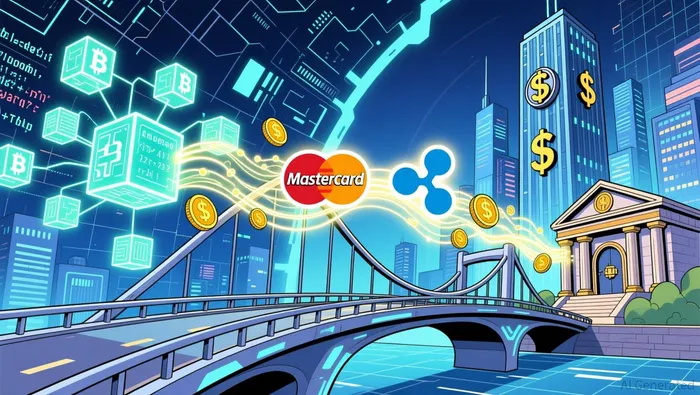 The program enables crypto transactions to connect directly with traditional financial services, allowing institutions to move value across borders using blockchain. Ripple has long focused on cross-border payments and liquidity services, utilizing XRPXRP-- for rapid settlement and efficient fund transfers. Mastercard’s initiative provides a platform that integrates these technologies with banking systems serving millions of users. Ripple’s inclusion in the program highlights its role in building payment infrastructure for digital assets. This expands Ripple’s presence within Mastercard’s global payments network, offering opportunities for XRP-powered solutions to reach a larger institutional audience.
Mastercard is introducing a Crypto Partner Program that adds Ripple to its network, which processes over $9 trillion in payments annually. This program aims to connect blockchain payment infrastructure with global financial systems, enabling crypto transactions to interface with traditional banking services. Ripple’s inclusion is significant given its focus on cross-border payments and liquidity solutions. Mastercard’s expanding digital asset strategy includes partnerships with blockchain firms as institutions explore tokenized payments and blockchain-based settlements. Ripple’s integration into this program may enhance XRP’s adoption and visibility among institutions reliant on Mastercard’s extensive network.
The SEC and CFTC jointly issued guidance classifying digital assets into categories like commodities, collectibles, and securities. This framework aims to reduce regulatory ambiguity and clarify the legal status of activities like staking and airdrops. The new joint guidance establishes a formal token classification framework, categorizing digital assets into distinct groups including digital commodities, digital collectibles, digital tools, stablecoins, and digital securities. For instance, assets functioning primarily as a decentralized medium of exchange or store of value fall under CFTC jurisdiction. The guidance clarifies that activities like protocol-level staking and airdrops distributed without requiring financial investment are generally not classified as securities. This provides a coherent roadmap for developers to build compliant networks while reducing regulatory uncertainty for investors and developers.
SEC Chair Paul Atkins announced at the DC Blockchain Summit that 'most crypto assets' are not securities, including activities like BitcoinBTC-- mining, staking, and airdrops. The guidance categorizes digital assets into five groups: digital commodities, digital collectibles, digital tools, stablecoins, and digital securities. Only the last category falls under SEC jurisdiction. The guidance includes safe harbor proposals for startups and exemptions for entrepreneurs raising up to $75M via crypto investment contracts. This shift from vague enforcement actions to formal classification provides clarity for the industry and reduces legal risks for projects and investors.
The SEC's framework divides crypto assets into five categories: Digital commodities, Digital collectibles, Digital tools, Stablecoins, and Digital securities. The first four categories are not considered securities and fall outside the SEC's jurisdiction. Digital commodities include assets like Bitcoin and EthereumETH--, while digital collectibles include NFTs and in-game items. Digital tools are tokens that provide functional benefits. This classification aims to provide clarity for developers and investors, reducing the risk of arbitrary enforcement and encouraging innovation within the U.S. market.
Project Crypto focuses on bringing clarity to the application of securities laws to crypto assets. This includes efforts to bring financial markets on-chain and to support innovation through a dedicated hub. The initiative seeks to provide a legal and regulatory framework that encourages innovation while protecting investors.
Blockchain and Web3 technologies are disrupting traditional financial models. Stablecoins are gaining traction as reliable stores of value and mediums of exchange. As a result, traditional banks are losing their dominance in the market. This shift reflects the growing adoption of decentralized finance and the demand for more flexible and accessible financial systems.
Since the Middle East conflict began, Bitcoin has seen increased inflows from institutional investors. While the broader market sentiment remains cautious, Bitcoin continues to outperform traditional assets like gold and equities. This trend highlights Bitcoin's role as a potential safe-haven asset during geopolitical uncertainty.
XRP has surged above $1.50, and the potential approval of the CLARITY Act is cited as a key driver for further growth. The article explains how the act could provide regulatory clarity, which may attract institutional investors and increase demand for XRP. It highlights how regulatory developments can act as catalysts for price movements in the cryptocurrency market.
Ripple’s valuation has increased to $50 billion, driven by factors such as a $750 million share buyback, acquisitions, and strategic partnerships. However, XRP's price has not followed suit due to the fact that most of Ripple's business does not rely on the token. While Ripple's On-Demand Liquidity (ODL) service does use XRP, it is limited to remittance firms and smaller institutions. The article explains that Ripple's success as a company does not directly translate to increased demand for XRP unless ODL is adopted by major global banks.
Mastercard has described Ripple as a key player in the future of digital payments. The article explains that Ripple's technology enables faster and more efficient cross-border transactions, which is attracting attention from traditional financial institutions. The endorsement highlights Ripple's role in improving global payment infrastructure and shows how blockchain solutions are being integrated with existing financial systems. The article emphasizes the strategic value of XRP within Ripple's ecosystem, particularly as a bridge currency in cross-border transactions.

Blending traditional trading wisdom with cutting-edge cryptocurrency insights.
Latest Articles
Stay ahead of the market.
Get curated U.S. market news, insights and key dates delivered to your inbox.
AInvest
PRO
AInvest
PRO



Comments
No comments yet