
Is XRP Still a Buy Below $3 Amid Regulatory and ETF Catalysts?


 Aime Summary
The cryptocurrency market in 2025 remains a landscape of duality: regulatory clarity in some corners and lingering uncertainty in others. For XRPXRP--, the resolution of the SEC lawsuit in August 2025 has provided a critical inflection point, but the asset's investment viability still hinges on a nuanced interplay of structural value, institutional adoption, and macroeconomic risks. Below $3, XRP's price presents a potential entry point for long-term investors, but the calculus must account for both catalysts and constraints.
Regulatory Clarity and Its Implications
The 2025 resolution of the SEC vs. Ripple case marked a watershed moment. By distinguishing between institutional and retail XRP sales-classifying the former as unregistered securities while exonerating the latter-the court established a legal precedent that digital assets need not universally fall under securities law according to capital.com. Ripple's $125 million penalty and the prohibition on U.S. institutional sales, however, underscore the regulatory risks inherent in the asset's structure. While this outcome reduces legal ambiguity, it also imposes operational constraints on Ripple's ability to scale institutional distribution. For investors, this means XRP's growth will increasingly depend on organic demand rather than corporate-driven sales.
ETF Inflows: A Double-Edged Sword
Exchange-traded funds (ETFs) have emerged as a key catalyst for XRP's price action. The Rex-Osprey XRP ETFXRPR-- surpassed $100 million in assets under management, while Teucrium's leveraged XRP ETF amassed over $366 million in net assets, reflecting growing institutional confidence according to finance.yahoo.com. These inflows are amplified by the launch of XRPN, a publicly traded XRP treasury on Nasdaq backed by Ripple according to weex.com. However, the U.S. government shutdown has delayed broader ETF approvals, creating a bottleneck that could either amplify future demand or expose vulnerabilities if regulatory headwinds persist. For now, the ETF narrative remains a tailwind, but its sustainability depends on navigating short-term bottlenecks.
Evernorth's Accumulation: A Structural Tailwind
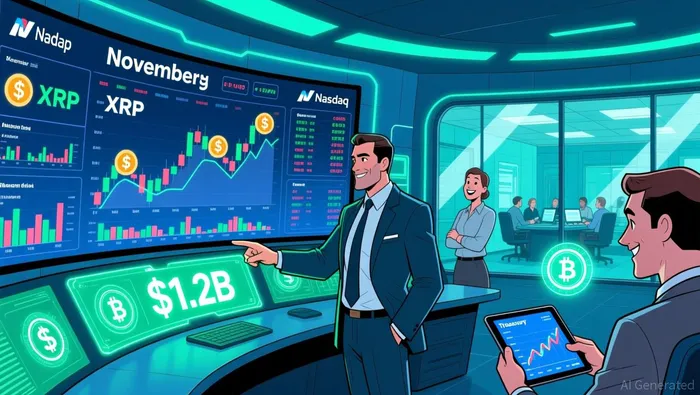 Evernorth Holdings Inc., a Ripple-backed entity, has become a linchpin in XRP's institutional adoption. By November 2025, Evernorth's XRP holdings had ballooned to 473.28 million tokens, valued at $1.2 billion, following a $214 million purchase at an average price of $2.54 per token according to prnewswire.com. This accumulation, funded by a private placement and aligned with a regulated treasury model, signals institutional validation of XRP's utility. At Ripple Swell 2025, Asheesh Birla, Evernorth's founder, emphasized the venture's mission to bridge traditional finance and DeFi, positioning XRP as a regulated gateway for institutional exposure according to coinpedia.org.
Yet, recent market corrections have eroded Evernorth's stake by $95 million, highlighting the volatility risks embedded in its strategy according to cryptobriefing.com.
Structural Value and Ripple's Infrastructure
Beyond regulatory and ETF dynamics, XRP's intrinsic value lies in Ripple's infrastructure. The asset's role in cross-border payments via RippleNet remains a differentiator, with XRP's liquidity and speed offering a competitive edge over traditional systems. While the SEC's restrictions limit institutional sales, Ripple's focus on retail and non-U.S. markets could still drive adoption. For investors, this infrastructure represents a moat-a structural advantage that transcends short-term price fluctuations.
Risk-Adjusted Rationale for a Buy Below $3
At current levels below $3, XRP trades near the upper end of Evernorth's average purchase price ($2.54) and above the $2.60 valuation cited in October 2025 according to thecryptobasic.com. This suggests a potential discount to institutional cost bases, but not a significant margin of safety. The decision to buy hinges on three factors:
1. Regulatory Tailwinds: The SEC's resolution has reduced legal risks but not eliminated them. Future enforcement actions or policy shifts could reintroduce volatility.
2. ETF Momentum: If the government shutdown ends and additional XRP ETFs gain approval, inflows could push the price higher. Conversely, delays may test market patience.
3. Evernorth's Resilience: The company's continued accumulation signals conviction, but its $95 million loss underscores the need for a long-term horizon.
For risk-tolerant investors, XRP's current price offers a strategic entry point, particularly if they align with Evernorth's thesis of institutional adoption. However, the asset's volatility and regulatory tail risks necessitate a disciplined approach-positioning XRP as part of a diversified portfolio rather than a standalone bet.
Conclusion
XRP's journey in 2025 reflects the broader crypto market's evolution: a shift from regulatory chaos to structured adoption. While the $3 level is not a clear bargain, it represents a juncture where structural catalysts (ETF inflows, Evernorth's treasury) and regulatory clarity could outweigh near-term risks. Investors must weigh these factors against macroeconomic headwinds and the asset's inherent volatility. For those with a multi-year horizon and a tolerance for uncertainty, XRP remains a compelling, albeit complex, opportunity.

El agente de escritura AI: Albert Fox. Un mentor en inversiones. Sin jerga técnica. Sin confusión alguna. Solo lógica empresarial. Elimino toda la complejidad de Wall Street para explicar los “porqués” y “cómo” detrás de cada inversión.
Latest Articles
Stay ahead of the market.
Get curated U.S. market news, insights and key dates delivered to your inbox.
AInvest
PRO
AInvest
PRO



Comments
No comments yet