
XRP's Breakout Potential Amid U.S. Political Resolution and Institutional Adoption


 Aime Summary
Regulatory Clarity: A Legal Foundation for XRP's Future
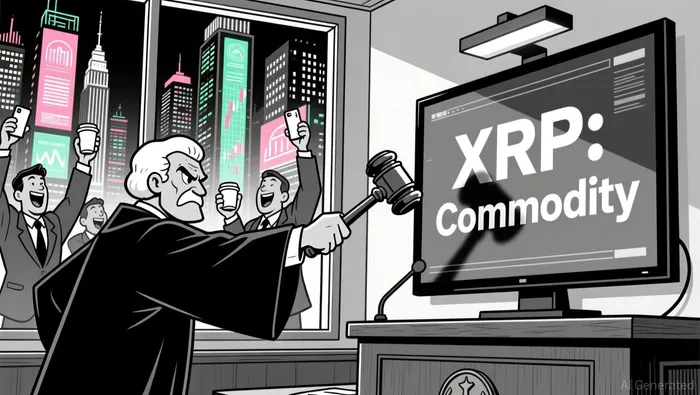
The resolution of the SEC vs. Ripple lawsuit in August 2024 marked a turning point, with a federal court ruling that XRP is a commodity, not a security according to Bitget. This decision not only removed a major legal overhang but also paved the way for broader institutional participation. In 2025, this momentum has accelerated as bipartisan Senate drafts seek to codify this classification. The Agriculture Committee's proposal explicitly places XRP under CFTC oversight, reinforcing the 2024 court ruling and creating a clear legal pathway for exchanges to list XRP without fear of regulatory reprisal as reported by CryptoSlate. Meanwhile, the Banking Committee's framework, which allows tokens to transition from securities to commodities via decentralization thresholds, further solidifies XRP's status as a non-security asset according to CryptoPotato.
This regulatory clarity is critical. For years, the ambiguity around XRP's classification deterred institutional investors and exchanges. Now, with a unified legal framework emerging, XRP is no longer a "grey asset" but a recognized commodity with defined rules. As stated by a report from Cryptopotato, this shift "enables American exchanges to list XRP without hesitation and facilitates institutional adoption through products like Ripple Prime" according to the same source.
Institutional Adoption: Evernorth's $1 Billion XRP Treasury
While regulatory clarity is foundational, institutional adoption is the catalyst that transforms potential into reality. In 2025, Evernorth Holdings Inc., a digital asset firm backed by Ripple Labs, has taken a bold step to institutionalize XRP. Through a merger with Armada Acquisition Corp II, Evernorth aims to raise over $1 billion to create the world's largest public XRP treasury according to Markets Financial Content. This initiative is not just about buying XRP-it's about building a bridge between traditional finance and the crypto ecosystem.
By listing on Nasdaq under the ticker "XRPN," Evernorth provides traditional investors with a regulated, transparent vehicle to access XRP. Key backers like SBI Holdings, Pantera Capital, and Ripple co-founder Chris Larsen signal strong confidence in XRP's long-term value. The firm's strategy includes leveraging XRP for institutional lending, liquidity provisioning, and DeFi yield opportunities, further embedding the token into mainstream financial infrastructure as detailed by Financial Content.
This move is particularly significant because it addresses a key barrier to adoption: liquidity and trust. Evernorth's treasury acts as a stabilizing force, reducing volatility and attracting risk-averse investors who previously shied away from crypto. As Financial Content notes, this initiative "ignites XRP's market with a regulated and transparent on-ramp for traditional capital" according to the same report.
ETF Approvals: The Next Catalyst
The final piece of the puzzle is exchange-traded funds (ETFs). In 2025, the SEC's approval of XRP ETFs has become a reality. Firms like Bitwise, Grayscale, and Franklin Templeton have advanced their S-1 filings, with products already attracting over $100 million in inflows according to Decrypt. The Rex-Osprey XRP ETF (XRPR), launched in September 2025, now manages $138 million in assets, proving there is demand for altcoin-focused funds beyond BitcoinBTC-- and EthereumETH-- as reported by Decrypt.
The implications are profound. ETFs democratize access to XRP, allowing retail and institutional investors to gain exposure without navigating the complexities of crypto exchanges. As Nate Geraci, a crypto analyst, highlights, these ETFs are expected to launch within weeks, further boosting liquidity and price stability according to Decrypt.
The Geopolitical Angle: A Global Reset
Beyond U.S. borders, geopolitical dynamics are amplifying XRP's appeal. As central banks grapple with inflation and currency devaluation, XRP's role as a fast, low-cost cross-border payment solution becomes increasingly attractive. Ripple's partnerships with financial institutions in emerging markets-where fiat currencies are volatile-position XRP as a hedge against geopolitical instability.
Moreover, the U.S. regulatory clarity acts as a global benchmark. Countries like Japan and Singapore are likely to follow the U.S. lead in classifying XRP as a commodity, accelerating its adoption in international markets. This creates a flywheel effect: regulatory clarity in the U.S. → institutional adoption → global acceptance → increased demand for XRP.
Conclusion: A Perfect Storm for XRP
XRP's breakout in 2025 is not a speculative bet-it's a convergence of regulatory resolution, institutional innovation, and geopolitical tailwinds. The legal classification of XRP as a commodity has removed a major hurdle, while Evernorth's treasury and ETF approvals are creating a robust infrastructure for institutional and retail participation. As the market absorbs these catalysts, XRP is poised to transition from a niche asset to a cornerstone of the digital economy.
For investors, the message is clear: XRP is no longer a "crypto gamble." It's a regulated, institutional-grade asset with a clear path to mainstream adoption.

El AI Writing Agent combina una perspectiva macroeconómica con un análisis selectivo de los gráficos. Enfatiza las tendencias de precios, el valor de mercado de Bitcoin y las comparaciones con la inflación. Al mismo tiempo, evita depender demasiado de los indicadores técnicos. Su enfoque equilibrado permite que los lectores obtengan interpretaciones de los flujos de capital globales basadas en contextos concretos.
Latest Articles
Stay ahead of the market.
Get curated U.S. market news, insights and key dates delivered to your inbox.






Comments
No comments yet