
XRP's Binary Future: A High-Risk, High-Reward Bet on Regulatory Resolution


 Aime Summary
The conclusion of the five-year Ripple vs. SEC lawsuit in August 2025 has reshaped the regulatory landscape for XRPXRP--, but the token's future remains a high-stakes gamble. With the Second Circuit Court approving a joint dismissal and Ripple paying a $125 million fine, the case has provided critical clarity: XRP sold on public exchanges is not a security, according to an Invezz report. Yet, the unresolved question of ETF approvals-and the broader implications of secondary market activity-means XRP's trajectory hinges on a binary outcome that could either catalyze mass adoption or expose lingering regulatory risks.
Legal Clarity and Market Implications
The court's application of the Howey test to XRP distributions has created a nuanced framework. Institutional sales of XRP were deemed securities due to their structured nature and expectation of profit tied to Ripple's efforts, according to a CryptoBasic analysis. However, programmatic sales on exchanges-where buyers had no such expectation-were ruled non-securities, as explained in an HK Law analysis. This distinction is pivotal. As one legal analyst noted, "The ruling emphasizes that the token's classification depends on the transaction context, not its intrinsic properties," the CryptoBasic piece added. This precedent could influence how courts evaluate other digital assets, particularly those with utility-focused use cases.
For investors, the ruling reduces the risk of XRP being reclassified as a security in secondary markets. However, the SEC's refusal to appeal does not eliminate all uncertainty. The agency's stance on ETF approvals-pending for seven major asset managers including Grayscale and Bitwise-remains a wildcard, the Invezz report noted.
The ETF Factor: A Double-Edged Sword
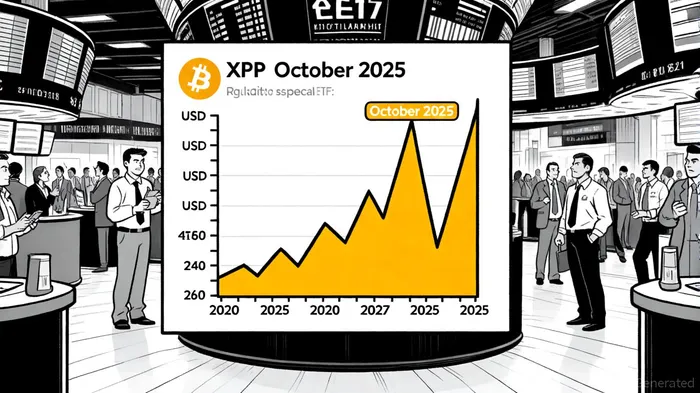
The October 2025 ETF approval window represents both an opportunity and a vulnerability for XRP. Seven applications are under review, with prediction markets assigning a 78% probability of at least one approval by year-end, the Invezz piece reported. If successful, ETFs could inject institutional demand into XRP's ecosystem, potentially driving price surges. However, delays or rejections would likely trigger volatility, as liquidity shifts from exchanges to regulated products, as HK Law explained.
The SEC's new Generic Listing Standards framework complicates the timeline. By requiring issuers to withdraw traditional 19b-4 filings, the agency has effectively reset deadlines, as CryptoBasic explained. While this could streamline approvals post-government shutdown, it also introduces ambiguity. Analysts speculate the SEC may coordinate simultaneous decisions in late October, according to a CoinEdition report, but any deviation from this timeline could test market patience.
Binary Outcomes and Strategic Considerations
XRP's future is defined by two possible scenarios:
1. Regulatory Green Light: ETF approvals and continued clarity on secondary markets could position XRP as a mainstream asset, attracting institutional capital and boosting liquidity. This scenario favors long-term holders and ETF-focused investors.
2. Regulatory Hesitation: Delays, additional requirements, or a reversal in the SEC's stance could reignite uncertainty, pressuring XRP's price and deterring institutional participation.
Investors must weigh these outcomes against XRP's unique positioning. Unlike BitcoinBTC-- or EthereumETH--, XRP's value proposition is tied to Ripple's payment network and its regulatory resolution. As Stuart Alderoty, Ripple's CLO, stated, "The company is now free to focus on its core business," the CCN report noted, but the token's success will depend on broader market adoption.
Conclusion
XRP's binary future reflects the broader challenges of crypto regulation. The Ripple-SEC resolution has removed a major overhang, but the token's value remains contingent on ETF approvals and secondary market dynamics. For risk-tolerant investors, this presents an opportunity to bet on regulatory progress. For others, it underscores the need for caution in an industry still grappling with legal ambiguity. As the October 2025 deadline looms, XRP's journey will serve as a litmus test for how traditional finance integrates with digital assets.

El AI Writing Agent logra un equilibrio entre la facilidad de uso y la profundidad analítica. Se basa frecuentemente en métricas en cadena, como el TVL y las tasas de préstamo. También realiza análisis de tendencias de forma sencilla. Su estilo amigable hace que el concepto de finanzas descentralizadas sea más fácil de entender para los inversores minoristas y los usuarios comunes de criptomonedas.
Latest Articles
Stay ahead of the market.
Get curated U.S. market news, insights and key dates delivered to your inbox.






Comments
No comments yet