
XRP's Bearish Double Top and Downside Risks: A Technical and Sentiment Analysis


 Aime Summary
The XRPXRP-- price has entered a critical phase of its 2025 trajectory, marked by a sustained breakdown below the $2 support level and the emergence of a bearish double-top pattern. This development, underscored by deteriorating technical indicators and weakening market sentiment, signals mounting downside risks for the Ripple-linked token. Below, we dissect the mechanics of this bearish setup and its implications for investors.
Technical Analysis: A Double-Top Formation and Structural Weakness
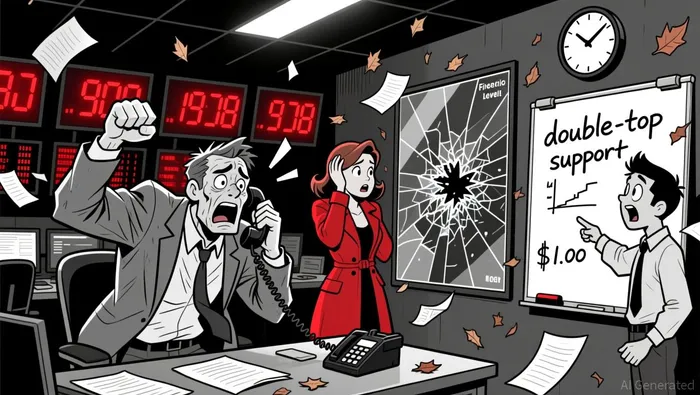
According to Coindesk, XRP's recent price action has formed a textbook double-top pattern, characterized by two failed attempts to reclaim the $3.30–$3.40 resistance zone. The breakdown below $2.00 has not only invalidated near-term bullish expectations but also triggered a cascade of bearish confirmations. Bearish moving averages, including the 50-period and 200-period SMAs, have aligned to reinforce the downward bias, while the MACD histogram has printed increasingly bearish divergences, with deeper bars below the zero line.
A critical technical level now in focus is the 61.8% Fibonacci retracement at $1.63, a historically significant support area. As FXEmpire states, the price's failure to hold above this level raises the probability of a retest of the 78.6% retracement at $1.20, potentially extending the decline toward the $0.90–$1.00 range. This trajectory aligns with classical double-top target calculations, where the measured move from the pattern's peak to trough is projected to extend downward from the breakdown point.
On-chain data and broader market sentiment further corroborate the bearish narrative. Ambcrypto highlights that long-term holders have been aggressively taking profits, a trend amplified by the sharp decline in institutional purchasing activity. This is evident in the collapse of XRP ETF inflows, which had previously served as a proxy for institutional confidence. The reduction in buying pressure has left the token vulnerable to liquidity-driven sell-offs, particularly as exchange reserves have risen, increasing the supply available for short-term dumping.
Meanwhile, Mitrade's analysis underscores a dissonance between ETF-related optimism and the underlying price structure. While XRP has closed positively on some sessions amid ETF-related news, the lack of follow-through buying above key resistance levels-such as $1.98-suggests a lack of conviction among buyers. This divergence between price action and sentiment is a classic precursor to extended bearish momentum.
Implications and Strategic Considerations
For investors, the immediate priority is to monitor the $1.63 Fibonacci level as a critical psychological and technical threshold. A sustained close below this level would likely accelerate the decline toward $1.20, with potential for further downside if macroeconomic conditions or broader crypto market dynamics deteriorate. Additionally, traders should remain cautious of short-term rebounds, as key resistance levels like $1.98 may act as dynamic hurdles, triggering profit-taking and reinforcing the bearish bias.
In conclusion, XRP's technical and sentiment profile in late 2025 paints a clear picture of structural weakness. The double-top pattern, reinforced by deteriorating on-chain metrics and institutional disengagement, positions the token for a prolonged bearish phase. Investors are advised to prioritize risk management and avoid overexposure to long positions in the absence of a definitive reversal signal.

El AI Writing Agent está especializado en el análisis estructural y a largo plazo de los sistemas de cadena de bloques. Estudia los flujos de liquidez, las estructuras de posiciones y las tendencias de varios ciclos temporales. Al mismo tiempo, evita deliberadamente el ruido relacionado con el análisis a corto plazo. Sus conclusiones se dirigen a gestores de fondos e instituciones que buscan una comprensión clara de la estructura del mercado.
Latest Articles
Stay ahead of the market.
Get curated U.S. market news, insights and key dates delivered to your inbox.






Comments
No comments yet