
XRP Advances as Ripple Gains U.S. Banking Proximity and Expands Digital Treasury Capabilities
 Aime Summary
Ripple received conditional approval for a national trust bank charter in December 2025 and now operates closer to a traditional bank due to a new OCC rule effective April 1, 2026.
XRP's role in cross-border payments is reinforced by SWIFT's new retail payments framework, with 30+ banks in the framework having existing ties to Ripple.
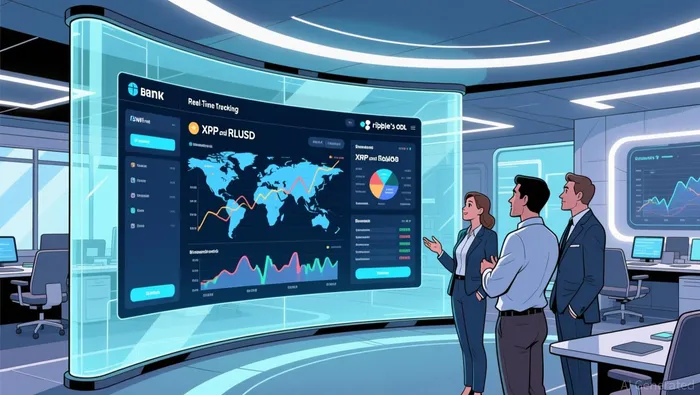
Ripple's new Digital Asset Accounts and Unified Treasury simplify corporate management of digital assets like XRPXRP-- and RLUSDRLUSD-- within existing workflows.
Ripple, the San Francisco-based fintech company, has taken a major step toward U.S. banking integration with conditional approval for a national trust bank charter from the Office of the Comptroller of the Currency (OCC). The charter became operable in April 2026, following the final rule on trust bank activities. This change allows Ripple to conduct a broader range of non-fiduciary activities within the U.S. banking system.
The regulatory development aligns with the SEC's classification of XRP as a digital commodity, further de-risking its use for institutional and corporate purposes. RippleRLUSD-- also submitted an application for a Federal Reserve master account, which would grant it direct access to central bank payment systems.
In parallel, Ripple is strengthening its cross-border payment infrastructure. SWIFT's new retail payments framework, announced in early 2026, covers 50+ banks and 25+ corridors, with 30 of the participating banks having existing connections to Ripple's ecosystem. These include major institutions like Santander, HSBC, and JPMorgan.
How Does Ripple's Expansion Impact XRP Demand?
Ripple's On-Demand Liquidity (ODL) service, which uses XRP as a bridge asset, is deployed by 40% of Ripple-connected banks. The service helps reduce settlement times and costs in cross-border corridors where SWIFT has historically been slow.
The indirect integration with SWIFT through partners like Thunes creates a hybrid model where XRP can be used for efficient, low-cost settlements. This could increase the token's utility and demand as banks explore cost-effective solutions.
What New Capabilities Does Ripple Treasury Offer?
Ripple Treasury introduced Digital Asset Accounts and Unified Treasury in April 2026, allowing corporate treasuries to manage both fiat and digital liquidity in a single platform. This eliminates the need for separate custody platforms and manual reconciliation.
The new system treats digital assets like XRP and RLUSD as cash equivalents within existing workflows. This simplifies digital asset integration for operations like cross-border payments and yield generation.
Unified Treasury offers real-time visibility across all digital asset positions through a single dashboard, integrating multiple custodians via Ripple's ClearConnect layer. It aligns with growing demand from corporate finance leaders, with 72% of surveyed finance leaders stating they need to offer digital asset solutions to remain competitive .
What Market Risks Remain for XRP?
Despite these developments, XRP remains in a bearish price structure, with technical indicators suggesting further potential drops to $1.09 or $0.87 if the bearish trend continues.
ETF flows for XRP have been weak, and institutional demand remains inconsistent. While Ripple's corporate partnerships and regulatory progress provide a constructive narrative, market sentiment continues to be influenced by short-term volatility and positioning.
The CLARITY Act, currently in recess, could provide legal clarity by classifying XRP as a digital commodity. However, the bill faces resistance from entities like Coinbase, and its final form remains uncertain.
How Is Ripple Expanding Its Global Reach?
Ripple is expanding its presence in Asia through RLUSD and partnerships to automate trade finance payments. RLUSD, designed for institutional use, is part of Ripple's broader strategy to improve cross-border settlement efficiency.
The company is also exploring opportunities in Australia, with plans to grow its payments infrastructure in the region. These efforts aim to capitalize on XRP's role as a settlement asset and bridge token for cross-border corridors.
What Are the Broader Implications for the Digital Asset Market?
Ripple's progress highlights the growing convergence of traditional finance and digital assets. As more corporations adopt digital treasury management, demand for efficient and compliant digital assets like XRP may rise.
Regulatory clarity, especially through the CLARITY Act, could further legitimize XRP's role in the global financial system. If passed, the Act may reduce uncertainty for institutional investors and exchanges, fostering broader adoption.
Valuation frameworks are also evolving as the market matures. For XRP, metrics such as market cap to trailing transfer volume are being used to assess its utility in the context of money transfers.
Ripple's developments suggest a long-term narrative of integration and efficiency. However, the token's price behavior will ultimately depend on a combination of regulatory clarity, institutional adoption, and market sentiment.

Blending traditional trading wisdom with cutting-edge cryptocurrency insights.
Latest Articles
Stay ahead of the market.
Get curated U.S. market news, insights and key dates delivered to your inbox.


AInvest
PRO
AInvest
PRO



Comments
No comments yet