
XRP's $3.30 Breakout: A High-Probability On-Ramp for Institutional Bullishness


 Aime Summary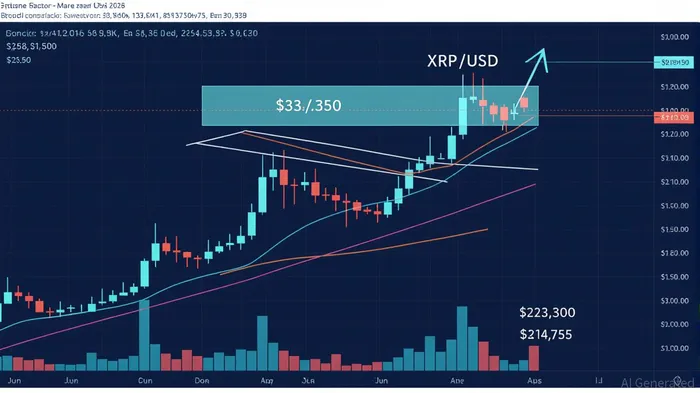
In late August 2025, XRPXRPI-- stands at a pivotal inflection pointIPCX--, with its price action and macroeconomic alignment converging to create a high-probability entry for institutional capital. The $3.30 level, long contested as a critical resistance-turned-support threshold, has emerged as a strategic catalyst for a potential multi-leg rally. A confirmed daily close above this level, supported by robust volume and institutional positioning, could validate a bullish trend reversal and redefine XRP's role in the crypto ecosystem.
Technical-Price Action Alignment: The $3.30 Breakout as a Structural Shift
XRP's recent consolidation between $2.73 and $3.30 has formed a classic bull flag pattern, a continuation formation that signals exhaustion of bearish pressure and the likelihood of a retest of historical highs. The $3.30 level is not merely a technical marker but a psychological and institutional milestone. A sustained close above this level would flip the structure to bullish, transforming it into a dynamic support base.
The 120% surge in trading volume over the past 24 hours underscores the liquidity and market participation required for a successful breakout. This volume surge reduces slippage during large orders, making it easier for institutional players to push the price beyond $3.30. On-chain data further reinforces this narrative: the Percent Supply in Profit for XRP has dropped to 93.5%, the lowest in two weeks, indicating that selling pressure is waning as more of the supply remains in profit.
Macro-Support Resilience: The $2.73 Floor as a Foundation for Accumulation
The $2.73 level has repeatedly served as a macroBMA-- support base, with its integrity intact despite multiple tests. This level aligns with the 61.8% Fibonacci retracement of XRP's recent consolidation phase, making it a critical psychological anchor. On-chain metrics such as the Network Value to Transactions (NVT) ratio, currently at a five-month low, suggest XRP's market value is undervalued relative to its transactional utility, a classic precursor to a rebound.
The Relative Strength Index (RSI) has shown a bullish divergence on the 30-minute and 1-hour charts, with XRP's price reaching $2.94 while the RSI printed higher lows. This divergence, combined with the RSI remaining in oversold territory for much of August, indicates that sellers have overextended their positions, creating a high-probability setup for a rebound. A successful defense of $2.73 would trigger a double-bottom pattern, a classic reversal formation that often precedes sustained uptrends.
Institutional Positioning and Macro Catalysts: A Convergence of Forces
The regulatory landscape has shifted dramatically in XRP's favor. The U.S. SEC's dismissal of its case against Ripple in early August 2025 removed a major overhang, enabling institutional investors to engage with XRP without legal ambiguity. This clarity has been amplified by Ripple's strategic upgrades, including EVM compatibility, tokenization protocols for real-world assets (RWAs), and the establishment of an institutional hub in New York. These developments position XRP as a foundational infrastructure asset for DeFi, cross-border payments, and CBDCs.
Whale activity has surged, with 900 million XRP (worth $2.88 billion) accumulated in just 48 hours, signaling long-term confidence. This accumulation occurs despite monthly escrow releases, reinforcing the conviction that XRP is seen as a utility-driven asset. Additionally, the growing probability of XRP ETF approval—estimated at 85% on prediction markets—adds structural demand. Seven major asset managers, including 21Shares and Grayscale, have filed for spot XRP ETFs, a move that could unlock billions in institutional capital.
Strategic Entry: Capitalizing on the $3.30 Breakout
For investors, the $3.30 level represents a binary decision point. A confirmed close above it would validate the bullish thesis and initiate a retest of the $3.84 historical high. Immediate resistance targets include $3.50 and $4.00, with a sustained close above $4 likely to shift market psychology decisively in a bullish direction.
However, caution is warranted. A failure to defend $2.95 or $2.90 could invalidate the bullish thesis and prolong consolidation or trigger a deeper pullback. Traders are advised to monitor volume dynamics and daily closure behavior to confirm the breakout's sustainability.
Conclusion: A High-Probability On-Ramp for Institutional Bullishness
XRP's $3.30 breakout in August 2025 is not merely a technical event but a confluence of macroeconomic clarity, institutional adoption, and on-chain strength. The $2.73 support floor has proven resilient, while the surge in volume and liquidity has increased the likelihood of a sustained move beyond $3.30. For investors with a medium-term horizon, this level offers a high-probability trigger for entering or adding to positions.
If XRP can maintain buyers' control and confirm the breakout with strong volume, it may not only retest its 2018 all-time high but also redefine its role in the broader crypto ecosystem. The next two weeks will be critical in determining whether this is the beginning of a multi-month bull run or a temporary consolidation phase. For now, the data suggests that the optimal juncture for capitalizing on XRP's potential lies in strategic entry at $3.30, supported by the convergence of technical, macro, and institutional forces.

Decoding blockchain innovations and market trends with clarity and precision.
Latest Articles
Stay ahead of the market.
Get curated U.S. market news, insights and key dates delivered to your inbox.


AInvest
PRO
AInvest
PRO



Comments
No comments yet