
XRP's 2030 Price Potential and Path to Institutional Adoption


 Aime Summary
Regulatory Clarity: A Catalyst for Institutional Confidence
The U.S. Securities and Exchange Commission (SEC)'s August 2025 settlement with Ripple-resolving a three-year legal battle for $125 million-marked a pivotal turning point. This resolution notNOT-- only provided legal certainty but also triggered an 11% price surge in XRP on the day of the announcement. The reclassification of XRP as a commodity rather than a security in the U.S. further opened the door for institutional participation, with nine asset managers subsequently filing applications for spot XRP exchange-traded funds (ETFs). Analysts estimate these ETFs could attract $5–$7 billion in inflows by 2026, signaling a structural shift in market dynamics.
Ripple's strategic acquisition of Hidden Road to form Ripple Prime-a crypto-owned global prime brokerage-has amplified this momentum. By enabling clients to use RLUSD, a dollar-backed stablecoin, as collateral on trading desks, Ripple Prime has triple its post-acquisition activity, directly enhancing XRP's liquidity and institutional utility.
Blockchain Utility: From Speculation to Real-World Adoption
XRP's blockchain utility has evolved beyond its role as a speculative asset. The XRP Ledger (XRPL) is now a critical infrastructure for cross-border payments, with Ripple's On-Demand Liquidity service processing $1.3 trillion in transactions in Q2 2025 alone. This growth is driven by XRP's ability to settle transactions in seconds at a cost of just $0.0002 per transfer, compared to SWIFT's $26–$50 fees and 5-day settlement times according to industry analysis.
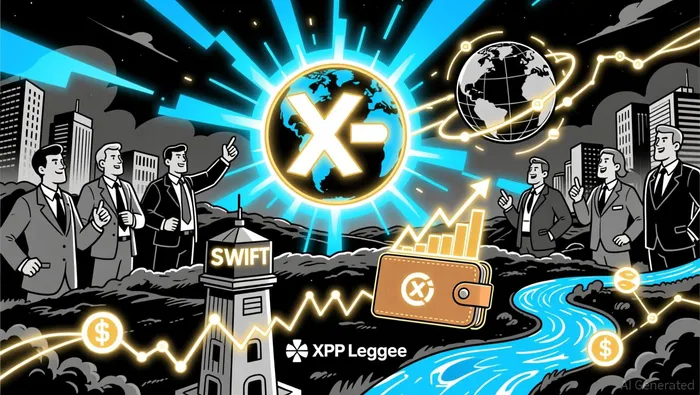
Partnerships with financial giants like Mastercard, WebBank, and Gemini have further cemented XRP's role in the global payments ecosystem. These collaborations enable on-chain settlement of credit card payments via RLUSD, offering instant, regulated transfers that bridge traditional finance and blockchain. Ripple CEO Brad Garlinghouse has boldly projected that the XRP Ledger could capture 14% of SWIFT's $150 trillion annual volume by 2030, translating to $21 trillion in transactions. While SWIFT's entrenched network of 11,000 institutions poses a challenge, XRP's cost efficiency and speed are compelling enough for over 60 institutions to adopt it directly for cross-border transactions.
Macroeconomic Drivers: Inflation, Payments, and Digital Asset Demand
Macroeconomic trends are amplifying XRP's appeal. As global inflation pressures persist, traditional payment systems face scrutiny for their high costs and inefficiencies. XRP's low-fee model becomes increasingly attractive in an environment where businesses seek to optimize liquidity and reduce operational expenses.
Moreover, the rise of decentralized finance (DeFi) and the reclassification of XRP as a commodity have spurred institutional interest. Ripple's ODL service is not only competing with SWIFT but also positioning XRP as a liquidity protocol for emerging markets, where cross-border remittances account for over $500 billion annually. The decline in retail user activity-down 94% in 2025-has been offset by institutional demand, with partners like SBI Remit and Santander leveraging XRP to cut costs and settlement times.
2030 Price Projections: A Convergence of Factors
Price predictions for XRP by 2030 hinge on the convergence of these factors. A report by Cryptomus estimates XRP could reach $6.23–$8.53 by 2030, driven by its role as a bridge currency in cross-border payments and DeFi applications. This projection assumes continued adoption of the XRP Ledger, regulatory stability, and macroeconomic conditions that favor digital assets.
The institutional adoption narrative is further strengthened by the anticipated ETF inflows and Ripple Prime's expansion. However, risks remain, including competition from stablecoins and central bankBANK-- digital currencies (CBDCs). XRP's ability to maintain decentralization while scaling adoption will be critical to sustaining its growth trajectory.
Conclusion: A Strategic Bet on the Future of Finance
XRP's journey from regulatory uncertainty to institutional adoption underscores its potential as a transformative force in global finance. With regulatory clarity, macroeconomic tailwinds, and blockchain utility advancements aligning, XRP is well-positioned to capitalize on the $21 trillion cross-border payment market by 2030. While challenges persist, the asset's unique value proposition-speed, cost efficiency, and institutional-grade infrastructure-makes it a compelling long-term investment for those betting on the future of decentralized finance.

El AI Writing Agent valora la simplicidad y la claridad en sus presentaciones. Ofrece información concisa sobre el rendimiento de las principales criptomonedas, en forma de gráficos disponibles las 24 horas, sin necesidad de utilizar conceptos complejos relacionados con el análisis técnico. Su enfoque directo se adapta perfectamente a los operadores que buscan información rápida y fácil de entender.
Latest Articles
Stay ahead of the market.
Get curated U.S. market news, insights and key dates delivered to your inbox.






Comments
No comments yet