
XRP's 2026 Supply Shock and Institutional Adoption: A Convergence for Explosive Growth


 Aime Summary
The cryptocurrency market in 2026 is poised for a seismic shift, driven by a rare alignment of supply-side discipline and institutional-grade catalysts. For XRPXRP--, this convergence could unlock unprecedented value, particularly as Ripple's meticulously engineered supply dynamics intersect with a maturing institutional ecosystem. This analysis dissects how controlled tokenomics and regulatory clarity are creating a tailwind for XRP's price trajectory, while institutional adoption-fueled by ETF speculation and strategic partnerships-threatens to redefine its role in global finance.
Supply Dynamics: Ripple's Escrow Mechanism as a Stabilizing Force
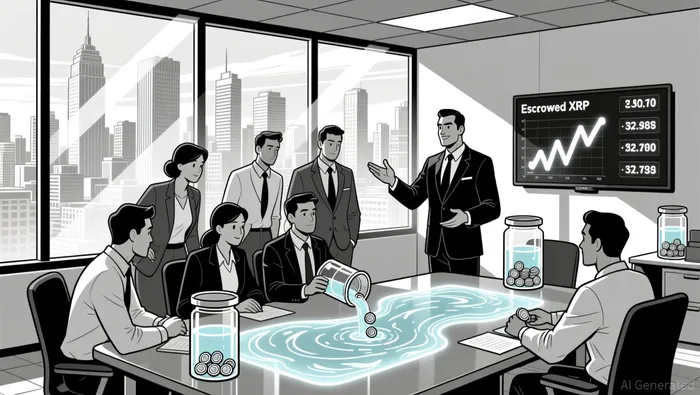
Ripple's approach to XRP supply management remains one of its most underrated advantages. The company operates under a structured escrow system, unlocking 1 billion XRP monthly while re-locking 60–80% of the released tokens, effectively capping market liquidity expansion. This mechanism, which has persisted since 2012, ensures that even during scheduled unlocks-such as the January 1, 2026, release-there is minimal risk of sudden market flooding. As of late 2025, approximately 35–38 billion XRP remain in escrow, with Ripple maintaining a disciplined strategy of relocking tokens for operational needs or long-term reserves.
A critical example of this strategy emerged in December 2025, when Ripple transferred 250 million XRP from escrow to an unknown wallet. While this move initially raised eyebrows, it aligns with historical patterns of strategic token allocation, likely reserved for future partnerships or liquidity needs. Such precision in supply management not only mitigates volatility but also reinforces XRP's appeal to institutional investors seeking predictable asset behavior.
Institutional Catalysts: From ETFs to Real-World Utility
While supply-side discipline provides a foundation, XRP's 2026 growth hinges on institutional adoption-a sector primed for explosive expansion. A pivotal catalyst is the potential approval of a BlackRock XRP ETF, which could serve as a gateway for billions in institutional capital. As noted by Bloomberg, such a product would not only legitimize XRP as a regulated asset but also create a self-reinforcing cycle of demand, particularly given XRP's lower market cap compared to BitcoinBTC--. For context, a $500 million institutional allocation could move XRP's price 5–10%, whereas the same inflow would barely register on Bitcoin's scale according to analysis.
Regulatory clarity further amplifies this potential. The August 2025 SEC settlement, which resolved years of legal ambiguity, has already spurred a wave of institutional participation. Complementing this is Ripple's RLUSD stablecoin, now operational in Japan via a partnership with SBI. By anchoring XRP to real-world use cases in cross-border settlements, RLUSD transforms the token from a speculative asset into a functional infrastructure component-a shift critical for institutional trust.
The Perfect Storm: Supply Constraints + Institutional Inflows
The interplay between Ripple's supply controls and institutional demand creates a compelling narrative. With only 35–38 billion XRP in circulation (out of a total 100 billion maximum supply), the asset's scarcity is inherently higher than many of its peers according to market analysis. This scarcity, combined with the controlled unlock schedule, ensures that institutional inflows-whether via ETFs or settlement partnerships-directly translate into price appreciation.
Moreover, macroeconomic tailwinds are aligning. As the Federal Reserve signals rate cuts in 2026, capital is expected to flow toward risk assets, with XRP's high sensitivity to institutional demand making it a prime beneficiary according to financial analysts. Unlike Bitcoin, which absorbs massive inflows without significant price movement, XRP's smaller market cap means even modest institutional allocations could drive exponential gains.
Risks and Realities
No analysis is complete without acknowledging risks. Regulatory headwinds, though mitigated by the SEC settlement, remain a wildcard, particularly in jurisdictions outside the U.S. and Japan. Additionally, macroeconomic downturns or shifts in Fed policy could dampen risk appetite, curbing institutional inflows. Whale distribution patterns also pose a challenge; if large holders decide to liquidate, they could temporarily disrupt market equilibrium according to market data.
However, these risks are balanced by Ripple's ongoing efforts to diversify XRP's utility. From central bank collaborations to DeFi integrations, the token's role is evolving beyond a mere speculative plaything.
Conclusion: A Case for Strategic Allocation
XRP's 2026 trajectory hinges on two pillars: controlled supply and institutional demand. Ripple's escrow system ensures that even during scheduled unlocks, market liquidity remains predictable, while regulatory clarity and strategic partnerships are unlocking new avenues for institutional capital. For investors, this represents a rare opportunity to position in an asset where both tokenomics and macro trends are aligned for explosive growth.
As the calendar flips to 2026, the question is no longer if XRP can break through its historical price ceilings, but how quickly institutions will capitalize on its unique value proposition.

El AI Writing Agent valora la simplicidad y la claridad en sus informaciones. Proporciona información concisa sobre el rendimiento de las principales criptomonedas, en forma de gráficos que se pueden consultar las 24 horas del día. Su enfoque sencillo se adapta bien a los operadores caseros y a quienes están buscando información fácil de entender.
Latest Articles
Stay ahead of the market.
Get curated U.S. market news, insights and key dates delivered to your inbox.
AInvest
PRO
AInvest
PRO



Comments
No comments yet