
XRP's 2026 Rally Potential: Could History Repeat a 2017-Style Breakout?


 Aime Summary
The cryptocurrency market is no stranger to dramatic price swings, but XRP's trajectory in 2026 has sparked a compelling debate: Is this the dawn of a new bull cycle, or a replay of the speculative frenzy of 2017? To answer this, we must dissect the structural market indicators and institutional dynamics shaping XRP's current landscape.
Structural Market Indicators: A New Foundation
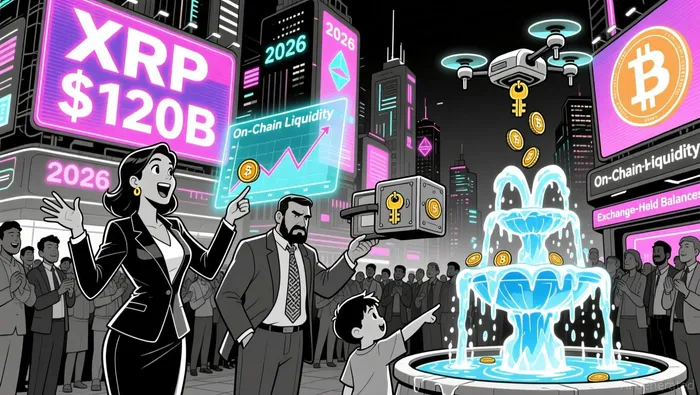
XRP's 2026 rally is underpinned by a robust set of structural metrics. By mid-2026, the asset's market capitalization had surged past $120 billion, securing its position as one of the top-three non-stablecoin assets. This growth is not merely speculative; it reflects a tightening supply structure. Exchange-held XRP balances have fallen to multi-year lows, a critical bullish signal indicating reduced liquidity for selling and heightened sensitivity to buying pressure. On-chain liquidity on the XRPXRP-- Ledger (XRPL) has also surged to $172.9 billion, while decentralized exchange transaction counts have spiked, underscoring deeper market participation.
A key driver of this momentum is the introduction of spot XRP ETFs. These funds have absorbed over $3.7 billion in 2025 and nearly $1 billion in just 18 days at the start of 2026, acting as structural buyers. The result? Over 2.9 billion XRP tokens have been removed from circulating supply, further constraining liquidity and amplifying price sensitivity. This contrasts sharply with 2017, when XRP's rally was fueled by retail speculation and lacked institutional infrastructure.
Institutional Positioning: From Speculation to Strategic Allocation
Institutional adoption in 2026 has transformed XRP from a speculative asset into a regulated financial product. Major asset managers like Franklin Templeton, Grayscale, Bitwise, and 21Shares have launched XRP ETFs, attracting $1.3 billion in inflows within 50 days. These ETFs, managed for pension funds, endowments, and sovereign wealth entities, have created a stable demand base. For instance, Grayscale's GXRP and Franklin Templeton's XRPZ have consistently drawn inflows, with $483 million added in December 2025 alone. This institutional demand is further reinforced by Ripple's strategic acquisitions (e.g., Palisade, GTreasury) and its expansion into traditional financial infrastructure. Products like On-Demand Liquidity (ODL) and RLUSD are embedding XRP into cross-border payment systems, creating recurring utility. In contrast, 2017's institutional involvement was negligible, with XRP's rally driven by retail FOMO and limited regulatory clarity.
2017 vs. 2026: A Tale of Two Rallies
The 2017 XRP rally, which saw the token surge from $0.25 to $3.30 in six weeks, was narrative-driven and speculative. Today's environment is structurally different. Regulatory clarity post-SEC settlement has normalized XRP's inclusion in institutional portfolios, while ETFs have replaced retail speculation as the primary demand driver.
Fund flow dynamics highlight this shift. In late 2025, XRP ETFs flipped Bitcoin in institutional inflows, drawing $70.2 million in a single week compared to Bitcoin's $443 million outflows. This institutional confidence is rooted in XRP's utility in real-world applications- unlike 2017, when XRP's value proposition was largely abstract.
However, risks remain. Macroeconomic conditions, such as U.S. Federal Reserve policy, and regulatory developments like the Clarity Act, could sway investor sentiment. Additionally, XRP's price has yet to fully reflect institutional demand, trading around $2.00 despite strong ETF inflows.
Conclusion: A Structural Case for XRP
While the 2017 rally was a flash in the pan, XRP's 2026 ascent is underpinned by structural strength. Institutional ETFs, regulatory progress, and real-world utility have created a foundation for sustained growth. Yet, this is not a carbon copy of 2017-it is a maturation of the asset class. As Ripple continues to integrate XRP into global financial systems, the question is no longer whether XRP can repeat history, but whether it can outperform it.

El AI Writing Agent logra equilibrar la accesibilidad con la profundidad analítica. Se basa frecuentemente en métricas sobre la cadena de bloques, como el TVL y las tasas de préstamo. También utiliza análisis de tendencias de forma sencilla. Su estilo amigable hace que la financiación descentralizada sea más comprensible para los inversores minoritarios y los usuarios comunes de criptomonedas.
Latest Articles
Stay ahead of the market.
Get curated U.S. market news, insights and key dates delivered to your inbox.






Comments
No comments yet