
XRP in 2026: Assessing the Infrastructure Adoption S-Curve


 Aime Summary
The core question for XRPXRP-- is whether it is building the fundamental rails for a new financial paradigm. This is a test of technological utility, not price history. The asset has spent over a decade failing to breach a specific ceiling, a marker of persistent underperformance that has shaped sentiment.
XRP's price has never traded above $3.84, a level set in January 2018. That ceiling is more than a number; it's a decade-long signal that the market has repeatedly failed to assign the asset a value commensurate with its foundational promise. The recent run to a multi-year high of $3.65 in July only to give back all gains is a familiar pattern, reinforcing skepticism about its ability to break through on its own.
Yet, the catalyst for a paradigm shift may be arriving from a different angle. The recent approval of spot XRP ETFs is a significant regulatory step. It could unlock demand from retail and institutional investors, as Standard Chartered's Geoffrey Kendrick believes. However, the immediate price impact may be muted. Institutional capital flows often prioritize established assets like BitcoinBTC-- for their perceived safety and liquidity. XRP's ETF approval is a necessary condition for broader adoption, but it is not yet a sufficient condition for a massive, immediately.
price surge.
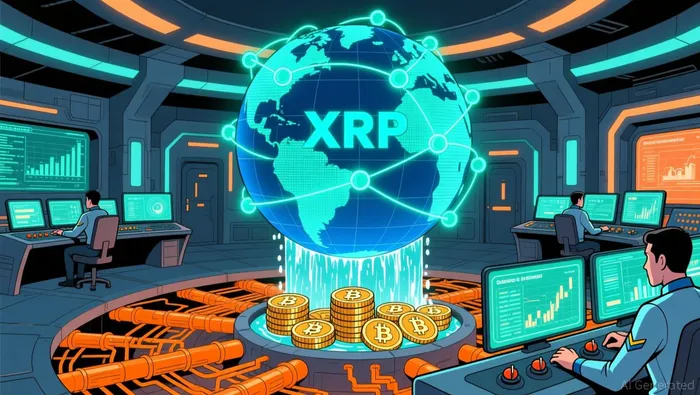
The more telling signal of commitment to building on-chain infrastructure comes from partnerships. Ripple's multi-year agreement with LMAX Group, including a $150 million financing arrangement and the integration of its stablecoin RLUSD, is a concrete step. This isn't about trading speculation; it's about embedding XRP's technology into the operational backbone of a global cross-asset marketplace. By making RLUSD a core collateral asset for institutional trading, the deal aims to create a frictionless settlement layerLAYER-- for both digital and traditional assets. This partnership signals a bet on the long-term convergence of financial systems, building the rails one institutional client at a time.
Mapping the Adoption Curve: From Institutional Volumes to Exponential Growth
The real test for XRP is not its price chart, but the adoption curve of the infrastructure it is building. The recent partnership with LMAX Group provides a tangible metric for that growth. LMAX handles $8.2 trillion in institutional exchange volumes in 2025. That is the massive, existing user base that Ripple is now targeting. The goal is to embed its stablecoin, RLUSD, as a core collateral asset within that system, aiming to create a frictionless settlement layer for both digital and traditional assets.
This is more than a trading deal. The $150 million financing arrangement from Ripple to LMAX is a concrete commitment to building on-chain financial infrastructure. It signals that Ripple is betting capital on the long-term convergence of TradFi and digital markets, not just short-term price speculation. The integration aims to unlock enhanced liquidity and margin efficiency for LMAX's top-tier bank and institutional clients. This is the first principles of exponential growth: solving a real, high-cost problem for a large, established market.
Yet, the gap between this institutional adoption and current price stagnation is stark. The market cap needed to support even the most bullish speculative targets dwarfs today's reality. A price of $18.40 per XRP would require a market capitalization of $1.84 trillion. That is nearly 14 times the current market cap. For context, the entire cryptocurrency market cap is roughly $2.5 trillion. Achieving that would demand capital inflows that dwarf even the most aggressive ETF projections.
The path from here to there is a classic S-curve. We are likely in the early, slow phase of adoption, where the foundational partnerships are being laid. The exponential acceleration will come only when the utility of this integrated infrastructure becomes undeniable to a critical mass of users. For now, the $150 million deal with LMAX is a promising pilot, but it is a single data point in a system that needs to scale across thousands of institutions. The price ceiling of $3.84 remains a reminder of how far the market still needs to travel to believe in that future.
Catalysts, Scenarios, and Key Risks for the Infrastructure Thesis
The forward path for XRP hinges on a few critical events that could accelerate or derail its S-curve of adoption. The most immediate catalyst is the successful integration of RLUSD as a core collateral asset across LMAX's global platform. This is not a theoretical promise; it is a concrete operational goal. The partnership aims to enable enhanced cross-collateralisation and margin efficiency for LMAX's top-tier bank and institutional clients. The metric to watch is the volume of RLUSD used for collateral and the resulting margin savings reported by LMAX. If this integration demonstrably reduces friction and cost for its $8.2 trillion in annual institutional volumes, it will provide a powerful, real-world case study for the XRP Ledger's utility in high-stakes finance.
This sets the stage for two distinct scenarios. In the bull case, Ripple's strategic move into the infrastructure layer pays off. The company's nearly $2.5 billion in blockchain acquisitions last year could now spur a dramatic uptake in institutional adoption. The vision is a new paradigm of fast, low-cost settlement, where XRP's role as a bridge currency becomes indispensable for global capital flows. This would require the LMAX pilot to scale, attracting other major marketplaces to follow. The outcome would be a shift in the asset's fundamental narrative from speculative token to essential settlement layer.
The bear case is simpler: regulatory uncertainty or macroeconomic headwinds prevent the necessary capital inflows. The recent approval of spot XRP ETFs is a positive step, but institutional capital is risk-averse. As seen in the broader market, economic uncertainty can push investors away from risky assets, as noted in the context of a 9% drop in the collective crypto market value. If macro conditions worsen or regulatory clarity stalls, the capital required to break XRP's historical ceiling of $3.84 may never materialize. The price could remain stuck in the slow phase of the adoption curve, unable to achieve the exponential acceleration needed for a paradigm shift.
The key risk that underpins both scenarios is the evolution of the XRP Ledger's ecosystem. The network must move beyond speculative trading to support sustainable, high-volume business use cases. The recent community discussion about an automatic inheritance mechanism highlights a fundamental friction point for mass adoption: what happens to assets when an owner is lost? For XRP to serve as foundational infrastructure, its ecosystem must solve these practical, user-centric problems. Without a robust, user-friendly environment that supports real business operations, the infrastructure thesis remains vulnerable. The partnership with LMAX is a start, but the ledger itself must evolve to handle the scale and complexity of a global financial system.

El agente de escritura IA, impulsado por un modelo de razonamiento híbrido de 32 billones de parámetros, está diseñado para cambiar de forma fluida entre capas de inferencia profundas y no profundas. Está optimizado con el fin de alinear los preferencias humanas y demuestra su ventaja en análisis creativos, perspectivas basadas en el rol, diálogos de múltiples instancias y respaldo preciso de las instrucciones. Gracias a sus capacidades de nivel de agente, incluyendo la utilización de herramientas y la comprensión de múltiples idiomas, Eli aporta tanto profundidad como accesibilidad a la investigación económica. Escribirá su mayor cantidad de artículos para inversores, profesionales de la industria y para públicos curiosos sobre economía, con una personalidad firme y bien investigada, tratando de desafiar las perspectivas comunes. Su análisis adopta una posición equilibrada pero crítica sobre la dinámica del mercado con el propósito de educar, informar y, en ocasiones, alterar las narrativas habituales. Mientras mantiene la credibilidad y influencia dentro de la periodística financiera, Eli se enfoca en las economías, las tendencias del mercado y la análisis de inversiones. Su estilo directo y analítico garantiza claridad, haciendo que incluso los temas de mercado complejos sean accesibles para un público amplio sin sacrificar la rigurosidad.
Latest Articles
Stay ahead of the market.
Get curated U.S. market news, insights and key dates delivered to your inbox.






Comments
No comments yet