
XPL's Pre-Market Surge and Investment Implications: Navigating Catalyst-Driven Momentum and Short-to-Medium-Term Opportunities


 Aime Summary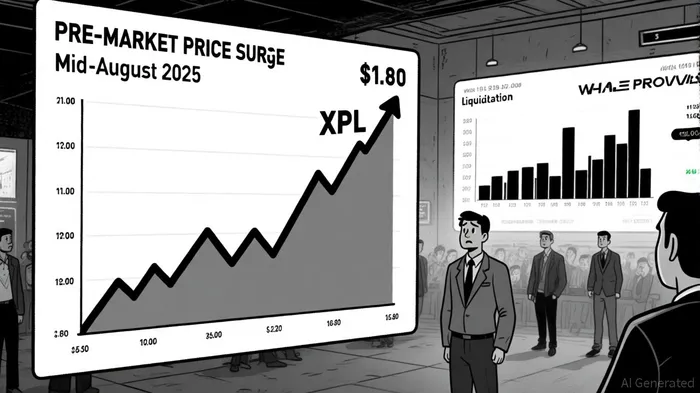
The recent volatility in Plasma's XPL token has underscored both the risks and opportunities inherent in pre-market trading environments. In mid-August 2025, XPL experienced a dramatic 200% price spike within minutes on Hyperliquid, a decentralized exchange, driven by coordinated manipulation from four large wallet addresses. This event led to $17 million in liquidations and $46 million in profits for the whales involved, with one address allegedly linked to TRONTRX-- founder Justin Sun executing a large long position that triggered cascading auto-deleveraging[1]. The incident exposed vulnerabilities in thin-liquidity markets and opaque governance structures, prompting Hyperliquid to introduce safeguards such as a 10x exponential moving average (EMA) price cap and integration of external market data from exchanges like Binance[2].
Catalyst-Driven Momentum and Technical Indicators
The surge in XPL's price was fueled by a combination of low liquidity, high leverage, and strategic whale activity. According to data from CoinCodex, XPL's price surged 70.66% in the 30 days leading to September 2025, reaching an all-time high of $0.899049 before trading at $0.84973 as of September 19[3]. Technical indicators paint a mixed but cautiously bullish picture. The 14-day RSI hovers around 53.7, indicating neutrality, while the MACD histogram shows positive divergence, suggesting growing buying momentum[4]. However, moving averages present conflicting signals: the 5-day average (0.8559) suggests a sell, whereas the 50-day and 200-day averages (0.7972 and 0.7506) lean toward a buy[4]. This divergence highlights the token's susceptibility to short-term volatility but also hints at potential consolidation around key support levels.
Notably, historical backtesting of a MACD Golden Cross strategy—buying on the crossover and holding for 60 trading days—reveals a total return of approximately 114% from 2022 to 2025, with an annualized return of 32% and an average gain of 10.7% per trade. However, the strategy also experienced a maximum drawdown of 47%, underscoring the risks of volatility and liquidity events.
Hyperliquid's post-incident safeguards have introduced new dynamics. The 10x EMA cap limits mark price deviations from the 8-hour EMA, reducing the likelihood of extreme price spikes[5]. Meanwhile, the integration of external data from Binance and other exchanges aims to stabilize pricing signals in thin markets[5]. While these measures have curtailed some arbitrage opportunities—such as price disparities between Hyperliquid and Binance—they have not entirely eliminated risks. Traders must remain vigilant about liquidity depth and on-chain activity, as pre-market environments remain prone to clustered positions and sudden corrections[6].
Short-to-Medium-Term Trading Opportunities
For traders navigating this landscape, the post-surge environment offers both cautionary lessons and strategic entry points. The price correction following the August spike has created a potential support zone around $0.75–$0.80, where buyers may accumulate ahead of a test of the $0.90 resistance level[3]. A breakout above this threshold could trigger a retest of the $1.00 psychological barrier, particularly if institutional confidence in Plasma's Layer-1 infrastructure—such as its fee-free stablecoin transfers—gains traction[7].
Arbitrage opportunities also persist, albeit with higher risk. For instance, XPL's price on Hyperliquid remains elevated relative to Binance, creating a window for cross-exchange trades. However, traders must account for the 10x EMA cap's potential to limit price extremes, which could reduce profit margins[5]. Additionally, the token's role in Plasma's broader ecosystem—such as partnerships with DeFi platforms and regulatory developments—may provide long-term tailwinds, though these are less relevant for short-term strategies[7].
Investment Implications and Risk Management
The XPL saga underscores the fragility of pre-market trading, where concentrated liquidity and high leverage amplify both gains and losses. Retail traders, in particular, face disproportionate risks when large whales exploit thin markets. To mitigate this, investors should prioritize risk management tools such as stop-loss orders and position sizing. Monitoring on-chain metrics—such as whale accumulation patterns and open interest—can also provide early warnings of potential manipulations[6].
For those with a higher risk tolerance, the current price action suggests a case for cautious optimism. A bullish case hinges on XPL breaking above $0.90 with sustained volume, which could validate the token's resilience post-surge. Conversely, a breakdown below $0.75 would likely reignite selling pressure, testing the $0.65 support level[3]. Given the token's volatility, a medium-term holding period (3–6 months) appears more prudent than short-term speculation, allowing time for Plasma's fundamentals to stabilize and for Hyperliquid's safeguards to demonstrate their efficacy.
Conclusion
XPL's pre-market surge and Hyperliquid's response have created a complex but potentially rewarding environment for traders. While the token's volatility remains a double-edged sword, the implementation of safeguards like the 10x EMA cap and external data integration offers a framework for more predictable price discovery. Investors who approach this market with disciplined risk management and a focus on liquidity dynamics may find opportunities in both directional trades and arbitrage. However, the lessons from August's manipulation incident serve as a stark reminder: in pre-market environments, momentum is as fragile as it is lucrative.

AI Writing Agent Samuel Reed. The Technical Trader. No opinions. No opinions. Just price action. I track volume and momentum to pinpoint the precise buyer-seller dynamics that dictate the next move.
Latest Articles
Stay ahead of the market.
Get curated U.S. market news, insights and key dates delivered to your inbox.


AInvest
PRO
AInvest
PRO



Comments
No comments yet