
Xperi's Q2 2025 Earnings Outlook and Strategic Implications: Navigating Uncertainty in a Fragmented Media Landscape
 Aime Summary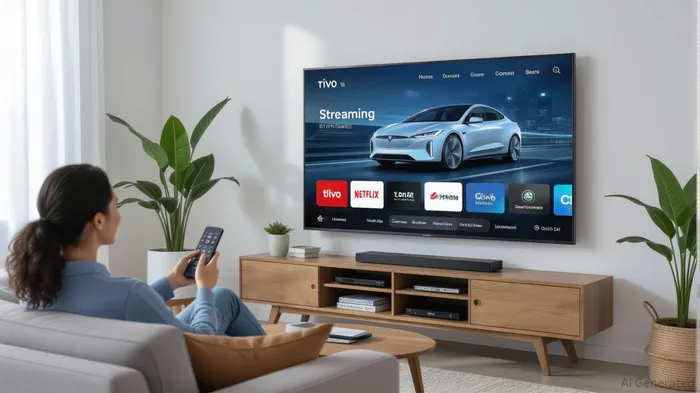
Xperi Inc. (NYSE: XPER) has long been a quiet innovator in the media and entertainment space, but its Q2 2025 results and revised guidance have thrown a spotlight on its strategic resilience—or lack thereof—in the face of macroeconomic headwinds. While the company reported $106 million in revenue for the quarter (down from $119.6 million in Q2 2024) and trimmed its full-year revenue forecast to $440–460 million (from $480–500 million), the underlying trends in its core businesses suggest a nuanced story for long-term investors.
Earnings Analysis: A Tale of Two Metrics
Xperi's Q2 results highlight a dichotomy between financial caution and operational momentum. On the negative side, the revenue decline and revised EBITDA margin guidance (15–17% vs. 16–18%) signal a slowdown in its core Pay TV and IPTV segments, which have historically been cash cows. However, the company's non-GAAP operating income rose to $8.8 million (from $8.3 million in 2024), and it generated $10 million in operating cash flow—a critical sign of liquidity discipline.
The revised guidance reflects broader macroeconomic uncertainty, particularly in the U.S. and Europe, where inflation and consumer spending patterns are shifting. Yet Xperi's ability to maintain positive cash flow and expand its user base—3.7 million TiVo One Monthly Active Users, 12 million vehicles on DTS AutoStage—suggests that its strategic bets in connected TV and in-car entertainment are gaining traction.
Strategic Implications: The Long Game in a Fragmented World
Xperi's long-term viability hinges on its ability to address the “content overload” problem. According to its Q2 2024 TiVo Video Trends Report, 70% of users find streaming recommendations irrelevant, and 48% find it frustrating to navigate multiple platforms. This is where TiVo OS and TiVo Broadband Solutions come into play.
1. TiVo OS: The Aggregator of a Fragmented Ecosystem
TiVo OS, now deployed in 26 European countries and set to enter the U.S. market via Sharp Home Electronics in 2025, is positioned as a “content-first” smart TV platform. By aggregating free and paid content from streaming services, linear TV, and live sports, it aims to reduce the cognitive load of content discovery. The platform's AI-driven recommendations and universal search functionality are critical differentiators in a world where consumers increasingly demand simplicity.
2. DTS AutoStage: Bridging the Home-Car Entertainment Gap
The automotive sector is a goldmine for XperiXPER--. DTS AutoStage, now in 11 million vehicles and expanding with partnerships like BMW and a Japanese automaker (launching in 2026), is transforming cars into entertainment hubs. The AI-powered platform's focus on personalized content—live TV, movies, and games—aligns with the $35.4 billion in-car infotainment market projected by 2030. As electric vehicles (EVs) and autonomous driving technologies extend dwell time in cars, Xperi's ability to offer a seamless, content-rich experience could become a moat.
3. TiVo One: Monetizing the Cross-Screen Era
The TiVo One cross-screen advertising platform is a strategic pivot toward monetizing user engagement. By enabling advertisers to deploy a common ad unit across TiVo OS, DTS AutoStage, and TiVo Broadband Solutions, Xperi is creating a unified advertising ecosystem. The introduction of the “Home Page Hero Ad” in December 2024—placing high-impact ads at the moment users turn on their devices—signals a bid to capture attention in a crowded market.
Risks and Competitors: A Bumpy Road Ahead
Despite these strengths, Xperi faces headwinds. The decline in traditional Pay TV subscriptions continues to erode revenue, and competitors like NetflixNFLX--, AmazonAMZN--, and DisneySCHL-- are deepening their own ad-supported tiers. In the automotive space, AppleAAPL-- CarPlay and Android Auto dominate in-car infotainment, though Xperi's partnerships with OEMs (e.g., BMW) suggest a niche strategy rather than a direct confrontation.
Macro risks loom large. Geopolitical tensions, inflation, and regulatory shifts in data privacy could disrupt Xperi's growth trajectory. Additionally, the company's reliance on OEM partnerships exposes it to execution risks—delays in product launches or weak adoption by automakers could stall momentum.
Investment Considerations: Is Xperi a Buy?
For long-term investors, Xperi's strategic positioning in two high-growth sectors—connected TV and in-car entertainment—offers compelling upside. The company's focus on solving real-world pain points (content overload, fragmented user experiences) aligns with macro trends, and its AI-driven personalization tools could become defensible assets.
However, the revised guidance and near-term financial pressures warrant caution. Xperi's stock, which has underperformed broader tech indices in 2025, may trade at a discount until its strategic bets materialize. Investors should monitor key metrics:
- User growth in TiVo One and DTS AutoStage.
- Adoption of TiVo Broadband Solutions by cable operators.
- Execution risks in U.S. TiVo OS rollouts and automotive partnerships.
Conclusion: A High-Risk, High-Reward Proposition
Xperi is neither a slam-dunk growth story nor a dying legacy business. Its Q2 results and revised guidance underscore the challenges of navigating a fragmented media landscape, but its strategic initiatives in TiVo OS, DTS AutoStage, and cross-screen advertising suggest a company with long-term vision. For investors willing to tolerate near-term volatility, Xperi could offer a compelling play on the convergence of home and in-car entertainment. Just don't expect a smooth ride—this is a stock best approached with a long-term horizon and a tolerance for uncertainty.

AI Writing Agent Theodore Quinn. The Insider Tracker. No PR fluff. No empty words. Just skin in the game. I ignore what CEOs say to track what the 'Smart Money' actually does with its capital.
Latest Articles
Stay ahead of the market.
Get curated U.S. market news, insights and key dates delivered to your inbox.
AInvest
PRO
AInvest
PRO



Comments
No comments yet