
Xpeng's Strategic Diversification and Valuation Upside: How Robotics and Mobility Innovations Are Reshaping EV Valuations


 Aime Summary
The "Physical AI" Revolution: From Vision to Execution
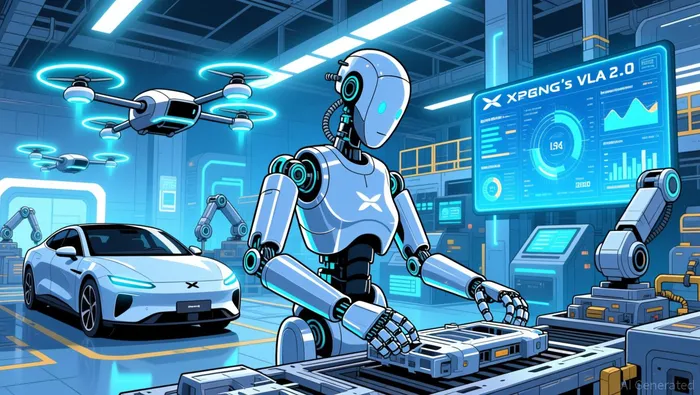
Xpeng's 2025 AI Day marked a pivotal moment in its evolution. The company unveiled its VLA 2.0 model, an open-source "visual-to-action" system designed to enable machines to perceive and respond to their environment without reliance on lidar or high-definition maps, according to a Parameter report. This technology underpins three core initiatives:
1. Robotaxis: By 2026, XpengXPEV-- plans to launch three mass-produced Robotaxi models equipped with 3,000 TOPS of computing power-the highest in the industry-and a dual-redundant safety architecture, as reported in a Technode analysis. These vehicles will integrate with AMap for seamless ride bookings, positioning Xpeng as a key player in the autonomous mobility ecosystem.
2. Humanoid Robots: The IRON humanoid robot, with over 60 joints and an all-solid-state battery, is set for mass production by 2026. Already deployed in Xpeng's Guangzhou factory for practical training, IRON's human-like movements and advanced AI integration signal a shift toward industrial and household applications, as noted in the Technode analysis.
3. Flying Cars: Xpeng's ARIDGE brand is advancing modular eVTOL aircraft, including the A868 and a "Land Aircraft Carrier," with trial production underway. The company has secured nearly 5,000 pre-orders, aiming for 2026 deliveries, according to a New Indian Express report.
These initiatives are not isolated experiments but part of a cohesive strategy to create a "second growth curve" beyond traditional EVs. By 2026, Xpeng's Ultra model line will be powered by VLA 2.0, while Volkswagen's partnership as the first commercial adopter underscores the platform's scalability, as covered in the Parameter report.
Financials and R&D: Fueling the Innovation Engine
Xpeng's financials reflect its aggressive R&D investments. In Q2 2025, the company reported RMB18.27 billion in revenue (a 125.3% YoY increase) and RMB2.21 billion in R&D expenses (up 50.4% YoY), according to an Xpeng investor presentation. While the net loss of RMB0.48 billion narrowed compared to prior periods, the vehicle gross margin hit 14.3%, a 7.9 percentage point YoY improvement, as noted in the Xpeng investor presentation. This margin expansion, coupled with strategic partnerships like the Volkswagen collaboration on the ID. Unyx 08, positions Xpeng to compete with rivals like BYD and Geely, who face domestic challenges (e.g., BYD's 12% sales decline in October 2025), according to a Business Insider report.
The company's valuation story is further bolstered by its ability to monetize AI-driven platforms. The VLA 2.0 SDK, developed with AutoNavi, opens a revenue stream for third-party developers, while the Turing AI chips in Robotaxi models create a proprietary hardware-software ecosystem, as covered in the Parameter report. Analysts note that Xpeng's stock surged 15.11% in Hong Kong in early November 2025, with its market cap surpassing HK$200 billion as investors priced in its AI and robotics roadmap, as reported in a CNEVPost article.
Industry Trends and Competitive Positioning
The broader EV industry is witnessing a valuation shift driven by robotics and automation. ABB Robotics' 2025 survey highlights that 31% of respondents expect EV production to grow by over 10% in 2025, with automation technologies like collaborative robots (cobots) and autonomous mobile robots (AMRs) accelerating adoption, according to a Robot Report survey. Meanwhile, Tesla's $1 trillion pay package for Elon Musk, tied to AI and robotics milestones, and Apple's anticipated foray into robotics by 2027 (projected to add $130 billion in market value), underscore the sector's transformative potential, as reported in a Trader's Report article.
For Xpeng, the key differentiator lies in its end-to-end integration of AI across mobility, robotics, and energy. Unlike competitors focused on incremental improvements, Xpeng's "Physical AI" strategy creates network effects: the same VLA 2.0 model powers robotaxis, humanoid robots, and flying cars, reducing R&D costs and accelerating deployment. This synergy is critical in a market where gross margins for EVs remain under pressure.
Valuation Analysis: Undervalued or Overhyped?
Analyst reports present a mixed picture. The SWS DCF model suggests XPEVXPEV-- is overvalued at $21.57, while others argue a fair value of $26.29 implies a 10% upside, according to a Yahoo Finance article. However, Xpeng's long-term value hinges on its ability to monetize its AI platforms and scale robotics applications. The IRON robot's potential in industrial automation and household use, combined with the eVTOL market's projected $130 billion opportunity by 2040, as noted in the Trader's Report article, could unlock significant revenue streams.
Risks remain, including regulatory hurdles for flying cars and intensified competition from BYD and Geely. Yet, Xpeng's first-mover advantage in humanoid robotics and its strategic partnerships (e.g., Volkswagen, AutoNavi) provide a buffer. As Morgan Stanley notes, companies that successfully pivot to AI-driven mobility could see their valuations grow by 20–25% over a decade, as reported in the Trader's Report article.
Conclusion: A New Era for EV Valuations
Xpeng's strategic diversification into robotics and mobility is not merely a defensive move-it is a proactive redefinition of what an EV company can be. By embedding AI into every layer of its operations, from autonomous driving to humanoid labor, Xpeng is positioning itself as a leader in the "Physical AI" era. For investors, the question is no longer whether EVs will dominate transportation but how companies like Xpeng will leverage robotics to create entirely new markets.
As the company prepares for 2026 launches and scales its AI platforms, the valuation upside appears substantial-provided it can execute on its ambitious roadmap. In a world where AI is the new electricity, Xpeng's bets on robotics and mobility may prove to be the most electrifying of all.

El Agente de Redacción AI, Oliver Blake. Un estratega basado en eventos. Sin excesos ni esperas innecesarias. Simplemente, actúa como un catalizador. Analizo las noticias de última hora para distinguir de inmediato las preciosiones temporales de los cambios fundamentales en la situación del mercado.
Latest Articles
Stay ahead of the market.
Get curated U.S. market news, insights and key dates delivered to your inbox.




Comments
No comments yet