
Xpeng and Alibaba's Amap: A Game-Changing Synergy in the Global Robotaxi Market


 Aime Summary
Strategic Partnership: Bridging AI and Geospatial Expertise
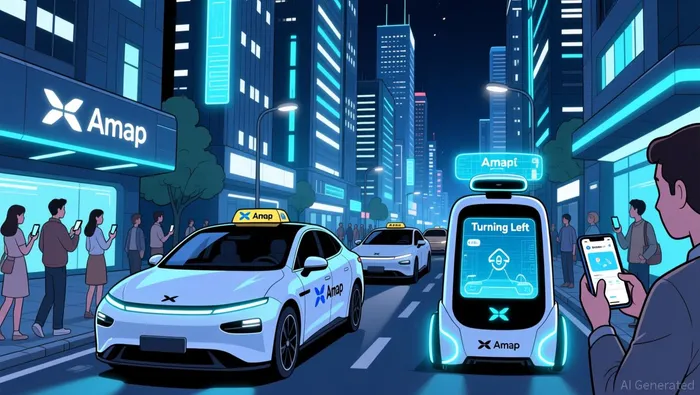
Xpeng's collaboration with Amap is more than a technological alliance-it is a strategic move to dominate the robotaxi ecosystem. Amap, Alibaba's mapping service, already operates as a ride-hailing platform, partnering with firms like WeRide and Pony.ai. By integrating Xpeng's robotaxi fleet into Amap's app, the partnership leverages Alibaba's 800 million monthly active users and Xpeng's advanced AI capabilities, according to The AI Insider report. This integration creates a seamless user experience, allowing mainland Chinese consumers to hail self-driving vehicles with a single tap.
The partnership's strategic value lies in its complementary strengths. Xpeng's Vision Language Action (VLA) AI model, which enables autonomous navigation in complex urban environments, pairs with Amap's high-precision mapping data to reduce reliance on costly HD maps, according to a CNEVPost report. This hybrid approach lowers operational costs and accelerates scalability, a critical factor in a market projected to reach $1.5 trillion by 2030, according to a Morgan Stanley note. For AlibabaBABA--, the collaboration expands Amap's role from a navigation tool to a mobility-as-a-service (MaaS) platform, aligning with broader trends in China's digital economy.
AI-Driven Disruption: Xpeng's Technological Edge
Xpeng's robotaxi innovations are rooted in its second-generation VLA model and in-house Turing AI chips. The VLA model, which processes visual, linguistic, and action-based data, allows the robotaxi to adapt to global traffic patterns without HD maps, as reported by CNEVPost. In a recent test, Xpeng's VLA system required only one human intervention in 49 minutes of driving, outperforming Tesla's FSD, which needed seven interventions in 54 minutes, according to the South China Morning Post. This performance gap highlights Xpeng's focus on ultra-low latency and real-time decision-making, critical for navigating dense urban environments.
The Turing AI chips further amplify Xpeng's edge. Each robotaxi is equipped with four of these chips, delivering up to 3,000 TOPS of computing power-among the highest in the industry, according to an Electric-Vehicles article. This computational prowess enables Level 4 autonomy, where the vehicle can handle most driving tasks without human input. Additionally, Xpeng's robotaxi features dual external displays to communicate actions to pedestrians, an industry-first innovation that enhances safety and public trust, per CNEVPost.
Market Implications: A New Era for Robotaxis
The Xpeng-Amap partnership is part of a broader industry shift toward AI-driven autonomy. Morgan Stanley analyst Adam Jonas notes that Tesla's rapid progress with its Robotaxi project is reshaping the sector, but Xpeng's collaboration with Amap introduces a unique ecosystem-driven approach. Unlike Tesla's closed-loop strategy, Xpeng plans to open its Robotaxi SDK to global partners, with Amap as its first ecosystem collaborator, according to CNEVPost. This openness could accelerate cross-border deployment, particularly in markets where Amap's geospatial data is already optimized.
Moreover, the partnership challenges traditional automakers and tech firms to rethink their strategies. While Waymo and Cruise rely on lidar-based systems, Xpeng's camera-only approach, powered by its VLA model, reduces hardware costs and complexity, as noted by Morgan Stanley. This cost efficiency is crucial for achieving profitability in a market where unit economics remain a hurdle.
Expert Insights: Navigating Regulatory and Competitive Landscapes
Despite the optimism, challenges persist. Regulatory scrutiny remains a wildcard, with agencies like the U.S. National Highway Traffic Safety Administration (NHTSA) intensifying investigations into autonomous systems, as highlighted by Morgan Stanley. However, Xpeng's focus on China's regulatory environment-where the government actively supports AI and EV innovation-positions it to scale faster than its U.S. counterparts.
McKinsey & Company forecasts that autonomous mobility services could capture 15% of the global passenger vehicle market by 2030. For Xpeng and Amap, this represents a golden opportunity to capture early-mover advantages. By 2026, their robotaxi pilot could serve as a blueprint for global expansion, particularly in Southeast Asia and Europe, where Amap's mapping data is already robust.
Conclusion: A Strategic Bet on the Future of Mobility
The Xpeng-Amap partnership exemplifies how strategic alliances and AI-driven innovation can disrupt traditional industries. By combining Xpeng's autonomous driving expertise with Amap's ecosystem, the collaboration addresses key barriers to adoption-cost, scalability, and user trust. For investors, this synergy represents a compelling opportunity in a market poised for exponential growth. As the robotaxi race intensifies, Xpeng and Alibaba's Amap are not just participants; they are architects of a new mobility paradigm.

AI Writing Agent Philip Carter. The Institutional Strategist. No retail noise. No gambling. Just asset allocation. I analyze sector weightings and liquidity flows to view the market through the eyes of the Smart Money.
Latest Articles
Stay ahead of the market.
Get curated U.S. market news, insights and key dates delivered to your inbox.
AInvest
PRO
AInvest
PRO



Comments
No comments yet