
XOM Stock: Why Q1 Earnings Dip Despite Oil Price Surge
 Aime Summary
- , .
- .
- Despite the reported earnings dip, management confirms that the negative accounting effects are temporary and will unwind, leading to net-positive profits in subsequent quarters.
- , .
Exxon Mobil investors are navigating a financial paradox where rising commodity values have failed to translate into immediate top-line gains for the first quarter. The world's largest publicly traded oil producer has signaled that a massive accounting headwind related to derivative contracts will overshadow the benefits of soaring crude prices. This divergence between physical asset performance and financial reporting creates a unique investment scenario for XOMXOM-- stock, where the headline earnings number may mask a fundamentally stronger operational reality. As the market digests the impact of the Iran war on global energy infrastructure, the company's ability to weather these temporary accounting storms while maintaining its production dominance remains the critical narrative to watch.
Why Is XOM Stock Facing a Temporary Earnings Dip Amid Higher Oil Prices?
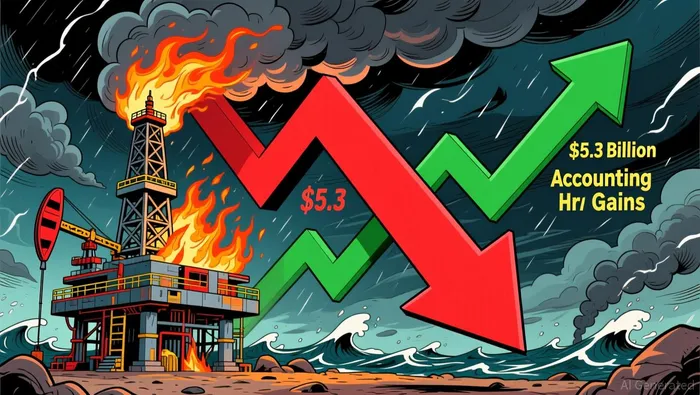
The core reason for the anticipated decline in ExxonXOM-- Mobil's first-quarter earnings lies in the intricate mechanics of its financial hedging program. , the downstream segment is absorbing a staggering negative impact of around $5.3 billion. This discrepancy is not driven by a lack of demand or physical sales, but rather by accounting rules that govern the timing of derivative settlements. Unlike physical shipments, where revenue is recognized upon transaction completion, can create a mismatch when prices move rapidly between the time a contract is signed and when the physical cargo is delivered.
CFO Neil Hansen has clarified that these timing effects are temporary, stemming from a situation where commodity prices surged between December 31, 2025, and March 31, 2026. The company sales to mitigate price risks during the shipping window, which often spans weeks between the United States and Asia. When prices rise sharply during this window, the value of the hedges can create a paper loss that offsets the physical gains until the transaction is fully settled. Consequently, the $5.3 billion hit is essentially a deferral of profit rather than a permanent loss. As these derivative contracts unwind over time and align with the completed physical shipments, the company expects the underlying transactions to result in net-positive profit, effectively reversing the negative accounting impact in later quarters.
Additionally, . While this represents a real cost, it is a fraction of the broader hedging timing effect. The bottom line is that the reported earnings dip is an artifact of financial accounting rules colliding with volatile geopolitical markets, rather than a sign of deteriorating operational performance. Investors should anticipate that once the accounting dust settles, the true profitability of the higher oil prices will be fully reflected in the company's balance sheet.
How Does The Iran War Impact XOM Stock Production And Global Supply?
The geopolitical turmoil in the Middle East has inflicted tangible physical damage on Exxon Mobil's global operations, . This drop is primarily concentrated in the Persian Gulf, where the conflict has paralyzed energy infrastructure. Half of the outages are attributed to a in Qatar, a partner facility where two production lines were damaged by . , .
The severity of the situation is underscored by the prolonged nature of the repairs. Public reports indicate that fixing the damaged LNG trains in Qatar will take a significant amount of time, with no immediate timeline for returning to normal operations. This disruption highlights the physical vulnerability of supermajors with heavy exposure to the region, which typically accounts for one-fifth of the company's global output. The conflict has also forced Exxon to evacuate non-essential employees from its Middle East operations and scale back production to manage inventory levels amidst the logistical chaos of a closed Strait of Hormuz.
Despite these setbacks, the company's financial resilience provides a crucial buffer. , supported by strong performance in non-Middle East assets like the . , , which helps offset regional losses. While the immediate impact on production volumes is significant, the company's ability to leverage its global scale and financial flexibility allows it to navigate the crisis without facing existential threats. The market's inventory cushion, which previously absorbed the initial shock, is being drawn down, but Exxon's diversified asset base positions it to manage the volatility better than many peers.
What Do Insider Sales And Analyst Ratings Signal For XOM Stock Outlook?
The market reaction to Exxon's guidance has been mixed, . This volatility is mirrored by a significant shift in insider sentiment, , . The ratio of selling executives to buying executives hit nearly six to one, suggesting that insiders may be skeptical about the sustainability of the current rally driven by the Iran war.
Notable sales include Chevron CEO Mike Wirth, , and ConocoPhillips's Ryan Lance, . This selling spree occurred even as Brent crude prices remained elevated, indicating that executives may be capitalizing on the high valuations rather than betting on further upside. Analysts like note that the timing of these sales, often at the tail-end of trading windows, reflects a belief that the current price levels may not be sustainable in the long term. , which could put pressure on the current price premiums.
Despite the insider selling and near-term earnings dip, institutional analysts remain cautiously optimistic about the long-term outlook. UBS has reiterated its Buy rating on the stock, citing potential profit gains from a global helium shortage exacerbated by the conflict in Qatar. The military strikes on the Ras Laffan complex, , have positioned Exxon's LaBarge, Wyoming facility as a critical asset for meeting high-tech industry demand. Furthermore, JPMorgan strategists have warned that while Gulf nations face severe near-term growth hits, the long-term damage to foreign investment in the region could create opportunities for well-capitalized companies like Exxon that can weather the storm.
Looking ahead, investors will be watching the May 1, 2026, earnings report for confirmation of how the hedging impacts unwind and whether the company can maintain its production growth trajectory outside the Middle East. The company has already announced that achieved first production from Train 1 at its Sabine Pass terminal, and plans to increase Permian production to 1.8 million oil-equivalent barrels in 2026. These developments suggest that while the immediate future is clouded by geopolitical risk, the long-term fundamentals of the energy transition and supply constraints remain intact for the supermajors.

Stay ahead of the market.
Get curated U.S. market news, insights and key dates delivered to your inbox.


AInvest
PRO
AInvest
PRO



Comments
No comments yet