
XMR Regulatory Risk Grows as EU Enforces Privacy Coin Restrictions in 2027
 Aime Summary
- Monero enforces mandatory privacy, attracting regulatory scrutiny compared to Zcash's optional model, as the EU prepares to ban anonymizing services in 2027.
- Institutional demand is pivoting from consumer payments to confidential settlement and DeFi front-running protection, reshaping the privacy coin market .
- Advanced surveillance analytics now profile users via transaction timing and exchange deposits, raising the barrier for effective anonymity beyond the coin itself .
- Regulatory friction from EU Regulation 2024/1624 threatens exchange availability of privacy coins, though peer-to-peer transfers remain unaffected .
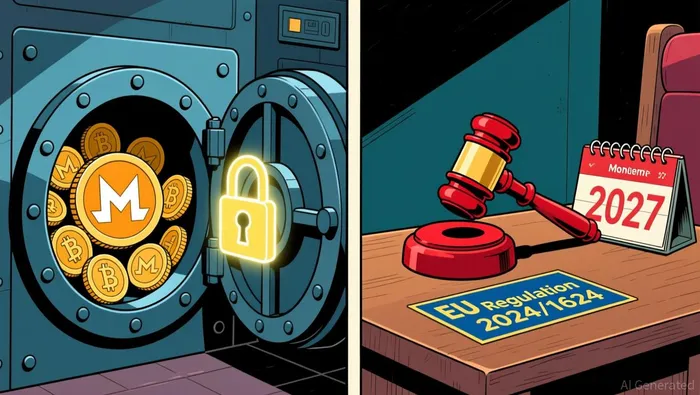
Monero faces intensifying regulatory pressure as global financial authorities move to restrict anonymous transaction capabilities. The European Union’s Regulation (EU) 2024/1624, effective July 10, 2027, explicitly bars regulated crypto-asset service providers from offering services for anonymizing transactions . This legislative shift threatens the availability of privacy coins like MoneroXMR-- on major exchanges, forcing platforms to either delist the asset or severely restrict user access . While the regulation does not ban the ownership or peer-to-peer transfer of these assets, the loss of regulated exchange infrastructure significantly impacts liquidity and on-ramp accessibility for institutional and retail participants .
How Does Monero’s Privacy Model Compare to Zcash?
The fundamental difference between Monero and ZcashZEC-- lies in their adoption mechanics and privacy enforcement. Monero enforces mandatory privacy, automatically strengthening the anonymity set for every transaction without requiring user decision-making . This approach ensures that all network participants benefit from a robust anonymity pool, but it also attracts greater regulatory scrutiny due to the lack of selective disclosure mechanisms . In contrast, Zcash offers optional privacy, where the strength of the shield depends entirely on user behavior and the adoption of shielded addresses . While Zcash provides a transparent option that may appeal to compliance-focused entities, Monero’s unconditional privacy makes it a primary target for regulatory enforcement actions .
What Is Driving Institutional Demand for Privacy Infrastructure?
Institutional demand for privacy is evolving beyond simple consumer anonymity toward complex enterprise utility. Privacy infrastructure, including networks like Secret, Oasis, and NEAR, is expanding to serve confidential settlement and private voting requirements . This shift reflects a broader market focus on developer and enterprise utility rather than just consumer payment anonymity . Institutions are increasingly utilizing private transactions to protect supply-chain settlements and prevent front-running in decentralized finance (DeFi) protocols . Consequently, the value proposition of privacy coins is transitioning from personal financial secrecy to strategic operational advantages for sophisticated market participants .
How Do Surveillance Analytics Threaten Monero’s Anonymity?
Advancements in surveillance analytics are complicating the landscape for privacy-focused cryptocurrencies. Firms now profile users by analyzing transaction timing, exchange deposit patterns, and wallet hygiene practices . These sophisticated methods raise the bar for effective anonymity, suggesting that protecting privacy requires more than just using a privacy coin . Investors must now consider the movement of assets between transparent and shielded layers, as well as the use of swap services, to maintain anonymity . This environment necessitates a more nuanced understanding of privacy risks, as network-level protections alone may not suffice against advanced behavioral analysis .

Blending traditional trading wisdom with cutting-edge cryptocurrency insights.
Latest Articles
Stay ahead of the market.
Get curated U.S. market news, insights and key dates delivered to your inbox.


AInvest
PRO
AInvest
PRO




Comments
No comments yet