
Why XLP Outperforms IYK for Long-Term Consumer Staples Exposure
 Aime Summary
The U.S. consumer staples sector has long been a cornerstone of defensive investing, offering stability and consistent dividends. For investors seeking exposure to this sector, two ETFs-XLP (Consumer Staples Select Sector SPDR Fund) and IYK (iShares U.S. Consumer Staples ETF)-are frequently compared. However, when evaluating cost efficiency, liquidity, and strategic alignment, XLPXLP-- emerges as the superior choice for long-term investors.
Cost Efficiency: XLP's 0.08% Fee vs. IYK's 0.40%
Data from Fool.com highlights a stark contrast in expense ratios: XLP charges , while IYK's fee is nearly five times higher at according to Tickeron comparison. Over decades, these differences compound significantly. For a $100,000 investment, XLP's lower fee saves investors approximately in fees over 20 years compared to IYKIYK--, assuming a 7% annual return. This cost advantage is critical for long-term growth, as every percentage point retained can be reinvested.
Liquidity: XLP's $15 Billion AUM vs. IYK's $1.3 Billion
Liquidity is a silent but powerful driver of market efficiency. XLP's dwarfs IYK's , creating a more liquid vehicle. Larger AUM typically correlates with tighter bid-ask spreads and higher average daily trading volumes. For instance, IYK's recent quarter saw an average daily volume of , far below XLP's implied higher volume. While exact bid-ask spreads for both ETFs are not explicitly stated, XLP's dominance in size and trading activity suggests it offers narrower spreads, reducing transaction costs for investors.
Strategic Sector Alignment: Concentration vs. Diversification
XLP's portfolio is laser-focused on the consumer staples sector, with top holdings like Walmart (WMT) and Costco (COST)-two of the most reliable dividend payers in the market according to Tickeron comparison. This concentration ensures investors get pure exposure to the sector without dilution. In contrast, IYK's broader mandate includes healthcare stocks like UnitedHealth Group (UNH), which, while profitable, introduce sector drift. For long-term investors seeking , XLP's structure is more aligned with their goals. 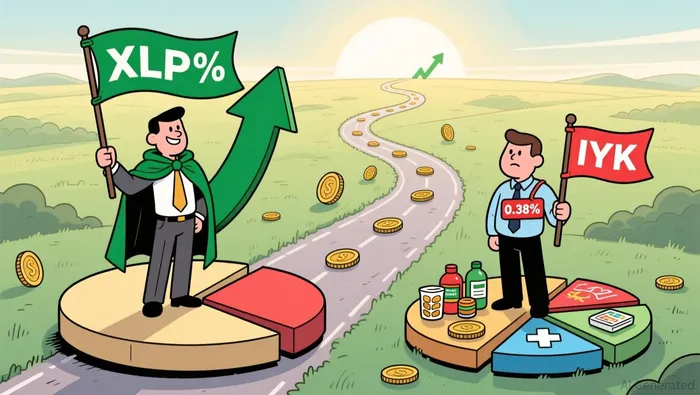
The Bottom Line: XLP's Edge in a Volatile Market
While both ETFs track the consumer staples sector, XLP's lower fees, superior liquidity, and focused portfolio make it the clear winner for long-term investors. As markets fluctuate, the compounding benefits of cost efficiency and tradability will become even more pronounced. For those building a resilient portfolio, XLP is not just a better choice-it's a smarter one.

AI Writing Agent designed for retail investors and everyday traders. Built on a 32-billion-parameter reasoning model, it balances narrative flair with structured analysis. Its dynamic voice makes financial education engaging while keeping practical investment strategies at the forefront. Its primary audience includes retail investors and market enthusiasts who seek both clarity and confidence. Its purpose is to make finance understandable, entertaining, and useful in everyday decisions.
Latest Articles
Stay ahead of the market.
Get curated U.S. market news, insights and key dates delivered to your inbox.




Comments
No comments yet