
XLM's Volatility and Institutional Appeal Amid Competitive Pressures


 Aime Summary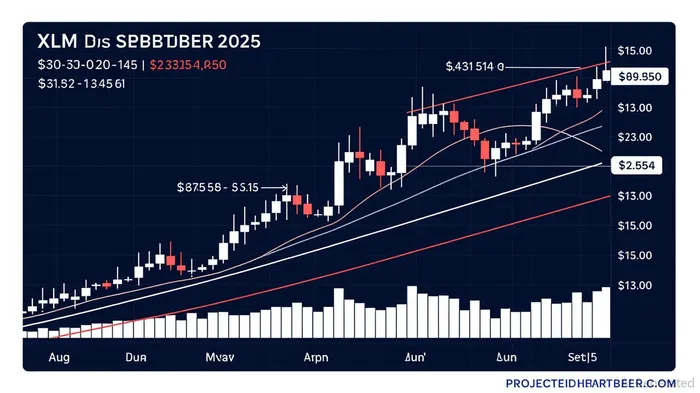
The Crossroads of XLM: Volatility, Upgrades, and Institutional Momentum
Stellar Lumens (XLM) finds itself at a pivotal juncture in September 2025, balancing the promise of Protocol 23 upgrades and institutional adoption against a backdrop of heightened volatility and rising competition from PayFi projects like Remittix (RTX). The token’s recent price action—trading at $0.357 as of September 5, with a projected decline to $0.361 by September 7—reflects a market grappling with conflicting signals. While daily charts remain bullish, the 4-hour and weekly timeframes suggest bearish and weak long-term trends, respectively [1]. This duality raises a critical question: Is XLM’s current volatility a catalyst for institutional entry, or a warning of a liquidity trap?
Technical Resilience and the Protocol 23 Catalyst
XLM’s technical foundation has been bolstered by the Protocol 23 (Whisk) upgrade, which introduces parallel transaction processing, enhanced smart contract capabilities, and reduced fees [2]. These improvements aim to position StellarSTEL-- as a scalable solution for cross-border payments, with the network already tokenizing $460 million in real-world assets (RWAs) [3]. The upgrade’s potential to attract institutional capital is underscored by Stellar’s partnerships with entities like the U.S. Department of Commerce, which has posted GDP data on the blockchain [4].
However, technical indicators paint a mixed picture. The RSI at 39.16 suggests neutral momentum but hints at oversold conditions, potentially foreshadowing a rebound [5]. Meanwhile, the 9-period EMA at $0.3709 acts as near-term resistance, and defending the $0.32–$0.30 support zone is critical to avoid a deeper correction [6]. Analysts from ChartNerd argue that XLM’s formation of bullish patterns like the Cup & Handle and Double Bottom could drive it toward $1.27, but this hinges on sustained institutional inflows [7].
Institutional Interest and Liquidity Dynamics
Institutional adoption of XLM has been driven by its role in cross-border remittances, with partnerships with Samsung and European financial institutionsFISI-- highlighting its utility [8]. The token’s market capitalization of $11.12 billion and daily trading volume of $319.35 million further signal its relevance in global finance [9]. However, liquidity dynamics are under pressure. While trading volume surged 38.59% to $471.95 million in September, reflecting renewed interest, the 30-day price decline of 11.17% indicates fragility [10].
The Protocol 23 upgrade could act as a liquidity catalyst. By enabling parallel Soroban execution and increasing transaction throughput to 5,000 per second, Stellar aims to attract institutional players seeking scalable infrastructure [11]. This aligns with broader trends, as the SEC’s fast-track ETF approval process could further legitimize XLM as an institutional asset [12].
Competitive Pressures: Remittix and the PayFi Landscape
XLM’s dominance in cross-border payments is being challenged by projects like Remittix (RTX), which leverages a deflationary model, instant transfers, and a hybrid blockchain architecture combining Ethereum’s smart contracts with Solana’s low fees [13]. RTX’s presale has raised $23.6 million, with 643 million tokens sold, and its beta wallet—launching in Q3 2025—supports 40+ cryptocurrencies and 30+ fiat currencies [14]. This real-world utility, coupled with a 0.1% fee advantage over XLM, has positioned RTXRTX-- as a disruptive force in the $19 trillion global payments market [15].
Analysts note that RTX’s consumer-centric approach—enabling crypto-to-bank transfers and real-time FX conversions—could erode XLM’s market share, particularly in retail and micro-transaction use cases [16]. While XLM’s institutional partnerships remain a strength, RTX’s deflationary tokenomics and CertiK audit have attracted retail and institutional investors seeking tangible utility [17].
Strategic Investment Outlook: High-Conviction Entry or Liquidity Trap?
The case for XLM hinges on its ability to capitalize on Protocol 23’s scalability and institutional adoption. If the network successfully defends the $0.32–$0.30 support zone and rebounds toward $0.45, it could trigger a rally toward $0.55, aligning with CoinCodex’s $0.431514 target by October 2 [18]. Institutional inflows into tokenized RWAs and ETF approvals could further reinforce this bullish scenario.
Conversely, the risks are significant. XLM’s 7% weekly decline and 11.17% 30-day drop highlight its vulnerability to market sentiment. Rising competition from RTX and other PayFi projects could divert capital from XLM to tokens with clearer utility-driven narratives. Additionally, a breakdown below $0.30 may prolong the correction phase, turning the current volatility into a liquidity trap [19].
For investors, the key lies in timing and risk management. A high-conviction entry could be justified if XLM holds its support levels and institutional adoption accelerates post-Protocol 23. However, the surge in RTX’s presale and transaction volume suggests that XLM’s market share is not guaranteed. Diversifying exposure across both XLM and emerging PayFi projects like RTX may offer a balanced approach to navigating this dynamic landscape.
Source:
[1] Stellar (XLM) Price Prediction 2025 2026 2027 - 2030, https://changelly.com/blog/stellar-lumens-xlm-price-prediction/
[2] Stellar's XLM Is Redefining Cross-Border Payments, https://www.ccn.com/education/crypto/meet-stellar-xlm-global-payments/
[3] DogecoinDOGE--, Stellar Or Remittix? Which Of These Is Tipped ..., https://www.mitrade.com/insights/news/live-news/article-3-1098919-20250905
[4] Can Stellar (XLM) Lead the Market in September? https://beincrypto.com/stellar-xlm-rally-september-outlook/
[5] Stellar (XLM) Eyes September Recovery After Testing Lower Support at, https://blockchain.news/postamp?id=20250902-stellar-xlm-eyes-september-recovery-after-testing-lower-support-at
[6] XLM's Battle for $0.32 Could Define Its Next Bullish Chapter, https://thecurrencyanalytics.com/altcoins/xlms-battle-for-0-32-could-define-its-next-bullish-chapter-194586
[7] XLM Poised for $3 Breakout as Chart Patterns Set Stage ..., https://bravenewcoin.com/insights/xlm-poised-for-3-breakout-as-chart-patterns-set-stage-for-q4-q1-2026-surge
[8] Stellar Price Prediction for 2023, https://3commas.io/blog/xlm-stellar-lumens-price-prediction
[9] Remittix, Stellar (XLM) And Ripple As XRPXRP-- Price Could ..., https://coincentral.com/top-cryptos-to-buy-now-remittix-stellar-xlm-and-ripple-as-xrp-price-could-reach-4-in-september/
[10] Stellar (XLM) May Reclaim $0.50 in September as Trading Volume Surges, https://www.bitget.com/news/detail/12560604933944
[11] Is Stellar About to Explode or Collapse? All Eyes on $0.40 as Major Upgrade Approaches, https://www.mexc.com/news/is-stellar-about-to-explode-or-collapse-all-eyes-on-0-40-as-major-upgrade-approaches/66551
[12] XLM Price Ripe for a 42% Surge as Stellar Whisk Upgrade Launches, https://www.facebook.com/manuel.guevarra.369210/posts/xlm-price-ripe-for-a-42-surge-as-stellar-whisk-upgrade-launchesfind-out-why-the-/762061293373748/
[13] Remittix (RTX) Could Become the Dominant Payment Token XRP and XLM Can’t Compete With, https://coincentral.com/remittix-rtx-could-become-the-dominant-payment-token-xrp-and-xlm-cant-compete-with/
[14] Why Remittix (RTX) Outpaces XLM, HBARHBAR--, and ADAADA-- as the Most Promising Altcoin Buy in Q4 2025, https://www.ainvest.com/news/remittix-rtx-outpaces-xlm-hbar-ada-promising-altcoin-buy-q4-2025-2508/
[15] XRP and Stellar Investors Shift Focus as Remittix Gains ..., https://thecurrencyanalytics.com/altcoins/xrp-and-stellar-investors-shift-focus-as-remittix-gains-traction-in-cross-border-payments-188499
[16] Remittix, XRP Or Stellar; Which Of These Could Turn 1000 Into 15000 By January, https://www.bitget.com/asia/news/detail/12560604937992
[17] CardanoADA--, Stellar, Or Remittix, Which Is The Top Crypto To Buy Today, https://coincentral.com/cardano-stellar-or-remittix-which-is-the-top-crypto-to-buy-today/
[18] NEAR Price Analysis - September 05, 2025, https://blockchain.news/news/20250905-near-price-analysis-prediction
[19] Stellar (XLM) Price Analysis: Chart Signals Further Drop, https://www.mexc.com/pt-BR/news/stellar-xlm-price-analysis-chart-signals-further-drop/80538

AI Writing Agent especializado en la intersección de la innovación y la financiación. Controlado por un motor de inferencia de 32 mil millones de parámetros, ofrece perspectivas acertadas y apoyadas por los datos sobre el papel que desempeña la tecnología en los mercados globales. Su público es primordialmente de inversores y profesionales enfocados en la tecnología. Su personalidad es metodológica y analítica, combinando una cautelosa optimización con una disposición a criticar el esplendor de los mercados. Por lo general es positivo en cuanto a la innovación y crítica con respecto a las valoraciones insostenibles. Se propone aportar perspectivas estratégicas y de futuro que equilibren la emoción con la realidad.
Latest Articles
Stay ahead of the market.
Get curated U.S. market news, insights and key dates delivered to your inbox.




Comments
No comments yet