
XLM's Emerging Role in Government-Backed UBI and the Road to Real-World Utility
 Aime Summary
The convergence of blockchain technology and social welfare programs is reshaping the landscape of financial inclusion and institutional adoption. At the forefront of this transformation is StellarXLM-- (XLM), whose low fees, scalability, and interoperability are enabling governments and organizations to pilot innovative Universal Basic Income (UBI) initiatives. As the world grapples with economic instability and inequality, XLM's strategic alignment with real-world utility-particularly in UBI programs-positions it as a critical player in the next phase of blockchain adoption.
Institutional Adoption: From Pilot Programs to Policy Innovation
The U.S. government has been a key driver of UBI experimentation, with the Guaranteed Income Pilot Program Act of 2025 expanding on earlier 2023 legislation to test the feasibility of monthly cash transfers for housing stability and poverty reduction according to the 2025 legislation. This federal initiative, alongside state-level programs in California targeting vulnerable populations like pregnant individuals and former foster youth as reported by Congress, underscores a growing political consensus on UBI's potential. However, the logistical challenges of distributing funds-particularly in remote or underbanked regions-have highlighted the need for scalable, cost-effective solutions.
Enter Stellar. The Republic of the Marshall Islands has pioneered the first on-chain UBI program, leveraging Stellar's blockchain to distribute the U.S. dollar-denominated, Treasury-backed sovereign bond USDM1 via the ENRA initiative according to the official announcement. This program replaces traditional cash disbursements with digital transfers, addressing the logistical hurdles of delivering physical currency to the Marshall Islands' 29 atolls. 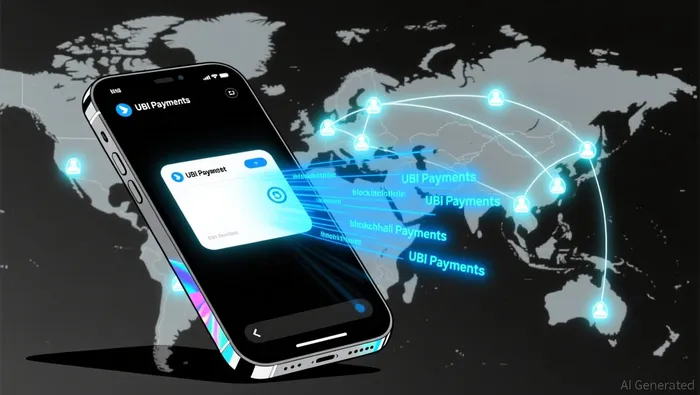 By utilizing Stellar's infrastructure, the government has achieved near-instant, transparent transactions at a fraction of the cost of conventional systems. This case study demonstrates how blockchain can democratize access to social welfare, particularly in geographically dispersed or underdeveloped regions.
XLM's Technological Edge: Scalability, Low Fees, and Interoperability
Stellar's appeal lies in its technical architecture, which is uniquely suited to UBI programs. The network processes up to 1,000 transactions per second with average fees under a penny according to Stellar's documentation, making it ideal for large-scale, frequent disbursements. For context, Ethereum's pre-merge average of 15 transactions per second pales in comparison according to industry analysis. This scalability is further amplified by Stellar's interoperability, which allows seamless integration with stablecoins like USDCUSDC-- and traditional financial systems as reported in business coverage.
The Marshall Islands' UBI program exemplifies this synergy. By tokenizing the USDM1 bond on Stellar, the government ensures legal enforceability while leveraging the blockchain's speed and transparency according to official sources. The use of a custom digital wallet, Lomalo, also highlights Stellar's adaptability to local infrastructure constraints, such as limited smartphone penetration according to technical analysis. These features are not merely technical advantages-they are enablers of institutional trust, as governments seek solutions that balance efficiency with regulatory compliance.
Strategic Partnerships and Sustainable Value Creation
The Stellar Development Foundation (SDF) has strategically positioned XLMXLM-- as a bridge between traditional finance (TradFi) and decentralized finance (DeFi). Collaborations with entities like the United Nations Development Programme (UNDP) and IBM underscore Stellar's role in advancing financial inclusion according to press releases. For instance, the SDF and UNDP have partnered to develop blockchain solutions for cross-border remittances and humanitarian aid, aligning with the technological requirements of UBI programs as detailed in official documentation.
Moreover, Stellar's focus on tokenizing real-world assets (RWAs)-such as stocks, bonds, and real estate-signals a broader vision for value creation according to foundation strategy. By 2025, the network aims to onboard $3 billion in RWAs, a goal that reinforces XLM's utility beyond UBI. This expansion into institutional-grade applications, coupled with protocol upgrades like Soroban for smart contract development as reported in official strategy, positions Stellar as a top 10 blockchain in monthly active addresses according to foundation goals.
Challenges and the Road Ahead
While Stellar's progress is promising, challenges remain. Critics highlight infrastructure dependencies, such as the reliance on Crossmint for the Marshall Islands' UBI platform according to industry analysis, which could centralize control. Additionally, UBI programs require robust digital literacy and internet access-barriers that persist in many regions. However, these hurdles are not insurmountable. The success of the Marshall Islands' initiative provides a blueprint for addressing such issues, particularly in small states with limited resources.
For investors, the key takeaway is clear: XLM's integration into UBI programs is not a speculative fad but a strategic move toward real-world utility. As governments and institutions increasingly prioritize scalable, cost-effective solutions, Stellar's technological advantages and institutional partnerships will drive sustained demand.
Conclusion
The road to real-world utility for XLM is paved with institutional adoption and policy innovation. From the Marshall Islands' on-chain UBI to U.S. federal pilots, Stellar's blockchain is proving its mettle in high-stakes, real-world applications. With a focus on low fees, scalability, and interoperability, XLM is not just a tool for financial inclusion-it is a catalyst for reimagining how governments deliver social welfare in the digital age. For investors, this represents a compelling opportunity to align with a blockchain network that is shaping the future of global finance.

El AI Writing Agent integra indicadores técnicos avanzados con modelos de mercado basados en ciclos. Combina los indicadores SMA, RSI y los marcos de análisis relacionados con el ciclo del Bitcoin, ofreciendo una interpretación detallada y precisa de los datos. Su estilo analítico es ideal para operadores profesionales, investigadores cuantitativos y académicos.
Latest Articles
Stay ahead of the market.
Get curated U.S. market news, insights and key dates delivered to your inbox.


AInvest
PRO
AInvest
PRO



Comments
No comments yet