
Xiaomi's YU7 Surge: A New Era for EV Market Leadership?
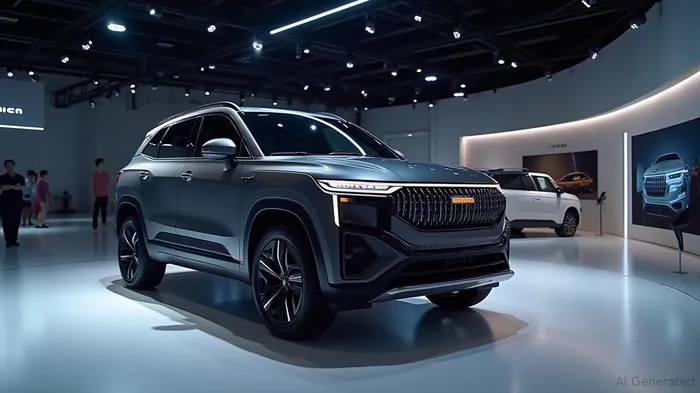
Xiaomi's YU7 electric SUV has ignited a seismic shift in China's EV market, with record-breaking pre-orders and pricing that could redefine industry dynamics. The SUV's launch in June 2025, which secured 289,000 pre-orders in its first hour, marks a pivotal moment for Xiaomi's EV ambitions—and a stark challenge to TeslaTSLA-- and BYD. This article examines how the YU7's success validates demand for affordable luxury EVs, leverages Xiaomi's supply chain prowess, and unlocks significant upside for its stock valuation.
Demand Surge Validation: A Landmark Moment for Xiaomi
The YU7's pre-orders—tripling the initial response to its sedan predecessor, the SU7—signal a paradigm shift for Xiaomi's EV strategy. Analysts had projected 100,000 pre-orders for the first 24 hours, but Xiaomi shattered expectations, with over 200,000 orders within three minutes. This surge is not merely a flash in the pan; it reflects pent-up demand for an EV that combines Tesla-beating specs (e.g., an 830 km range vs. Tesla's 719 km) with a 4% price discount over the Model Y.
The YU7's aggressive pricing and feature set—such as its lidar-enabled driver-assist system and electrochromic sunroof—are resonating with Chinese consumers, who have long prioritized value for money. Xiaomi's CEO, Lei Jun, had anticipated this demand, targeting 350,000 EV sales in 2025, up from 135,000 for the SU7 in 2024. The YU7's success could push that figure higher, validating Xiaomi's strategy of premium mass-market EVs.
Supply Chain Leverage: Xiaomi's Hidden Advantage
While Tesla and BYD battle inventory overhangs—BYD's dealer inventories hit 3.21 months in Q2 2025, versus the industry average of 1.38 months—Xiaomi's supply chain integration offers a competitive edge. The company's smartphone manufacturing expertise has been repurposed to build its EV factories, with Phase 2 of its EV plant now operational to meet YU7 demand.
Crucially, Xiaomi's $20 billion investment over five years in EV tech (including battery R&D and AI chips) positions it to scale production without the bottlenecks plaguing rivals. Unlike Tesla, which relies heavily on US semiconductor imports, Xiaomi is pivoting to domestic suppliers, mitigating geopolitical risks. This self-reliance, combined with its 9-color customization options, allows it to pivot quickly to market preferences.
Tesla's declining stock price—down 30% since mid-2024—contrasts sharply with Xiaomi's ascent. The YU7's pricing pressure has already forced Tesla to consider incentives, signaling a strategic retreat in China's EV battleground.
Competitive Positioning: Xiaomi vs. BYD and Tesla
BYD, once untouchable with a 36% NEV market share, faces slowing growth as its Song SUV's sales dropped 15% YoY in Q2 2025. Meanwhile, Tesla's China sales fell 30% YoY in May, with its Model Y ceding the top SUV spot to the YU7. Xiaomi's 28.9% YTD market share growth in China's EV sector underscores its disruptive potential.
The YU7's specs and pricing are no accident:
- Price: Starts at ¥253,500 ($35,360), undercutting the Model Y by ¥10,000.
- Range: 830 km (CLTC) vs. Tesla's 719 km.
- Tech: Free driver-assist software (vs. Tesla's ¥64,000 FSD charge).
These advantages have forced BYD and Tesla to recalibrate. BYD's production cuts in Q2 and Tesla's export declines (down 33% YTD) highlight their vulnerability to Xiaomi's value-driven assault.
Stock Valuation Upside: Xiaomi's $200 Billion Runway
Xiaomi's stock surged 8% post-YU7 launch, hitting a record high of HK$61.45, with Goldman SachsGS-- raising its target to HK$69. The company's market cap now exceeds ¥1.55 trillion ($197.5 billion), surpassing BYD's valuation.
The earnings catalysts are clear:
1. Volume Growth: Xiaomi aims for 350,000 EV sales in 2025, but YU7 pre-orders suggest it could hit 400,000+.
2. Margin Expansion: The YU7's higher price point (vs. the SU7) and economies of scale could push EV gross margins to 15-20% by 2026.
3. Ecosystem Synergy: Pairing EVs with Xiaomi's AI glasses, smart home devices, and foldable phones creates a $350 billion connected ecosystem play.
Risks and Investment Thesis
Risks remain:
- Regulatory Scrutiny: A fatal SU7 accident led to stricter assisted-driving rules.
- Price Wars: BYD and Tesla may retaliate with deeper discounts.
- Supply Chain Hiccups: Scaling production for the YU7's second half deliveries could strain resources.
Investment Advice:
- Buy the Dip: Xiaomi's stock is up 70% YTD but remains undervalued relative to its EV growth trajectory.
- Hold for Long-Term: The YU7's success could cement Xiaomi as China's #2 EV player by 2026, with global ambitions.
Conclusion
The YU7's pre-order frenzy is more than a sales win—it's a strategic masterstroke that reshapes EV leadership. Xiaomi has validated demand for affordable luxury EVs, leveraged its supply chain agility, and unlocked stock upside. While BYD and Tesla adjust, Xiaomi is positioned to capitalize on China's $500 billion EV market, making it a compelling buy for investors betting on the next EV giant.
Disclosure: This analysis is for informational purposes only and not financial advice. Always conduct your own research before investing.

Stay ahead of the market.
Get curated U.S. market news, insights and key dates delivered to your inbox.
AInvest
PRO
AInvest
PRO



Comments
No comments yet