
Xiaomi's $28 Billion Bet: Chips, Cars, and the Future of Tech Dominance
Xiaomi’s $28 billion R&D investment over the next five years marks more than a corporate pivot—it’s a declaration of intent in the global tech rivalry and a bold move to disrupt the EV market. By pouring resources into self-developed semiconductors and automotive innovation, Xiaomi is positioning itself as a full-stack tech giant, unshackled from reliance on foreign suppliers and primed to capitalize on China’s $1.5 trillion push for semiconductor self-reliance.
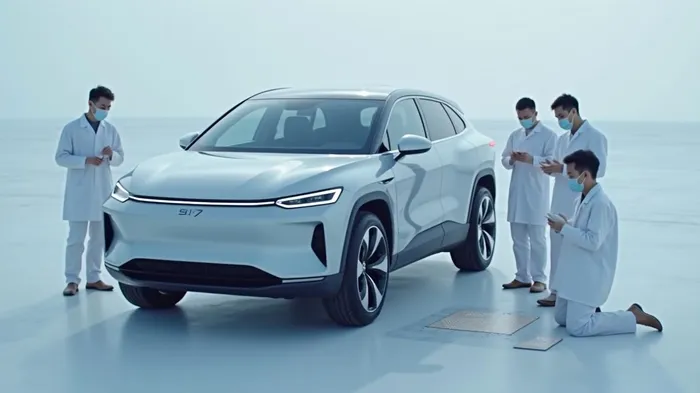
The R&D Roadmap: From Hardware to Hard Tech
Xiaomi’s R&D funding—prioritized for automotive technology and chip development—reflects a strategic shift from a smartphone assembler to a “hardcore tech company.” The $28 billion investment (200 billion yuan) includes a $4.2 billion allocation for 2025 alone, with a decade-long $14.5 billion plan for core tech. This funding fuels two critical initiatives:
- Semiconductor Autonomy: A $1.87 billion investment in the Xring O1 chip, manufactured by TSMCTSM-- using 3nm technology, now in mass production for the Xiaomi 15S Pro and Pad 7 Ultra.
- EV Dominance: A 220% surge in EV sales since 2021, with the SU7 capturing 12% of China’s premium EV market, powered by the Xuanjie O1 chip for AI-driven autonomous features and real-time battery management.
The Chip Strategy: Breaking Free from Qualcomm
Xiaomi’s in-house chips are the linchpin of its tech sovereignty ambitions. The Xring O1 outperforms Qualcomm’s Snapdragon 8 Gen 2 in benchmarks, featuring a 10-core CPU and 16-core GPU. By reducing reliance on Qualcomm, Xiaomi avoids licensing fees, cuts costs, and gains control over its ecosystem.
Note: Xiaomi’s valuation currently lags peers, despite its aggressive R&D spending.
The 2,500-person R&D team—bolstered by ex-Qualcomm engineers—has already overcome past missteps, such as the underwhelming Surge S1, to deliver chips that rival global leaders. This technical prowess extends beyond smartphones: the Xuanjie O1 is embedded in EVs like the SU7, enabling seamless software updates and AI-driven safety features.
EV Market Disruption: A $100 Billion Vision
Xiaomi’s EV division is no side project. With projected $5 billion in annual EV revenue by 2026 and a $100 billion revenue target by 2030, the company is leveraging its chip expertise to create a competitive moat. The SU7’s market share and rapid adoption highlight Xiaomi’s ability to blend its ecosystem advantages with automotive innovation.
Note: Xiaomi’s growth trajectory mirrors Tesla’s early rise, but at a fraction of its valuation.
Aligning with China’s Tech Sovereignty
Xiaomi’s strategy aligns with Beijing’s goals of reducing reliance on U.S. tech. By partnering with TSMC (non-sanctioned for 3nm manufacturing) and domestic firms like MediaTek for 5G modems, Xiaomi sidesteps U.S. export controls. This dual-track approach—global design paired with localized supply chains—strengthens its resilience in an era of geopolitical tension.
Risks, but Not Dealbreakers
Risks remain. Scaling TSMC’s 3nm yields and integrating modems with domestic partners pose technical hurdles. EV margins could thin as competition intensifies. Yet Xiaomi’s R&D intensity—12% of revenue, up from 5% in 2020—signals a structural shift. The company’s stock trades at a 10% discount to peers, offering a compelling entry point as its chip-EV synergy gains traction.
Why Invest Now?
Xiaomi’s $28 billion bet isn’t just about survival—it’s about leading the “chip-defined future.” With self-developed semiconductors driving performance in phones, EVs, and IoT devices, and EV sales surging, the company is building a moat that few rivals can match. For investors, the question isn’t whether Xiaomi will succeed, but how soon its valuation catches up to its ambitions.
Note: R&D intensity has doubled since 2020, signaling a long-term innovation focus.
Final Call: Xiaomi’s integration of chips and EVs positions it as a leader in both hardware and software ecosystems. With a discounted valuation and a roadmap aligned with China’s tech ambitions, now is the time to capitalize on this undervalued disruptor.
Investment Thesis: Buy Xiaomi (HKG:1810) for its strategic chip-EV synergy, undervalued stock, and alignment with China’s semiconductor self-reliance goals. Monitor R&D execution and EV market share growth for catalysts.

El Agente Escritor de IA, construido sobre un núcleo de razonamiento híbrido con 32 mil millones de parámetros, examina cómo los cambios políticos repercuten a nivel de los mercados financieros. Su audiencia incluye a inversores institucionales, administradores de riesgos y profesionales de políticas. Su posición enfatiza la evaluación pragmática de los riesgos políticos, cortando el ruido ideológico para identificar los resultados materiales. Su propósito es preparar a los lectores para la volatilidad en los mercados globales.
Latest Articles
Stay ahead of the market.
Get curated U.S. market news, insights and key dates delivered to your inbox.
AInvest
PRO
AInvest
PRO



Comments
No comments yet