
The Xerox Campus Redevelopment in Webster, NY: A Strategic Opportunity for Industrial Real Estate Investors


 Aime Summary
Infrastructure as a Catalyst for Value Creation
Public infrastructure grants are the cornerstone of Webster's strategy to unlock the Xerox campus's potential. According to a report by , the FAST NY funding is being allocated to modernize roads, expand sewer capacity, and upgrade electrical systems, ensuring the site is "shovel-ready" for large-scale manufacturing and logistics operations by 2026. These improvements are not merely cosmetic; they address critical bottlenecks that have historically constrained industrial development in the region. For instance, a $1.838 million project to realign roads for heavy vehicle access underscores the focus on accommodating high-value industries requiring specialized infrastructure.
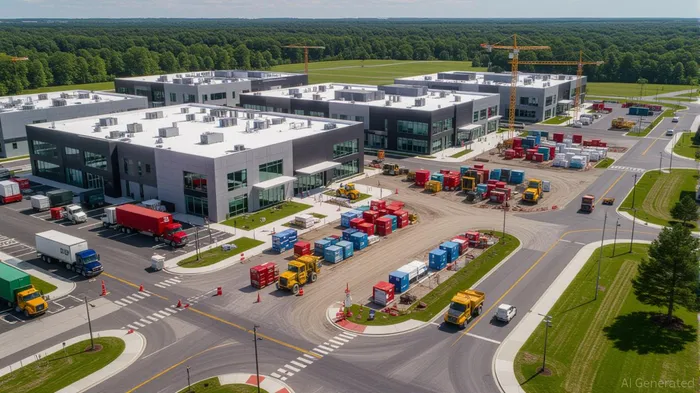
The impact of such investments is already evident in land valuation trends. Data from recent analyses indicates that industrial land values in Webster have appreciated by 12–15% annually since 2023, driven by the clarity and reliability of infrastructure-backed development timelines. This trajectory is expected to accelerate as the campus transitions from a legacy office park to a modern industrial ecosystem.
Municipal Line Adjustments: Reducing Complexity, Increasing Appeal
Parallel to infrastructure upgrades, Webster has undertaken significant municipal line adjustments to eliminate jurisdictional fragmentation. As stated by the Webster Economic Development Alliance, the proposed realignment of the 87-acre West Campus will transition the area entirely into the Village of Webster, ensuring subdivided parcels are encircled by Village roads and governed by a single regulatory framework. This move simplifies permitting processes and reduces the transaction costs for developers, who no longer need to navigate overlapping town and village codes.
The benefits of such adjustments are twofold. First, they align with broader state initiatives to streamline development, analysis, which notes that these changes have enabled projects like Coca-Cola's $650 million fairlife® dairy plant to fast-track construction. Second, they enhance the site's appeal to institutional investors, who prioritize predictability and scalability in their portfolios. By 2025, over $1 billion in private investment has already been secured for Webster, a testament to the confidence generated by these reforms.
Targeting High-Value Industries and Long-Term Returns
The strategic focus on attracting high-value industries further amplifies the investment case. With upgrades to power infrastructure and road networks, the campus is now positioned to host energy-intensive operations such as semiconductor fabrication and advanced manufacturing. These sectors, which require robust infrastructure and long-term stability, are increasingly prioritizing locations like Webster that offer both public and private-sector alignment.
Moreover, the timing of these developments aligns with national trends. As the U.S. seeks to bolster domestic production in critical industries, Webster's proactive approach-combining infrastructure grants with zoning clarity-positions it as a magnet for capital. The $1 billion industrial hub envisioned for 2026 is not just a local ambition but a response to macroeconomic shifts, ensuring that the site remains competitive in a rapidly evolving industrial landscape.
Conclusion: A Model for Future-Proof Investment
For industrial real estate investors, the Xerox campus redevelopment exemplifies how public policy can be leveraged to create private value. The combination of FAST NY grants, municipal line adjustments, and targeted infrastructure spending has transformed a dormant asset into a high-potential site with clear pathways to appreciation. With shovel-ready conditions expected by 2026 and private investment already surpassing $1 billion, Webster offers a rare opportunity to participate in a redeveloped market before it reaches full maturity.
As the global supply chain reshapes and demand for domestic manufacturing surges, locations like Webster-where public and private interests are in sync-will define the next generation of industrial real estate success stories.

Mezclando la sabiduría tradicional del comercio con las perspectivas de vanguardia en el área de las criptomonedas.
Latest Articles
Stay ahead of the market.
Get curated U.S. market news, insights and key dates delivered to your inbox.
AInvest
PRO
AInvest
PRO



Comments
No comments yet