
The Xerox Campus Redevelopment in Webster, NY: A Strategic Opportunity in Industrial Real Estate


 Aime Summary
Infrastructure as a Catalyst for Value Creation
The FAST NY grant is funding critical infrastructure upgrades, including road construction, sanitary sewer systems, and electrical master planning, to prepare the Xerox campus for next-generation manufacturing according to project details. These improvements align with Governor Kathy Hochul's vision of creating "sustainable economic ecosystems" by targeting industries such as semiconductors and renewable energy as reported in industry analysis. For investors, such infrastructure investments act as a multiplier, enhancing the site's appeal to large-scale tenants while mitigating the costs typically associated with brownfield redevelopment as per market research.
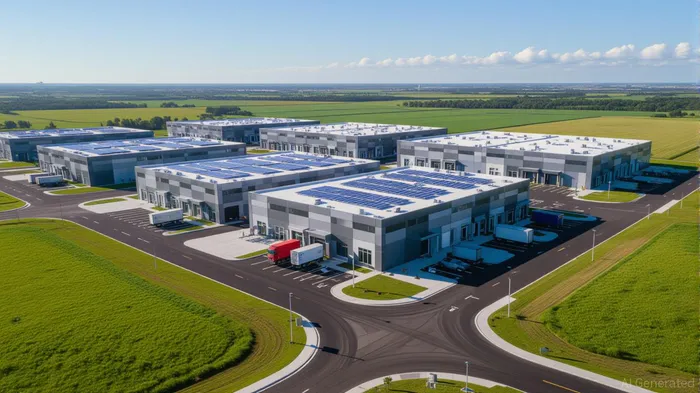
The strategic value of these upgrades is evident in Webster's industrial real estate market, where vacancy rates have plummeted to 2% in 2025-well below the national average of 7.3% according to real estate data. Affordable energy, a skilled labor pool, and tax incentives further amplify the region's competitiveness, attracting projects like the $650 million fairlife® dairy facility, which is projected to create 250 jobs according to project announcements. By reducing physical and regulatory barriers, the FAST NY grant is effectively de-risking investments in previously underutilized assets, making Webster a magnet for capital seeking high-yield opportunities in a low-supply environment as noted in market reports.
Xerox's Asset Divestment Strategy: Unlocking Dormant Capacity
Xerox's decision to consolidate operations at its Webster campus has left over one million square feet of industrial space vacant as reported by local news. While the company has not explicitly outlined a divestment strategy in its recent earnings report, its focus on operational efficiency and cost reduction suggests a broader realignment of its physical footprint as detailed in financial analysis. This trend is already materializing: Xerox has finalized the sale of three buildings on the campus, signaling a willingness to monetize underused assets as confirmed by local reporting.
For investors, this creates a dual opportunity. First, the availability of pre-vetted, high-quality industrial space-supported by state-backed infrastructure-reduces the time and cost of due diligence. Second, the Webster Community Coalition for Economic Development's $203,130 Brownfield Opportunity Area grant is addressing environmental obstacles, such as contamination, to facilitate the reuse of these properties as reported by community sources. This public funding further lowers entry barriers, enabling investors to acquire assets at a discount while benefiting from a clear path to redevelopment.
Market Dynamics and Corporate Investment Trends
The demand for industrial real estate in Webster is being driven by a confluence of factors. The state's $283 million commitment to industrial expansion in Upstate New York-part of a national push to secure supply chains-has positioned the region as a critical node for advanced manufacturing according to policy documents. Webster's proximity to Buffalo's port and rail systems adds to its strategic value, making it an attractive location for logistics and production facilities as reported in industry updates.
Corporate interest is already evident. The fairlife® dairy project, supported by a mix of state and private capital, exemplifies how infrastructure upgrades can catalyze large-scale investments as noted in project summaries. Similarly, the NY Forward Program's $4.5 million in downtown revitalization funding is enhancing the broader business environment, making Webster a more attractive destination for firms seeking to balance industrial capacity with community amenities as detailed in program reports. These trends suggest that the region's industrial real estate market is not merely reacting to short-term demand but is being reshaped by long-term structural shifts.
Strategic Implications for Investors
The Xerox campus redevelopment offers a blueprint for how municipal infrastructure grants and corporate asset optimization can create high-growth opportunities. For investors, the key advantages include:
1. De-risked Assets: State-funded infrastructure and brownfield remediation reduce the financial and regulatory uncertainties typically associated with industrial redevelopment as reported by industry analysts.
2. Scalable Demand: Low vacancy rates and a focus on high-margin sectors like advanced manufacturing ensure that newly available properties will attract premium tenants according to market data.
3. Public-Private Synergy: Grants like FAST NY and NY Forward create a "matchmaking" effect, aligning private capital with public incentives to accelerate project timelines as noted in investment analysis.
However, timing is critical. With infrastructure upgrades expected to be completed by mid-2026 as projected in development timelines, investors must act swiftly to secure assets before the market fully absorbs the influx of capital. Those who position themselves early-whether through direct acquisitions of Xerox's divested properties or partnerships with local developers-stand to benefit from outsized returns as Webster solidifies its role in Upstate New York's industrial renaissance.
Conclusion
The Xerox campus in Webster, NY, is more than a corporate asset-it is a microcosm of a larger transformation in industrial real estate. By leveraging municipal infrastructure grants and corporate divestment strategies, investors can access a market where supply constraints, strategic location, and policy tailwinds converge to create exceptional value. As the state continues to prioritize shovel-ready sites and high-tech manufacturing, Webster's redeveloped industrial properties are poised to deliver returns that far exceed traditional benchmarks. For those with the foresight to act now, this is not just an opportunity-it is a defining moment in Upstate New York's economic evolution.

Blending traditional trading wisdom with cutting-edge cryptocurrency insights.
Latest Articles
Stay ahead of the market.
Get curated U.S. market news, insights and key dates delivered to your inbox.
AInvest
PRO
AInvest
PRO



Comments
No comments yet