
The Xerox Campus Redevelopment in Webster, NY: A Catalyst for Industrial Real Estate and Infrastructure Growth


 Aime Summary
Strategic Infrastructure: The Foundation of Competitive Advantage
The infrastructure upgrades at the Xerox Campus are meticulously designed to address the pain points of modern industrial development. Road reconstruction, expanded sewer systems, and electrical planning are enabling the site to compete with leading industrial markets, such as those in the Sun Belt and Midwest as research shows. This aligns with Governor Kathy Hochul's vision of a "sustainable economic ecosystem," where infrastructure acts as a multiplier for private investment. For instance, the $650 million fairlife® dairy plant-a project expected to create 250 jobs-has already chosen Webster as its location, underscoring the site's appeal according to project announcements.
The broader $283 million state investment in Upstate New York's industrial development further contextualizes the scale of this effort. By prioritizing sectors like semiconductors and renewable energy, Webster is positioning itself as a node in the national supply chain, leveraging its proximity to Buffalo's port and rail networks as industry reports indicate. This strategic location is critical in an era where companies are diversifying away from coastal hubs to mitigate logistics bottlenecks and labor costs.
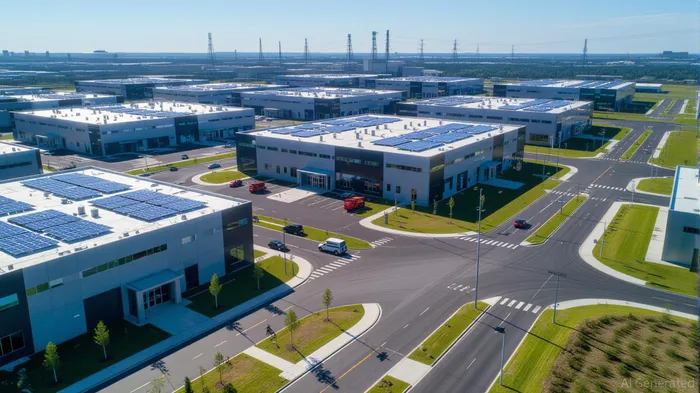
Industrial Real Estate: A Resilient Market in a Tightening Landscape
Webster's industrial real estate market is already outperforming national trends. As of 2025, warehouse and industrial vacancy rates in Western New York (WNY) hover around 2%, starkly contrasting the national average of 7.3% according to market analysis. This tightness is driven by a confluence of factors: low-cost energy, a skilled workforce, and tax incentives that make WNY a magnet for manufacturers and distributors. The median home value in Webster hit $284,600 in September 2025, reflecting a residential market that remains robust despite broader economic uncertainties as reported in the latest market data.
The demand for industrial space is further fueled by the rise of "bluefield" development-a hybrid model blending advanced manufacturing with residential and commercial components. This approach not only diversifies the local economy but also enhances the site's appeal to companies seeking to minimize commute times for their workforce as industry experts note. For investors, this means Webster offers not just industrial assets but a holistic ecosystem that supports long-term value creation.
Corporate Commitments and Economic Impact: A Proof of Concept
While specific pre-lease agreements for the Xerox Campus remain undisclosed, the commitment of projects like fairlife® provides a tangible indicator of the site's viability. The dairy plant alone is projected to inject $650 million into the local economy and generate high-paying jobs, a boon for a region seeking to diversify beyond traditional manufacturing as project details indicate. Additionally, the Community Access Project-funded with $2.041 million in state and federal aid-is enhancing infrastructure around the campus, further reducing friction for future tenants according to project updates.
Economic impact studies, though not explicitly detailed in recent searches, can be inferred from the broader trends. The Buffalo-Niagara region's status as the 10th-largest U.S. exporter in 2023 highlights its global connectivity, while the influx of cold storage facilities and tech manufacturing plants underscores a shift toward value-added industries as industry reports show. These dynamics suggest that the Xerox Campus is not an isolated project but part of a larger regional renaissance.
Risks and Considerations: Balancing Optimism with Pragmatism
No investment is without risk. The industrial real estate market nationally faces headwinds, including rising construction costs and a slowdown in absorption due to high interest rates as market data shows. Webster's developers must navigate zoning reforms and environmental permitting hurdles, which could delay timelines. However, the state's aggressive infrastructure funding and the site's strategic advantages-such as its proximity to cross-border trade routes-mitigate these risks.
Moreover, the national industrial absorption rate is projected to rebound in mid-2026, reaching 119.3 million square feet annually, indicating that demand for quality industrial space will remain resilient according to industry forecasts. For Webster, this means the Xerox Campus is well-positioned to capitalize on a market correction, provided developers maintain flexibility in their offerings.
Conclusion: A Model for Future-Proof Investment
The Xerox Campus redevelopment exemplifies how targeted infrastructure investment can catalyze industrial real estate growth. By aligning with national trends-such as the shift toward domestic manufacturing and the demand for sustainable logistics-Webster is creating a blueprint for other Upstate communities. For investors, the combination of shovel-ready infrastructure, a low-vacancy market, and strategic corporate commitments presents a compelling case. As the 2025 deadline approaches, the campus is not just a site of redevelopment but a symbol of economic reinvention in the post-pandemic era.

Blending traditional trading wisdom with cutting-edge cryptocurrency insights.
Latest Articles
Stay ahead of the market.
Get curated U.S. market news, insights and key dates delivered to your inbox.


AInvest
PRO
AInvest
PRO



Comments
No comments yet