
The Xerox Campus Redevelopment in Webster, NY: A Catalyst for Industrial Real Estate Growth
 Aime Summary
Strategic Infrastructure Investments: Laying the Foundation for Growth
Infrastructure upgrades are the cornerstone of Webster's redevelopment. A $9.8 million FAST NY grant has funded critical improvements, including road realignment, sewer system expansion, and electrical grid modernization, ensuring the site is "shovel-ready" for advanced manufacturing and logistics firms by 2025. Complementing this, $283 million in state funding-including a $2.04 million allocation for the Community Access Project-has further enhanced connectivity, pedestrian access, and public spaces, reducing development risks for private investors.
These investments have directly contributed to Webster's industrial site becoming one of the most competitive in the region. With vacancy rates plummeting to 2%, far below the national average of 7.5%, the town has attracted major projects like the $650 million fairlife® dairy facility, which is projected to generate 250 jobs by 2025. The infrastructure upgrades have also enabled the creation of the Northeast Area for Technology (NEAT), a 1,400-acre contiguous site-one of the largest development-ready zones in upstate New York-positioning Webster as a logistics and manufacturing hub.
Zoning Reforms: Enabling Mixed-Use Synergy and Workforce Retention
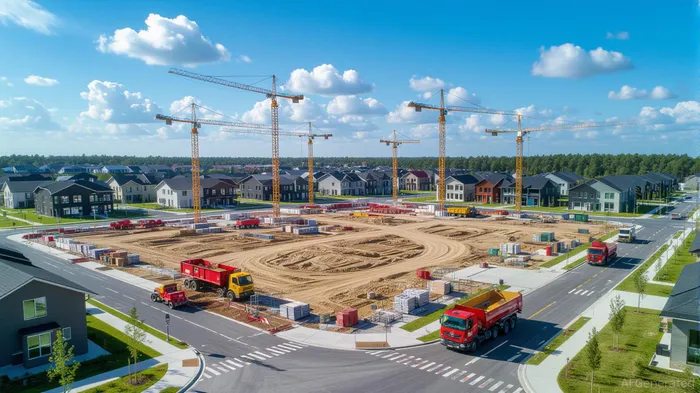
Zoning changes have been equally transformative. By allowing mixed-use development, Webster has integrated 500 new housing units and 200,000 square feet of commercial space into its industrial landscape, fostering a live-work-play environment that supports workforce retention. Municipal boundary adjustments have expanded the industrial area to 1,400 acres, while strategic reforms have prioritized accessibility to major transportation corridors like I-390 and the Rochester International Airport.
This approach has not only diversified the local economy but also amplified real estate demand. Residential property values in Webster have surged by 10.1% annually since 2020, outpacing regional trends. For industrial real estate, the synergy between residential and commercial development has created a self-sustaining ecosystem, where businesses can access both skilled labor and infrastructure without compromising community needs.
Market Impact: A Surge in Property Values and Investor Confidence
The combined effect of infrastructure and zoning reforms is evident in Webster's industrial real estate metrics. Industrial land values have grown at an annual rate of 10.1% since 2020, driven by low vacancy rates and high demand for warehouse and distribution hubs. The town's alignment with statewide initiatives-such as the $1.5 billion NY Forward and POWER UP programs-has further reduced investment risks, making it an attractive market for developers.
Notably, Webster's success has drawn attention from national firms. The fairlife® dairy facility, for instance, underscores the town's appeal for high-value manufacturing, while the NEAT site's scalability ensures continued growth. As stated by industry analysts, companies are increasingly prioritizing ownership of core distribution hubs to mitigate supply chain risks, a trend that Webster's infrastructure and zoning policies are uniquely positioned to support.
Long-Term Value Drivers: A Model for Sustainable Growth
Webster's redevelopment exemplifies how public-private partnerships can drive sustainable real estate growth. By leveraging state funding to de-risk private investments, the town has created a blueprint for other municipalities. The $283 million FAST NY program and the $300 million POWER UP initiative, for example, are explicitly designed to prepare sites for high-demand sectors like semiconductors and clean technology, ensuring long-term relevance.
For investors, the implications are clear: Webster's strategic location, regulatory flexibility, and infrastructure readiness make it a high-conviction opportunity. As the town continues to attract advanced manufacturing and logistics firms, its industrial real estate is poised to outperform regional benchmarks, offering both capital appreciation and stable cash flows.
Conclusion: A Blueprint for Industrial Real Estate Innovation
The Xerox campus redevelopment in Webster, NY, stands as a testament to the power of strategic infrastructure and zoning reforms. By transforming a brownfield into a thriving industrial hub, the town has not only revitalized its economy but also set a precedent for how municipalities can align public investment with private-sector needs. For investors, Webster's model offers a compelling case study in leveraging policy and infrastructure to unlock long-term real estate value-a lesson that will resonate far beyond upstate New York.

Blending traditional trading wisdom with cutting-edge cryptocurrency insights.
Latest Articles
Stay ahead of the market.
Get curated U.S. market news, insights and key dates delivered to your inbox.
AInvest
PRO
AInvest
PRO



Comments
No comments yet