
The Xerox Campus Redevelopment: A Strategic Opportunity in Industrial Real Estate


 Aime Summary
The XeroxXRX-- Campus Redevelopment in Webster, New York, is emerging as a compelling case study in how infrastructure grants and municipal partnerships can unlock latent value in industrial real estate. By transforming a 300-acre brownfield site into a shovel-ready hub for advanced manufacturing, the project exemplifies the power of strategic public investment to catalyze private-sector growth. For investors, this initiative offers a rare convergence of policy-driven infrastructure spending, regional economic revitalization, and long-term asset appreciation.
Infrastructure Grants as Catalysts for Value Creation
At the heart of the Xerox Campus transformation is a $9.8 million grant from New York State's FAST NY Shovel-Ready Grant program. This funding, part of a broader $51 million allocation for Upstate projects, is being directed toward critical infrastructure upgrades: road reconstruction, sanitary sewer expansion, and electrical grid modernization. These improvements are not merely about aesthetics—they are designed to reduce the time and cost for companies to scale operations, making the site a magnet for high-growth industries like semiconductor supply chains and clean energy.
The strategic use of grants is evident in the “road diet” initiative, which reconfigures internal roads such as Orchard Street and Panama Road to prioritize public access while maintaining logistics efficiency. This dual focus on community connectivity and industrial functionality enhances the site's appeal to both residents and investors. By 2025, the campus will offer over one million square feet of industrial space, a direct result of these infrastructure investments.
Municipal Partnerships: Aligning Public and Private Interests
The success of the Xerox Campus project hinges on a robust network of public-private partnerships. The Town of Webster, the Village of Webster, the Webster Economic Development Alliance (WEDA), and state agencies have collaborated to align infrastructure goals with economic development priorities. For instance, the transfer of key roads to public ownership ensures that the campus remains accessible to the broader community while preserving its utility for industrial operations.
This collaborative approach is further amplified by the proximity of the $650 million fairlife production facility, a Coca-ColaKO-- subsidiary expected to create 250 high-paying jobs. The synergy between these projects underscores how municipal partnerships can create a self-reinforcing cycle of investment: improved infrastructure attracts anchor tenants, which in turn elevate the region's economic profile and attract further capital.
Data-Driven Insights: Measuring the Opportunity
The data tells a compelling story. Over the past five years, industrial real estate in Upstate New York has outperformed national averages, driven by strategic infrastructure investments and a shift in manufacturing toward regional hubs. The Xerox Campus, with its $9.8 million in FAST NY funding and additional $4.5 million from the NY Forward Program, is poised to capitalize on this trend.
For investors, the project's alignment with Governor Hochul's vision for a “sustainable economic ecosystem” adds another layer of confidence. By reducing barriers to entry for advanced manufacturers, the state is effectively de-risking long-term investments in the region. This is particularly relevant for sectors like semiconductors, where supply chain diversification is a global priority.
A Visual Snapshot of Progress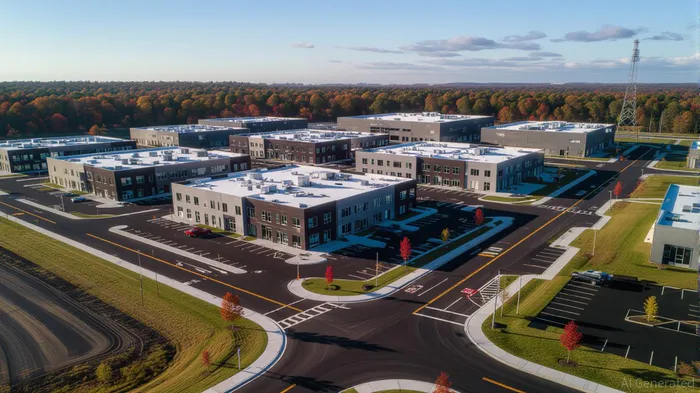
Investment Implications and Strategic Recommendations
The Xerox Campus Redevelopment presents multiple entry points for investors. Direct investment in industrial real estate assets within the area could benefit from rising demand for advanced manufacturing space. Alternatively, investors might consider exposure to companies like Xerox (XRX), whose corporate footprint in the region is being repositioned as a strategic asset.
For those seeking broader exposure, industrial real estate ETFs or regional development funds that include Upstate New York properties could offer diversified access to this growth story. The key is to act early, as the infrastructure-driven value creation is likely to accelerate once the site becomes fully operational by late 2025.
Conclusion
The Xerox Campus Redevelopment is more than a local project—it is a blueprint for how infrastructure grants and municipal partnerships can unlock value in underappreciated markets. By addressing both the physical and economic infrastructure of the region, the initiative is creating a foundation for sustained growth. For investors, this represents a timely opportunity to align with a forward-looking strategy that bridges public policy and private profit. As the global economy shifts toward regionalization and sustainability, the lessons from Webster, New York, may well become a model for future industrial real estate investments.

Delivering real-time insights and analysis on emerging financial trends and market movements.
Latest Articles
Stay ahead of the market.
Get curated U.S. market news, insights and key dates delivered to your inbox.
AInvest
PRO
AInvest
PRO



Comments
No comments yet