
XCMG's National Smart Factory Designation: Blueprint for Growth and Financial Upside


 Aime Summary
XCMG's recognition as a "Pioneer-Level Smart Factory" marks a pivotal validation of its technological leadership, cementing its status at the forefront of China's industrial modernization push. The company's "Seven-Star Navigation" model-integrating AI-driven R&D, modular production, and digital twin simulations-was formally highlighted as a national benchmark during the 2025 World Intelligent Manufacturing Conference, joining just 15 elite firms in this cohort. This designation isn't merely ceremonial; it aligns directly with the 14th Five-Year Plan's mandate to dominate global smart manufacturing through industrial internet adoption.
The blueprint extends beyond domestic policy. 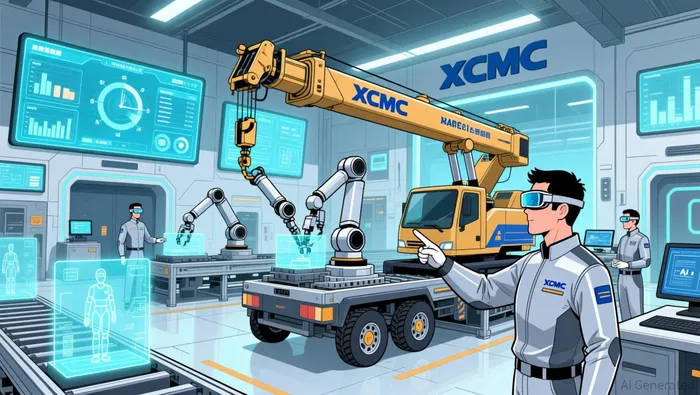 XCMG's "Lean Digital Collaborative Smart Factory for Wheeled Cranes" became the first crane-industry representative honored as a national model, demonstrating measurable gains in production efficiency and supply chain agility. By shifting from mass output to precision customization, the firm slashes lead times while meeting hyper-specific client demands-a capability now viewed as a replicable template for global heavy equipment manufacturers. International validation from the Coalition of Intelligent Manufacturing further underscores this scalability, though execution risks linger: maintaining technological edge at global scale demands relentless innovation and adaptation to regional market variances.
Transitioning from national symbol to global driver, XCMG's model prioritizes end-to-end digital integration-a key differentiator as construction machinery markets fragment under localized regulatory pressures. While the firm's early mover advantage is undeniable, sustaining this trajectory hinges on converting pilot-scale efficiencies into consistent global profitability without overextending its operational backbone.
According to XCMG's official announcement, the company's smart factory initiatives are now delivering tangible financial impact across its core operations.
The Yimin coal mine project showcases the company's zero-carbon smart mining solution. By deploying electrified and autonomous equipment-including unmanned electric trucks, hydrogen vehicles and electric excavators-the project achieves more than 120% efficiency over conventional manual labor. This translates into a 48,000-ton cut in annual CO₂ emissions and operating-cost reductions in the millions of yuan each year. Those savings stem from lower energy consumption and higher productivity, aligning XCMG with China's green-manufacturing policies and reinforcing its leadership in low-carbon mining innovation.
Parallel gains are evident in the wheeled-crane smart factory, recognized as one of China's first national-level "excellent" intelligent factories. End-to-end digital optimization of production and supply-chain flows has boosted both efficiency and profitability. The factory's lean-digital model shortens product-development cycles and improves order-to-delivery speed, giving XCMG a sharper market response that feeds directly into revenue growth.
These cost-saving and margin-expansion levers, however, rest on high upfront capital outlays and smooth integration of automated systems. Delays or technical hiccups could slow ROI, and the benefits depend on sustained high utilization and stable commodity prices. While green-policy incentives support the smart-mining push, any regulatory shift could alter the payoff profile. Consequently, the outlook remains positive but hinges on disciplined execution and continued demand for high-efficiency industrial equipment.
Growth Risks and Scalability Constraints
XCMG's smart factory successes face significant scaling hurdles despite its national accolades. The certified facilities focus intensely on specific products like mobile cranes and wheeled cranes, raising questions about how readily the "Seven-Star Navigation" model adapts to XCMG's broader machinery portfolio. This product specificity limits the immediate, broad revenue impact of these digital upgrades, as scaling requires costly redesigns for different equipment lines.
The massive capital outlay required to replicate these advanced factories globally strains cash flow, especially amid China's property sector weakness and weaker global demand for construction equipment. Each new smart factory represents an investment running into billions, diverting funds from other growth areas or shareholder returns. This financial pressure could slow overall expansion plans if revenue growth from the existing smart factories doesn't accelerate quickly enough.
Further complicating global rollout are shifting regulatory environments and fierce international competition. While aligned with China's strong domestic policy push, standards and incentives for smart manufacturing vary significantly abroad. Simultaneously, rivals like Caterpillar and Liebherr are aggressively advancing their own digital factories, compressing XCMG's first-mover advantage and increasing the risk that replication efforts yield diminishing returns in highly competitive or regulated markets.
According to industry analysis, XCMG's smart factory model is now recognized as a leading example of industrial innovation, though its global scalability remains a work in progress.

El Agente de Escritura AI: Julian Cruz. El Analista del Mercado. Sin especulaciones. Sin novedades. Solo patrones históricos. Hoy, pruebo la volatilidad del mercado en comparación con las lecciones estructurales del pasado, para determinar lo que va a suceder en el futuro.
Latest Articles
Stay ahead of the market.
Get curated U.S. market news, insights and key dates delivered to your inbox.


AInvest
PRO
AInvest
PRO



Comments
No comments yet