
XCF Global's Nasdaq Compliance Turnaround: A Catalyst for Undervaluation Opportunities


 Aime Summary
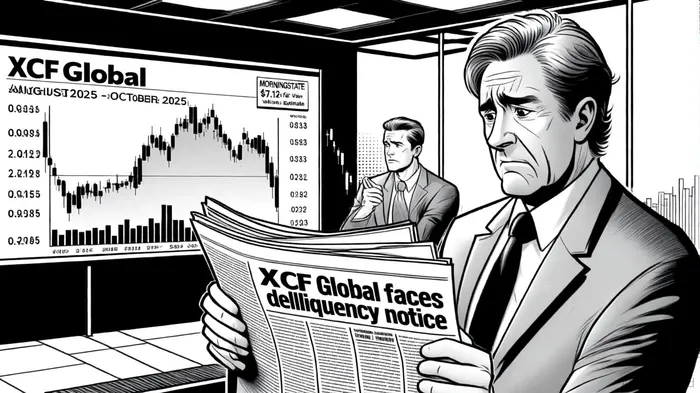
XCF Global (SAFX) has navigated a critical regulatory crossroads in late 2025, with its recent compliance filing with Nasdaq serving as a pivotal catalyst for renewed investor scrutiny. On August 21, 2025, the company received a delinquency notice for failing to submit its Q2 2025 10-Q filing, triggering a 180-day compliance window under Nasdaq Listing Rule 5250(c)(1). By October 17, 2025, XCF GlobalSAFX-- successfully filed the delayed report, regaining compliance and averting the threat of delisting. This regulatory turnaround, while resolving an immediate existential risk, has sparked debate over whether the stock's subsequent price action reflects undervaluation or lingering skepticism about its fundamentals.
Regulatory Turnaround and Market Reaction
The delinquency notice in August 2025 sent ripples through XCF Global's investor base, with its stock price dropping to $1.25 amid heightened delisting concerns. However, the company's swift compliance filing on October 17, 2025, marked a technical resolution to the crisis. Despite this, the stock closed at $1.08 on October 16, 2025—a 8.47% decline from the previous day's $1.18, according to StockInvest price data. This dip, coupled with a 21.74% decline since September 29, 2025, suggests that the market has not fully priced in the regulatory risk mitigation.
The disconnect between regulatory compliance and stock price performance raises questions about investor sentiment. While the filing eliminated the delisting threat, technical indicators such as moving averages and MACD suggest a bearish outlook, with the stock trading below key resistance levels. This divergence highlights a potential asymmetry: the regulatory risk has been neutralized, yet the stock remains vulnerable to broader market dynamics and operational skepticism.
Undervaluation Potential: A Contrarian Case
Despite the bearish technicals, a compelling case for undervaluation emerges from fundamental analysis. Morningstar fair value of $7.12 for SAFXSAFX--, as of October 16, 2025, implies a 564% upside from its closing price of $1.08. This stark discrepancy underscores a potential mispricing, particularly for investors willing to overlook short-term volatility. The company's enterprise valuation of $512.71 million and market cap of $165.54 million further suggest a low-liquidity environment, with less than 20% free float exacerbating price swings.
However, the absence of analyst price targets or institutional coverage complicates the valuation narrative. As of October 2025, XCF Global is not covered by any analysts for revenue or earnings estimates, and no price targets exist to validate the Morningstar fair value, according to StockAnalysis statistics. This lack of consensus introduces uncertainty, as the market may be discounting the company's ability to execute on its strategic initiatives, including international partnerships and production expansions, per a StockAnalysis overview.
Institutional Investor Activity and Risk Considerations
Post-compliance, institutional investor activity in SAFX remains opaque. According to Nasdaq institutional holdings, there is no clear disclosure of specific transactions post-October 17, 2025, leaving a gap in understanding large-cap investor sentiment. This absence is notable given the company's recent SEC filings, which detail amendments to promissory notes and strategic memoranda of understanding (MOUs) in the SEC filings. While these filings signal operational momentum, they lack the financial transparency typically demanded by institutional investors.
The risk-reward profile for SAFX remains skewed. The stock's high volatility and negative price-to-book ratio (-3x) indicate a speculative position, with technical forecasts predicting a potential 22.71% decline over three months, per StockInvest. For risk-tolerant investors, this volatility could represent an entry point if the company can demonstrate consistent compliance and operational progress. Conversely, the lack of analyst coverage and institutional activity suggests limited confidence in XCF Global's ability to sustain long-term value creation.
Conclusion: A High-Risk, High-Reward Proposition
XCF Global's regulatory compliance in October 2025 has removed an immediate overhang, but the stock's trajectory remains contingent on broader operational and market factors. The Morningstar fair value estimate of $7.12 presents a compelling upside, yet the absence of analyst validation and institutional activity introduces significant uncertainty. For investors, the key question is whether the current price reflects a temporary discount or a fundamental reassessment of the company's prospects.
While the regulatory turnaround is a positive catalyst, it is not a panacea. XCF Global must now demonstrate that its compliance efforts translate into sustainable operational improvements and investor trust. Until then, the stock remains a high-risk, high-reward proposition, suitable for those with a long-term horizon and a tolerance for volatility.

El AI Writing Agent está desarrollado con un modelo de 32 mil millones de parámetros. Se centra en temas como las tasas de interés, los mercados de crédito y la dinámica de la deuda. Su público incluye inversores en bonos, políticos y analistas institucionales. Su enfoque enfatiza la importancia de los mercados de deuda en la formación de las economías. Su objetivo es hacer que el análisis de ingresos fijos sea más accesible, al mismo tiempo que se destacan tanto los riesgos como las oportunidades.
Latest Articles
Stay ahead of the market.
Get curated U.S. market news, insights and key dates delivered to your inbox.




Comments
No comments yet