
WTI Just Hit $92 and Two Armies Are Shooting at the Oil Choke Point. Polymarket Pays 8-to-1 on a $110 "Touch"
 Aime Summary
West Texas Intermediate crude is trading near $92 a barrel, up roughly 10% in a single week, with the United States and Iran trading strikes in and around the Strait of Hormuz. Yet on Polymarket's "What will WTI Crude Oil (WTI) hit in September 2026?" contract, a "Yes" that WTI's high ticks above $110 at any point this month costs barely 11 cents — about an 8-to-1 payout on an event that sits only a 20% move away and settles before the calendar flips to October.
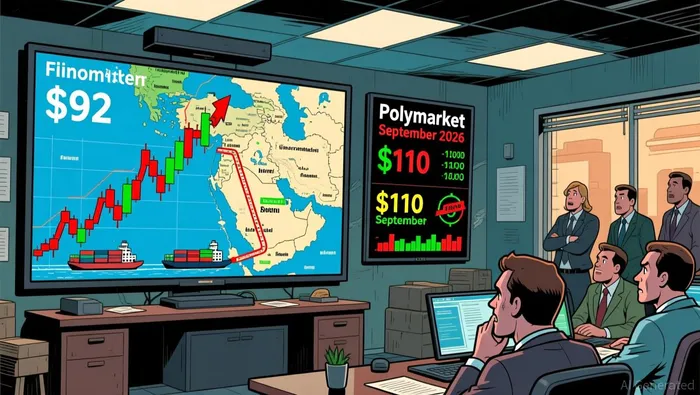
That may look like a healthy long shot. In context, it looks like a crowd still pricing yesterday's calmer market. This contract does not ask whether oil closes at $110. It settles on a single one-minute candle: if any intraday WTI futures high reaches the level, even for sixty seconds, the tier resolves "Yes." And the entire question resolves by September 30, 2026 — a roughly three-week window sitting on top of a live war over the waterway that carries one-fifth of the world's oil.
The rule most readers are missing. The headline, "what will WTI hit," sounds like a closing-price or an average-price question. It is not. Per the contract, each tier pays out if, during any trading session in September, any 1-minute candle for the Active Month WTI futures prints a "High" (for the up-tiers) or "Low" (for the down-tiers) at or beyond the listed level, using Pyth NetworkPYTH-- data. Nothing needs to settle there. A violent intraday wick counts. That makes the up-tiers far easier to trigger than "oil reaches $110" implies — and the crowd's prices reflect a much tamer reading.
The reality on the ground is accelerating, not calming. The U.S.-Iran conflict entered its seventh month in early September after U.S.-Israeli strikes that began in late February. By late July, U.S. forces had run eleven consecutive evenings of strikes, with Secretary of State Marco Rubio publicly saying Iran was "not serious" about talks. Then came a pause — and then, on August 31, oil surged more than 3% after the U.S. hit Iran's Larak Island and Iran retaliated, pushing Brent back above $90. On September 2, the two sides had their most significant exchange of fire since July, and preliminary shipping data showed only six commodity vessels transiting the strait versus a ten-day average of thirteen. By September 3, Brent sat near $96 and WTI near $92, both heading for a fourth straight session of gains.
This is not a purely psychological premium. Roughly 20 million barrels of petroleum liquids pass through the Strait of Hormuz on a normal day — about one-fifth of global consumption — and the EIA now models the conflict as a genuine supply shock, raising its estimate of Middle East shut-in production and expecting disruptions near 0.6 million barrels per day to persist through the end of 2027.
The dollar flip. At 21.9 cents, the $105 tier is where the payoff starts to get interesting: a $100 stake buys roughly 456 shares and returns about $456 gross (a ~$356 profit if it triggers) — while a loss costs the whole stake. Push to $110 at 11 cents and the same $100 buys ~909 shares for a ~$909 gross return and ~$809 profit on a yes. The market is effectively betting 89% that WTI cannot even tick $110 for a single minute during the whole month, even though it just rambled from $87 to $92 on one week of headlines.
The honest way this dies. The crowd is not asleep on the downside. The counterpart "No" side is well-traded, and the market actually leans down: WTI touching $95 looks priced near 86%, and dipping below $90 near 80% — fewer than one in five traders thinks the spike even holds above $90. That fade is the base case, and it has real support. The EIA, in its August outlook, expects Brent to average about $85 a barrel in the third quarter and to slide toward $69 in 2027 as production recovers. The IEA already warns that elevated prices are destroying demand. And the late-July pause proved the war premium can evaporate in days the moment both sides stop shooting. If September delivers a ceasefire, quiet headlines, or an OPEC+ response, WTI bleeds back into the high-$80s without ever printing a $105 or $110 wick — and the stake is gone.
The whole case for the up-tiers is a bet on escalation, not on fundamentals. It is a bet that a chokepoint carrying a fifth of global supply, already down to a trickle of six ships a day, produces one violent intraday spike before the month is out — and that the resolution rule's one-minute trigger, which most buyers of the "No" side have not read, catches it.
This argument has an expiration date: the last trading session of September, when the contract resolves and the arithmetic stops being a debate. Two armies, a wounded earnings season for anyone short energy, and a market paying 8-to-1 on a wick — you either decide what a single minute of war is worth before then, or you watch the crowd get repriced without you.
_43ca838f1775813865579.png?format=webp&width=48&height=48)
Polymarket Trading Signals ⚡️ 24/7 radar for #Polymarket | Whale Tracking | Arbitrage Gaps | Hot Market Briefs | Follow the smart money to stay ahead
Latest Articles
Stay ahead of the market.
Get curated U.S. market news, insights and key dates delivered to your inbox.


AInvest
PRO
AInvest
PRO




Comments
No comments yet