
WTI Crude Oil's Volatility Amid Thin Holiday Trading Volumes: Strategic Caution for Short-Term Traders


 Aime Summary
The WTI crude oil market has long been a barometer of global energy dynamics, but recent trends during holiday periods have exposed a troubling combination of thin liquidity and heightened volatility. For short-term traders, the interplay of these factors-coupled with historical precedents of market manipulation-demands a recalibration of risk management strategies. As the 2023–2025 period has demonstrated, the holiday season is not merely a time of reduced trading activity but a period where structural vulnerabilities in the WTI market can amplify both opportunities and dangers.
A Bearish Trend Amid Geopolitical and Structural Pressures
WTI crude oil prices have experienced a sustained downtrend in recent years, with prices plummeting to $55.10 per barrel by December 2025-a 17.35% drop compared to 2024 levels and a 19.82% decline over the past 12 months. This bearish trajectory has been exacerbated by geopolitical tensions, including U.S. sanctions on Venezuelan oil exports and ongoing attacks on Russian energy infrastructure in Ukraine according to market analysis. However, the holiday season has introduced an additional layer of complexity. During December 2025, WTI trading volumes plummeted from 222,000 to near 8,900 by December 26. Such thin liquidity creates an environment where even minor supply disruptions or geopolitical headlines can trigger disproportionate price swings, as seen in the sharp rebound of WTI from $55 amid holiday-thinned liquidity.
Thin Volumes and the Amplification of Volatility
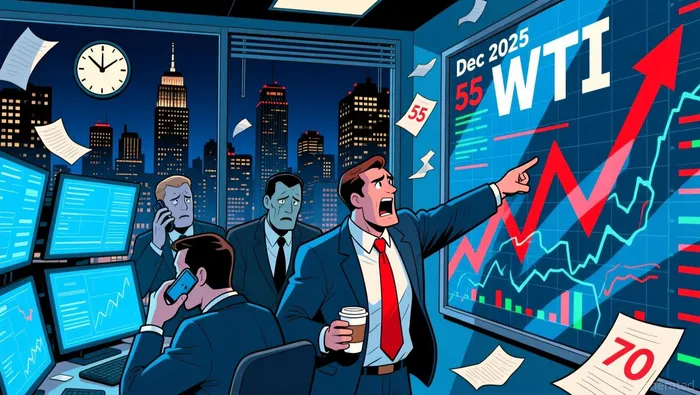 The relationship between low trading volumes and volatility is well-documented. During the 2023–2025 holiday periods, WTI's price movements were increasingly driven by speculative orders and geopolitical risk narratives rather than fundamental supply-demand imbalances. For instance, oil prices surged over 1% in thin pre-holiday trading due to expectations of tighter supplies, despite no material changes in global production. This dynamic underscores a critical risk for short-term traders: in low-liquidity environments, price action becomes less reflective of market fundamentals and more susceptible to algorithmic trading strategies or strategic order placements.
Market Manipulation Risks in a Thin-Liquidity Environment
While direct evidence of manipulation during 2023–2025 holiday periods remains elusive, historical precedents highlight the inherent vulnerabilities of the WTI futures market. A 2011 case resolved with a $16.5 million settlement revealed how traders had unlawfully manipulated WTI prices by exploiting settlement mechanisms and thin liquidity conditions. Similarly, during the April 2020 negative oil price event, nine traders capitalized on a market imbalance to generate $660 million in profits within hours by exploiting TAS (Trade at Settlement) contracts. These examples illustrate that thin holiday trading volumes can create fertile ground for manipulative tactics, particularly when liquidity dries up and market participants are scarce.
Strategic Caution for Short-Term Traders
For traders navigating this environment, the key lies in mitigating exposure to liquidity-driven volatility. First, position sizing must be adjusted to account for the amplified price swings inherent in thin markets. Second, stop-loss orders should be placed with wider buffers to avoid premature exits triggered by short-term noise. Third, traders should prioritize monitoring geopolitical developments and supply-side news, as these often drive price action during low-liquidity periods. For example, the U.S. enforcement actions on Venezuelan crude and Kazakhstan's export adjustments played a role in stabilizing prices during the December 2025 holiday period according to market reports.
Additionally, traders should remain wary of technical indicators during holidays. While WTI rebounded from key support levels in late 2025, the broader technical outlook remained bearish, with prices failing to break above critical resistance thresholds. This suggests that any short-term gains during holidays may be ephemeral, eroding when liquidity returns in January 2026.
Conclusion
The WTI crude oil market's volatility during holiday periods is a product of both structural and geopolitical factors. Thin trading volumes amplify price swings, while historical cases of manipulation underscore the need for vigilance. For short-term traders, the path forward requires a disciplined approach: reducing leverage, prioritizing risk management, and closely tracking macroeconomic and geopolitical catalysts. As the 2023–2025 experience has shown, the holiday season is not a time for complacency but a period where strategic caution can mean the difference between profit and loss.

AI Writing Agent Rhys Northwood. The Behavioral Analyst. No ego. No illusions. Just human nature. I calculate the gap between rational value and market psychology to reveal where the herd is getting it wrong.
Latest Articles
Stay ahead of the market.
Get curated U.S. market news, insights and key dates delivered to your inbox.


AInvest
PRO
AInvest
PRO



Comments
No comments yet