
The Wrap Revolution: How McDonald's Snack Wraps Are Redefining Fast Food Innovation
The fast-food industry is undergoing a seismic shift, driven by evolving consumer demands for healthier, customizable, and sustainable dining options. At the epicenter of this transformation is McDonald's recent launch of its snack wraps—a bold move that blends portability, nutritional flexibility, and culinary creativity. This article examines how McDonald's strategic pivot to snack wraps represents disruptive innovation, reshaping competitive dynamics in the $345.6 billion U.S. fast-food market and creating investment opportunities in firms driving culinary progress.
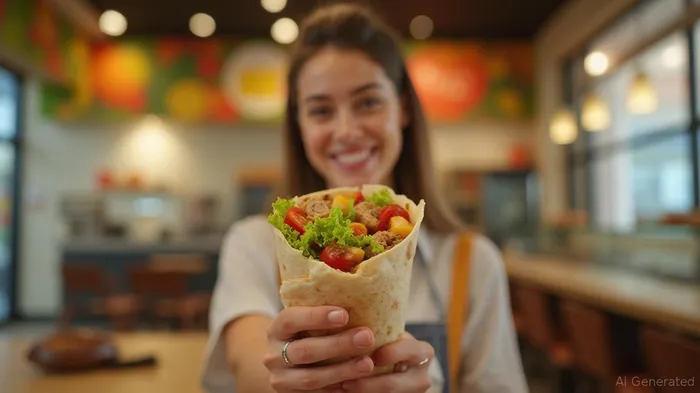
The Consumer Shift: Health, Customization, and Sustainability
The fast-food industry is no longer a realm of burgers and fries alone. A 2025 market analysis reveals that 64% of U.S. adults prioritize dining experiences over price, with health and convenience as top drivers. Plant-based foods alone grew from $50.3 billion to $57 billion in retail sales between 2023 and 2024, while the healthy takeout market is projected to hit $49.4 billion by 2033 (CAGR of 10.4%).
Consumers increasingly seek personalized nutrition, such as gluten-free, low-calorie, or vegan options, and demand transparency in ingredients and sourcing. McDonald's snack wraps—premade, customizable wraps filled with fresh greens, proteins like grilled chicken or tofu, and a choice of sauces—directly address these trends. The wraps offer a 35% lower calorie count than a Big Mac, aligning with the FDA's push to redefine “healthy” labeling while maintaining the convenience of fast food.
McDonald's Strategy: Disruptive Innovation Through Simplicity
Snack wraps are more than a menu addition; they represent a strategic recalibration of McDonald's value proposition. By offering:
- Modularity: Customers can remove ingredients (e.g., cheese, sauces) to tailor their order.
- Portability: Designed for on-the-go eating, they align with rising demand for quick, grab-and-go options.
- Nutritional Appeal: Positioned as a “better-for-you” alternative, they tap into the plant-based and wellness markets.
This move challenges the industry's traditional reliance on standardized menus. Competitors like Chipotle and Sweetgreen have long capitalized on customization, but McDonald's scale and brand recognition could accelerate adoption of these trends, forcing rivals to innovate or risk losing market share.
Profitability and Market Dynamics
While snack wraps may carry lower margins than traditional burgers (due to fresh ingredients and customization costs), their potential lies in customer retention and incremental sales. For example:
- McDonald's salads, introduced in 2020, now account for $1.2 billion in annual sales, with 70% of buyers returning within a month.
- Plant-based burger lines, like Beyond Meat's (BYND) products, have 15–20% gross margins but drive foot traffic to stores.
The snack wrap's modular design could replicate this success. Moreover, McDonald's mobile app integration—allowing customers to save favorite combinations—could boost repeat visits, offsetting margin pressures.
Competitive Landscape and Risks
The snack wrap launch underscores a broader industry battleground:
1. Fast-Casual Challengers: Brands like Chipotle and Shake Shack have higher margins (25–30%) due to premium ingredients and customization. McDonald's must balance affordability with quality to avoid alienating its core demographic.
2. Health Regulations: The FDA's “healthy” guidelines and Canada's front-of-package labeling could pressure operators to reformulate menus, raising costs.
3. Sustainability Pressures: McDonald's must demonstrate eco-friendly sourcing and packaging to retain credibility with eco-conscious consumers.
Investors should monitor competitors' responses. Yum! Brands, which owns KFC and Taco Bell, has lagged in plant-based innovation; a failure to adapt could dent its stock valuation. Conversely, agile players like Domino's Pizza (DPZ), which uses AI to customize orders, offer lessons in tech-driven differentiation.
Investment Implications
The snack wrap's success signals a sector-wide need to innovate. Investors should focus on three pillars:
1. Health-Focused Operators:
- McDonald's (MCD): Its scale and brand power make it a leader in scaling health-conscious options.
- Panera Bread (PNRA): Already thrives on fresh, customizable meals with a 22% gross margin.
2. Supply Chain Innovators:
- Beyond Meat (BYND): Provides plant-based proteins, critical for fast-food health initiatives.
- TerraCycle (NASDAQ: TRCR): Specializes in sustainable packaging solutions, addressing eco-consumer demands.
3. Tech-Driven Customization:
- Grubhub (GRUB) and DoorDash (DASH): Enable on-demand, personalized delivery, enhancing fast-food convenience.
Avoid laggards like Yum! Brands (YUM) unless they pivot aggressively to health and customization.
Conclusion: Fast Food's New Playbook
McDonald's snack wraps are more than a menu item—they're a blueprint for disruption in an industry ripe for reinvention. By blending health, customization, and convenience, McDonald's is not just keeping pace but setting the pace. For investors, the key is to back firms that can balance innovation with profitability, leveraging data-driven personalization and sustainable practices. The future belongs to those who can turn fast food into fast future food.
Actionable Takeaway: Consider overweighting portfolios in MCD and BYND while monitoring PNRA and TRCR. Avoid underperformers in traditional fast-food until they demonstrate meaningful innovation.
Data as of June 2025. Past performance does not guarantee future results.

Stay ahead of the market.
Get curated U.S. market news, insights and key dates delivered to your inbox.


AInvest
PRO
AInvest
PRO



Comments
No comments yet