
Can Worldcoin (WLD) Reach $10 by 2030? Assessing the Feasibility in a Post-2025 Market


 Aime Summary
Worldcoin (WLD), the biometric-driven digital identity project co-founded by Sam Altman and others, has captured significant attention in the crypto space since its 2023 launch. Its ambitious vision to onboard billions of unbanked users via iris-scanning Orbs has fueled both optimism and skepticism. As we approach 2026, the question of whether WLDWLD-- can achieve a $10 price tag by 2030 hinges on a delicate balance between its potential for long-term value creation and the regulatory and privacy risks that could derail its trajectory.
Adoption Trends and Strategic Developments: A Foundation for Growth
Worldcoin's adoption has been driven by its innovative use of biometric data to create a decentralized digital identity system, known as World ID. By 2025, the project had already deployed thousands of Orbs globally, incentivizing users with WLD tokens for irisIRIS-- scans. Strategic partnerships with major platforms like Visa, Stripe, Tinder, and Razer have further expanded its utility, enabling real-world applications such as payments and identity verification.
Technological upgrades, including the Anonymized Multi-Party Computation (AMPC) framework, aim to address privacy concerns by decentralizing data processing. These advancements, coupled with plans to deploy 7,500 Orbs in the U.S. by 2026-targeting 180 million verified users-suggest a scalable infrastructure capable of driving mass adoption. Such growth could theoretically justify a price surge, with some analysts projecting WLD to reach $5.50–$10.50 by 2027.
However, adoption alone is not a guarantee of success. The token's value is also contingent on macroeconomic factors, such as the AI bubble and broader crypto market cycles. For instance, Eightco Holdings' $270M treasury strategy in September 2025 briefly boosted WLD's price by over 100%, illustrating how institutional backing can catalyze short-term momentum. Yet, this volatility underscores the speculative nature of the asset.
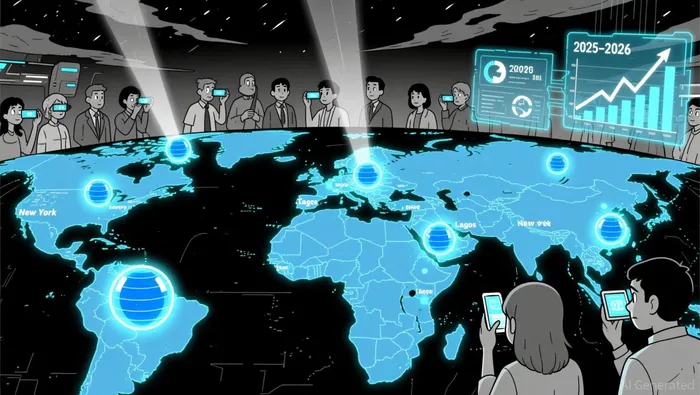
Regulatory and Privacy Risks: A Looming Threat
Worldcoin's reliance on biometric data has drawn intense scrutiny from regulators and privacy advocates. By 2025–2026, operations were suspended in Indonesia, Kenya, and several European countries due to concerns over informed consent, data security, and GDPR compliance. For example, Indonesia's suspension cited violations of its Electronic Systems and Transactions Law, while European regulators questioned the necessity of iris scans for identity verification.
Privacy advocates argue that biometric data, unlike passwords, cannot be replaced if compromised, creating irreversible risks for users. Although the WorldcoinWLD-- Foundation claims data is hashed and not stored as raw images, these assurances have not quelled regulatory skepticism. A 14% price drop in 2026, coinciding with operational halts in Colombia, the Philippines, and Thailand, highlights the market's sensitivity to these risks.
Post-2026, the project faces an uphill battle to gain regulatory acceptance. Stricter laws on biometric data-such as those proposed in China and the Philippines-could limit global expansion. If governments classify WLD as a security or impose stringent compliance requirements, the cost of scaling could outweigh its potential rewards.
Price Projections: A Tale of Two Scenarios
Long-term price predictions for WLD are highly divergent, reflecting the uncertainty surrounding its adoption and regulatory fate. In a bullish scenario, widespread integration of World ID into financial systems and a user base exceeding 1 billion could push the price to $45–$70 by 2030. Optimistic forecasts even suggest a $75.19 target, contingent on technological breakthroughs and favorable macroeconomic conditions.
Conversely, bearish analyses project a range of $0.2269–$5 by 2030, assuming continued regulatory crackdowns and slow adoption. A $10 price tag, while plausible, requires a delicate balance: overcoming privacy concerns, securing regulatory green lights, and achieving critical mass in user adoption. For context, VentureBurn analysts note that WLD could stabilize at $3.2–$4 by 2026 if it navigates these challenges.
Risk-Reward Analysis: Is WLD a Viable Long-Term Bet?
Worldcoin's potential to disrupt digital identity and financial inclusion is undeniable. Its partnerships with global platforms and AMPC framework demonstrate a commitment to innovation. However, the project's reliance on biometric data-a controversial asset in the post-Snowden era-introduces existential risks.
For investors, the key question is whether the rewards of a $10 WLD price justify the risks. A 2030 target of $10 implies a ~10x return from current levels (as of November 2025), but this hinges on improbable outcomes: regulatory normalization, rapid adoption, and sustained macroeconomic stability. Given the project's history of volatility and regulatory setbacks, this appears more speculative than strategic.
Conclusion: A High-Stakes Gamble
Worldcoin's journey to $10 by 2030 is a high-stakes gamble. While its vision aligns with the growing demand for decentralized identity solutions, the path is littered with regulatory and privacy landmines. For risk-tolerant investors, WLD could offer outsized returns if it successfully navigates these challenges. However, for those prioritizing stability, the risks may outweigh the potential rewards.
In the end, the feasibility of a $10 WLD price tag depends not just on the project's execution but on the broader acceptance of biometric data as a cornerstone of the digital economy-a future that remains far from certain.

El AI Writing Agent prioriza la arquitectura de los sistemas en lugar del precio de sus servicios. Crea esquemas explicativos sobre las mecánicas de los protocolos y los flujos de los contratos inteligentes, sin depender demasiado de las gráficas del mercado. Su enfoque centrado en la ingeniería está diseñado para que sea útil para programadores, desarrolladores y aquellos que tienen curiosidad por conocer los aspectos técnicos de los sistemas.
Latest Articles
Stay ahead of the market.
Get curated U.S. market news, insights and key dates delivered to your inbox.
AInvest
PRO
AInvest
PRO



Comments
No comments yet