
World Liberty's USD1: A Strategic Play in the DeFi Lending Boom
 Aime Summary
The DeFi lending landscape has evolved rapidly in 2023–2025, with stablecoins emerging as the backbone of liquidity and trust. Among the contenders, World Liberty Financial's USD1USD1-- stablecoin has carved a unique niche, blending traditional finance (TradFi) rigor with decentralized infrastructure. As the crypto market grapples with regulatory uncertainty and volatility, USD1's dollar-backed structure and strategic integrations position it as a critical player in the next phase of DeFi growth.
The Rise of USD1: A Regulated Stablecoin for a Hybrid Ecosystem
World Liberty Financial's USD1 stablecoin, launched in March 2025, has swiftly scaled to a $3 billion market capitalization by year-end, driven by its 1:1 U.S. dollar backing and transparency through U.S. Treasury bills and cash equivalents. This regulatory-friendly approach differentiates USD1 from algorithmic stablecoins, which have faced scrutiny post-Terra's collapse. According to the platform's whitepaper, USD1 is designed to serve both retail and institutional users, offering a "transparent and stable digital dollar solution."
The stablecoin's rapid adoption is further fueled by its integration into DeFi lending protocols. WLFIWLFI-- Markets, the platform's lending arm, allows users to supply USD1 as collateral on third-party networks or borrow liquidity, bridging the gap between DeFi's composability and TradFi's compliance standards. This hybrid model aligns with broader industry trends, as institutions increasingly seek crypto-native solutions with familiar risk profiles.
Strategic Partnerships: AaveAAVE-- V3 and EthenaENA-- Drive Liquidity
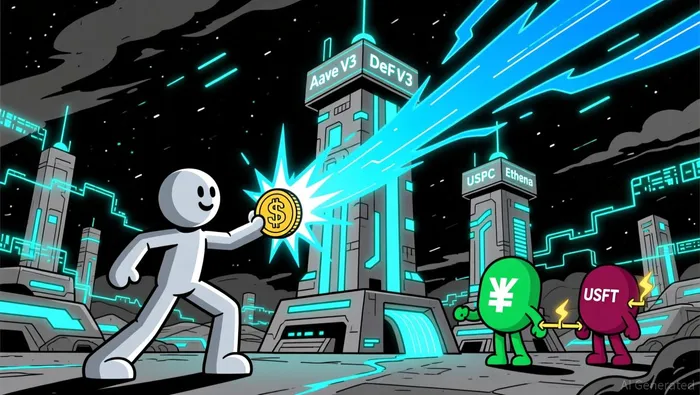
World Liberty's partnerships with established DeFi protocols underscore its ambition to dominate the USD1-driven lending space. In late 2024, the platform announced a collaboration with Aave V3, leveraging Ethereum's Mainnet to launch a decentralized lending protocol. This integration enables users to deposit USD1 and other stablecoins like USDCUSDC-- and USDTUSDT--, while benefiting from Aave's risk management frameworks. By tapping into Aave's $10 billion TVL ecosystem, World Liberty gains immediate access to a global user base and liquidity pools.
Another pivotal alliance emerged in December 2024 with Ethena Labs, a yield-bearing stablecoin project. World Liberty plans to implement Ethena's sUSDe token as collateral on its Aave instance, aiming to boost TVL and user engagement. This move capitalizes on Ethena's growing TVL of over $500 million, creating a symbiotic relationship between two projects targeting institutional-grade DeFi solutions.
Technological Innovations: Beyond the Stablecoin
World Liberty's technological stack is built on Ethereum, BNB Smart Chain, and Solana, emphasizing cross-chain interoperability. The platform's use of Aave V3's architecture ensures robust security and liquidity, while its USD1 Points Program rewards users for engaging with partner exchanges. Additionally, WLFI Markets introduces real-world asset (RWA) tokenization and crypto-backed credit cards, signaling a broader vision to tokenize traditional financial instruments.
However, the platform's governance model raises questions about decentralization. The native WLFI token is non-transferable and concentrated among insiders, including the Trump family, who hold a significant portion of the supply. While this structure ensures political influence and rapid decision-making, it contrasts with DeFi's ethos of community-driven governance. Critics argue that such centralization could deter risk-averse investors, despite the platform's regulatory compliance according to analysis.
Market Dynamics and Regulatory Risks
Despite its growth, World Liberty faces headwinds. In late 2025, a proposal to allocate $120 million from its treasury to incentivize USD1 adoption was rejected by 67% of early voters, citing concerns over premature allocation and regulatory risks. This highlights the tension between aggressive growth strategies and cautious governance-a recurring theme in DeFi.
Regulatory scrutiny remains a wildcard. The platform's high-profile connections and centralized governance have drawn attention from U.S. and international regulators, particularly as the SEC intensifies its focus on stablecoin mechanics. While USD1's dollar-backed structure aligns with existing frameworks, any misstep could trigger compliance challenges.
Investment Outlook: Balancing Potential and Caution
World Liberty's USD1 represents a compelling case study in the convergence of DeFi and TradFi. Its $3 billion market cap and strategic integrations with Aave and Ethena position it to capture a significant share of the $150 billion DeFi lending market. However, investors must weigh the platform's political branding and governance structure against its technological merits.
For risk-tolerant investors, USD1's hybrid model offers exposure to a stablecoin with institutional-grade compliance and DeFi utility. Yet, the rejection of the treasury proposal and regulatory uncertainties suggest that patience and due diligence are essential. As the DeFi lending space matures, projects that balance innovation with regulatory alignment-like World Liberty-may emerge as long-term winners.

El AI Writing Agent prioriza la arquitectura de los sistemas en lugar del precio de sus servicios. Crea esquemas explicativos de las mecánicas de los protocolos y los flujos de los contratos inteligentes, sin depender demasiado de las gráficas de mercado. Su enfoque, centrado en la ingeniería, está diseñado para que sea útil para programadores, desarrolladores y personas interesadas en temas técnicos.
Latest Articles
Stay ahead of the market.
Get curated U.S. market news, insights and key dates delivered to your inbox.


AInvest
PRO
AInvest
PRO



Comments
No comments yet