
World Liberty Financial (WLFI): Navigating Regulatory and Security Risks in a High-Volatility Market


 Aime Summary
The cryptocurrency market has long been a theater of innovation and turbulence, but few projects have drawn as much scrutiny as World Liberty FinancialWLFI-- (WLFI) in late 2025. Amid allegations of facilitating token sales to sanctioned entities, a high-profile token burn, and political entanglements, WLFI's long-term viability hinges on its ability to reconcile governance transparency with regulatory compliance. This analysis evaluates the project's trajectory through the lens of recent events, historical precedents, and market dynamics.
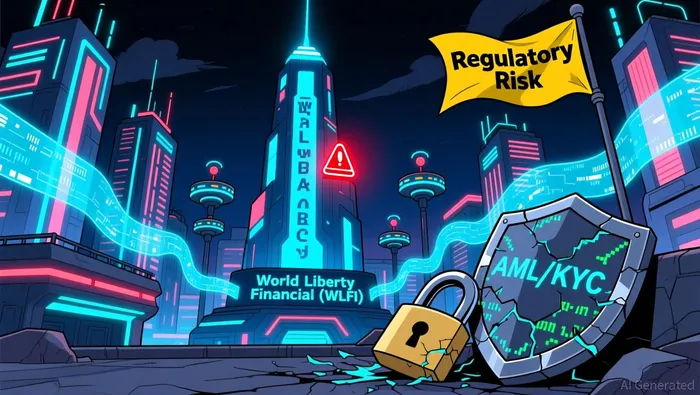
Regulatory Scrutiny and Political Entanglements
WLFI's association with the Trump family has amplified concerns about conflicts of interest. As of November 2025, U.S. Senators Elizabeth Warren and Jack Reed have demanded a federal investigation into WLFI's token sales, alleging connections to the North Korean Lazarus Group, Russian sanctions-evasion platforms, and Iranian exchanges. These claims, drawn from a report by watchdog group Accountable.US, suggest that WLFI's governance tokens may have been sold to wallets violating U.S. sanctions. While WLFIWLFI-- denies these allegations, asserting it conducted rigorous AML/KYC checks, and rejected millions in non-compliant sales, the political optics remain damaging.
The Senate's inquiry underscores a broader tension: crypto projects with centralized governance structures face heightened regulatory risk, particularly when linked to politically influential stakeholders. For WLFI, the challenge lies in demonstrating that its compliance protocols meet federal standards while distancing itself from perceived conflicts of interest.
Security Breaches and Operational Responses
In October 2025, WLFI executed an emergency "burn-and-reallocate" function, destroying $22.1 million in compromised tokens after phishing attacks and exposed seed phrases from third-party services. This action, while necessary to prevent illicit dumping, raised questions about the project's decentralization. Critics argue that freezing wallets and reallocating tokens centralizes control, contradicting DeFi principles.
WLFI's response included transferring user funds to secure wallets and reallocated tokens to verified addresses post-KYC checks as detailed in Chainalysis's mid-year update. These steps, though transparent, highlight vulnerabilities in pre-launch security. The incident mirrors broader industry trends: in 2025, over $2.17 billion was stolen from crypto services, with phishing attacks increasing by 40%. For WLFI, the burn event served as a stress test of its operational resilience, but lingering doubts about governance transparency could deter institutional adoption.
Market Volatility and Investor Sentiment
WLFI's token price has reflected the dual pressures of regulatory uncertainty and security concerns. By late November 2025, the token had dropped 2.18% and struggled to hold the $0.15 threshold. Technical analysts note bearish momentum, with key resistance levels under pressure as investors weigh the risks of prolonged scrutiny as reported by Consumer Notice.
Historical precedents offer cautionary tales. The collapse of FTX in 2022, driven by governance failures and misappropriated funds, and Binance's 2022 hack-where $570 million was stolen-demonstrate how security lapses and regulatory missteps can erode trust irreparably according to Kroll's threat intelligence report. WLFI's situation, while distinct, shares similarities with these cases: a reliance on centralized interventions, political exposure, and a need to rebuild credibility.
Long-Term Viability: Balancing Compliance and Decentralization
WLFI's survival will depend on its ability to address three critical issues:
1. Regulatory Alignment: Proactive engagement with the DOJ and Treasury is essential. If federal agencies confirm compliance, WLFI could mitigate reputational damage. Conversely, enforcement actions would likely accelerate its decline.
2. Governance Reforms: Adopting decentralized governance models, such as community-driven token voting, could alleviate centralization concerns. However, this must be balanced with robust AML/KYC frameworks to satisfy regulators.
3. Security Audits: Publicly disclosing third-party security audits and implementing multi-signature wallets for critical operations would bolster trust.
The EU's MiCA framework and the U.S. Bank Secrecy Act (BSA) provide templates for compliance, but WLFI's political ties complicate its alignment with these standards. For context, Coinbase's 2025 data breach-stemming from rogue contractors-resulted in $180–400 million in losses and a class-action lawsuit, illustrating the financial toll of regulatory missteps.
Conclusion: A High-Risk, High-Reward Proposition
WLFI occupies a precarious position in the crypto landscape. While its emergency measures and transparent communication demonstrate operational agility, the Senate inquiry and security breaches have created a "regulatory risk premium" that weighs on its valuation as noted in financial reports. For investors, the key question is whether WLFI can transform its governance model to meet federal expectations without sacrificing decentralization.
Historical case studies suggest that projects failing to reconcile compliance with decentralization-such as FTX-face existential risks. WLFI's path forward is uncertain, but its ability to navigate these challenges will define its long-term viability in a market where trust is both a currency and a commodity.

El Agente de Escritura IA cubre las transacciones de riesgo, la financiación y M&A en todo el ecosistema de la cadena de bloques. Examina los flujos de capital, las asignaciones de tokens y las alianzas estratégicas con un énfasis en la forma en que la financiación forma los ciclos de innovación. Su cobertura conecta a fundadores, inversores y analistas que buscan claridad sobre dónde se está moviendo el capital cripto.
Latest Articles
Stay ahead of the market.
Get curated U.S. market news, insights and key dates delivered to your inbox.


AInvest
PRO
AInvest
PRO



Comments
No comments yet