
World Liberty Financial Borrows $75M Against Own Tokens Amid Dolomite Risk Concerns
 Aime Summary
World Liberty Financial (WLFI) has drawn intense scrutiny after its treasury borrowed approximately $75 million in stablecoins by pledging 5 billion of its own WLFIWLFI-- tokens as collateral on the DolomiteDOLO-- lending protocol. On-chain data indicates that this single position now represents over 50% of the protocol's total value locked, creating a significant concentration risk for other participants. Critics argue the structure creates a circular dependency where the project's solvency relies on its own asset price, while the team dismisses these concerns as unfounded market fear.
The transaction pushed the USD1 pool on Dolomite to a utilization rate exceeding 93%, making timely withdrawals difficult for ordinary depositors. Following the borrowing, over $40 million of the stablecoins was transferred to Coinbase Prime wallets, raising questions about the intended use of the funds and potential withdrawal bottlenecks. Despite the team's assertions of ample resources to defend the position, the WLFI token price has fallen sharply as investors weigh the implications of this related-party transaction.
Compounding the leverage concerns is a governance proposal to unlock tokens for early holders, which has triggered preemptive selling in an already fragile market. The project insists the arrangement generates higher yields for other participants and that it faces no immediate liquidation risk. However, analysts warn that if the token price falls further, the lack of market depth could result in massive bad debt for the protocol's other lenders.
What Are the Mechanics Behind the $75 Million Loan?
World Liberty Financial deposited approximately 5 billion WLFI tokens, nominally valued at $440 million, into the Dolomite protocol to secure the $75 million loan in USDCUSDC-- and USD1 stablecoins. The project's treasury claimed the collateral is sufficient to avoid liquidation, stating it can supply additional collateral at any time if necessary. However, the collateral now constitutes roughly 55% of the $835.7 million total value locked on the platform, according to recent on-chain records.
Critics highlight that this setup resembles circular token economics, where the project's value relies on its own assets to secure debt. The mechanism involves depositing tokens into a lending pool to borrow stablecoins, which are then used for various treasury operations. This structure creates a direct link between the project's balance sheet and its token's market value, meaning a price decline weakens the collateral value and increases the risk of undercollateralization.
The transaction utilized Dolomite's USD1 pool, pushing its utilization rate above 93%. This high utilization makes timely withdrawals difficult for ordinary depositors. On-chain data reveals that WLFI transferred over $40 million of the borrowed funds to Coinbase Prime, likely for institutional over-the-counter conversions, with $15 million subsequently repaid. Additionally, the treasury had previously deposited nearly $14 million in its own USD1 stablecoin into Dolomite to borrow 11.4 million USDC.
Why Do Analysts Warn of Concentration Risk?
DeFi analysts warn that the WLFI token's thin market depth could trigger forced sales if prices decline, potentially leading to bad debt for depositors similar to past DeFi failures involving CRV and Wonderland. The concentration of WLFI tokens on Dolomite has triggered intense scrutiny from market participants who fear a "circular" financial structure. If WLFI's price hits liquidation levels, the lack of market depth could result in massive bad debt for the protocol's other lenders.
Analyst EthanDeFi noted that a WLFI collateral position close to liquidation would be "basically unliquidatable without major losses for lenders," advising users to withdraw stablecoins from any pools accepting WLFI as collateral. The situation underscores the dangers of high concentration risk and the potential for insider entities to manipulate market mechanics. With utilization near 100%, other depositors face potential withdrawal constraints.
Concerns were further compounded by the discovery that WLFI's advisor, Corey Caplan, is a co-founder of Dolomite. In traditional finance, such a scale of related-party transaction would typically require disclosure and independent board approval, which WLFI has not provided. The company dismissed market concerns as FUD, despite the WLFI token dropping over 10% following the news.
How Do Token Unlocks Affect Market Dynamics?
Compounding these leverage concerns is a governance proposal to introduce a phased token unlock for early investors. While designed to reduce immediate shocks, the prospect of increasing circulating supply in a fragile market has triggered preemptive selling. Approximately 75% of the total 100 billion token supply remains locked, meaning future unlocks could significantly alter market dynamics.
The project clarified that the unlock proposal would feature a "long-term vesting and unlock schedule" rather than an immediate release. However, the combination of leverage concerns and potential supply expansion has led to a sharp increase in trading volume as holders reduce exposure ahead of the governance vote. The WLFI token is currently hovering near its all-time low of $0.0801, with immediate support sitting at $0.079.
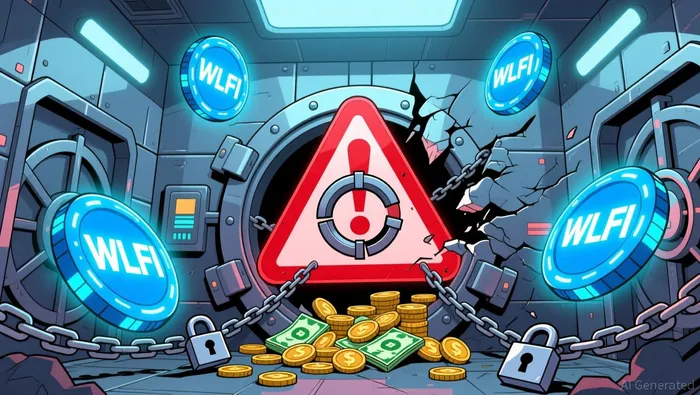
World Liberty Financial has confirmed repurchasing 435.3 million WLFI tokens at an average price of $0.1507, totaling $65.58 million in buybacks. The team highlighted a USD1 upgrade adding gasless transfers and support for AI agent payment protocols, maintaining that their presence provides higher yields for other participants. Despite these assurances, the project's token price has declined amid the controversy, with a governance vote scheduled to address the unlock for early retail buyers.

Blending traditional trading wisdom with cutting-edge cryptocurrency insights.
Latest Articles
Stay ahead of the market.
Get curated U.S. market news, insights and key dates delivered to your inbox.


AInvest
PRO
AInvest
PRO



Comments
No comments yet